In this week’s Tipples feature, Sophie McLean explores Ca del Bosco, where Franciacorta, contemporary art and radical vision converge — a winery that turns landscape, architecture and wine into one immersive, effervescent artwork…
In 2016, for sixteen days, northern Italy’s fourth largest lake, Lake Iseo, was transformed into a living art work by Christo Jeanne-Claude, a Bulgarian-Moroccan marriage of creativity, known for their large scale outdoor installations. From the shores of Sulzano to the island of Monte Cristo, 100,000 square meters of fabric coloured in a dazzling yellow-gold lit the way across the water, in a project aimed to “expose unnoticed angles and alter perspectives”. Visitors to the lake could freely walk along the 3km-long floating piers, safeguarded by a security team in snorkelling gear treading water beneath them. As you might imagine, the project is still the talk of the town today some nearly-ten years later.
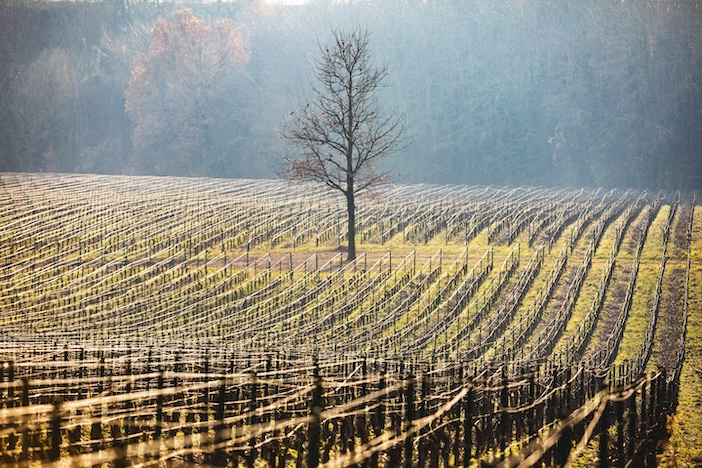
Not far from Lake Iseo you’ll find a series of other creative ‘auteurs’ – those inhabiting the vineyards that define the local landscape here beyond the water. Here, these wineries turn their attention towards making Franciacorta – Italy’s answer to Champagne. With the right climate, altitude and soil composition, plus the cooling effect of the lake in the height of summer, these undulating hills provide the perfect conditions for growing and ripening Chardonnay, Pinot Noir, and in an Italian twist (at odds with their French counterparts), Pinot Blanc, as the third grape that makes up this traditional-method’s holy trinity. The region was officially recognised as a DOC in 1967 and as a DOCG in 1995, adding yet more sparkle to its status.
We visit Ca del Bosco, a winery whose Cuvée Prestige – their signature bottle of fizzy Franciacorta comes wrapped in golden cellophane, almost in harmony with the flowing fabric of the since famous piers. But here the colour alone is not the only similarity to Jeanne-Claude’s work, as we soon find out.
Some fifty-five years earlier, the story of Ca del Bosco began with similar intentions. Maurizio Zanella founded Ca del Bosco in 1961. This operation came to fruition thanks to his self-described ‘somewhat anarchistic’ personality, and because his mother – Anna Maria Clemente, originally from Trento, chose to make a summer home here. The chosen spot, next to a chestnut tree, can now be more literally translated to ‘a place in the woods’.
Cheerfully, Zanella tells us, as a younger man, he didn’t much care for the ‘traditional’ system of schooling. At age 14 he chose instead to “support the revolutionaries”. This meant that by age 15 he had been sent away by his father far from the bucolic postcard of Italy, to work on the docks in Liverpool – a striking contrast to the world he had grown up in. After entering a competition in a magazine on his return to win a bike, he succeeded, meaning he could then travel away from home to work on the land. At 16 he was given the opportunity to join some of these landowners on a visit to France by bus.
In esteemed company they travelled to estates such as Domaine Romanée Conti, through Richebourg and up to Champagne where as the youngest of the crowd, he made quite the impression on these gentlemen – betting and borrowing money to buy a precious few bottles. In this part of France they used smaller barrels rather than the ‘grandi botti’ that Italy was known for, and used horses to plough the land. It was in Champagne that Zanella met Andre du Bois – the then ‘chef du cave’ for Moët and Chandon. A serendipitous moment; ‘possibly leading to the name of the estate – ‘bois’ in French, like ‘bosco’ in Italian, meaning ‘woods.’
Zanella returned home and decided to plant vines, taking what he had learnt in France and seeing the great potential of his area in collaboration with Du Bois. Aside from all of this, the real challenge was that Italy at the time was really only known for table wine. Life was simply ‘pane e vino’; bread and wine. Wine could be cheaper than water – a far cry from the great estates of Bordeaux and Burgundy.
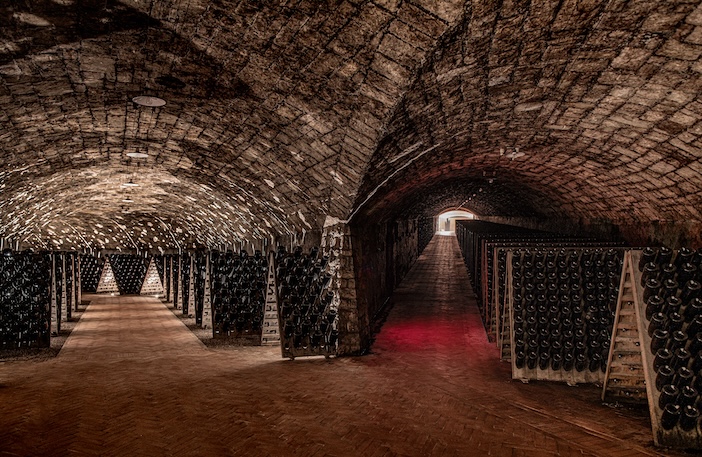
Just as Jean-Claude attempted to ‘expose unnoticed angles and alter perspectives’, Zanella had done the same. “I needed to have something to make people understand we were doing something different” – something to turn people’s heads to discover the quality possible in wine from this specific place. “I used art to give [the wine]the attention it needed. Wine was like bread. Nothing special.”
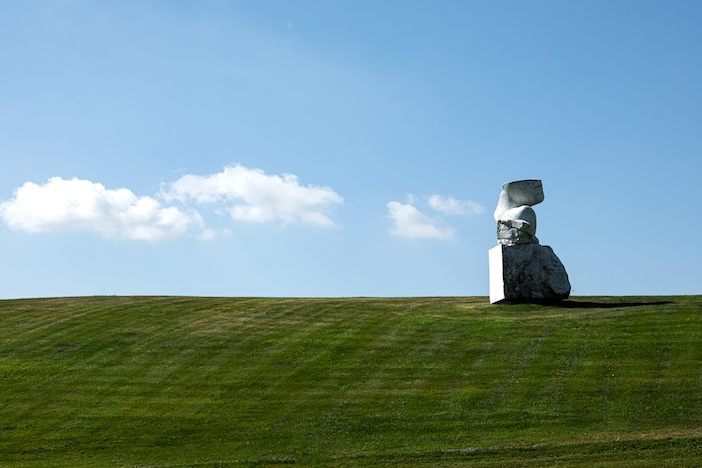
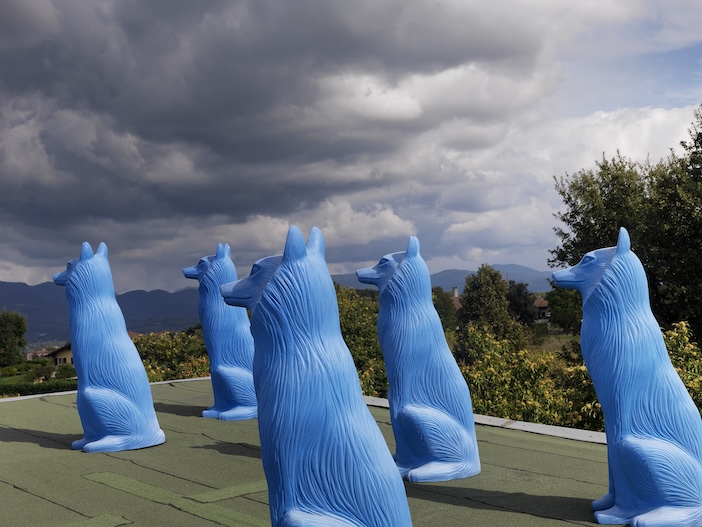
The estate now hosts a vast collection of different creative pieces, sculpture, paintings and photography. Each sculpture is is “related to a place” with the goal being “to give emphasis to the place that they are”. Starting with the sun gate by acclaimed artist Arnaldo Pomodoro that clasps the entrance together ‘the most important guardian of the vine – the sun’ says Zanella, to a Tirolese style bridge, a gift from his (presumably since humbled) father, that takes guests from visitor centre towards the winery.
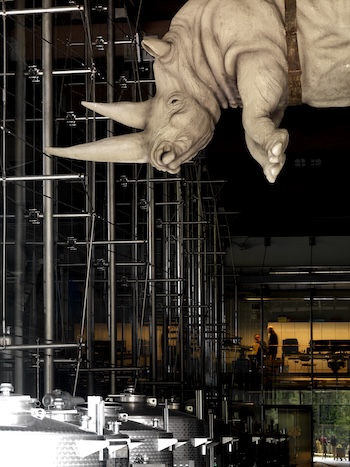 Inside the winery, suspended from the ceiling is a large Rhino – ‘the weight of suspended time’, flanked at either side by sparkling stainless steel tanks. “It takes time to create the perfect bottle” – so says our guide as we walk further into the cellar, where an explosion of silver bubbles crafted in 2016 by Chinese artist Zheng Lu, wrap around ‘the mother’ tank that holds 300,000 hl of this Lombardian liquid gold.
The winery has since opened a striking interactive area, bringing alive the senses that wine ignites against multimedia surrounds to tell the region’s story, while the wines themselves can now be found on the list at prestigious venues internationally, including nearby three michelin-star restaurant, Da Vittorio. The latest addition to the artwork in the cellar is a repeated phrase fashioned out of neon lights that grip one of the side walls designed by Sicilian artist Elena Coppola, installed in November 2024. It says ‘hand and land’ encapsulating the very essence of winemaking, and perhaps the original liquid art.
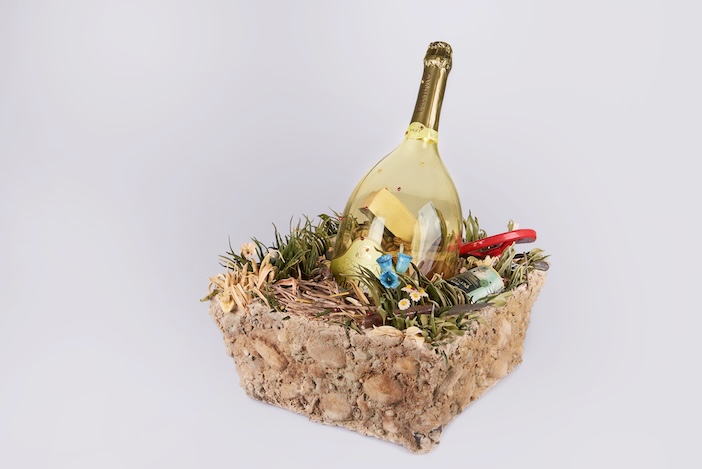
Visits start from €70 a person and are available year-round. To find out more, visit www.cadelbosco.com. Sophie stayed at Hotel Rivalago, more information can be found at www.rivalago.it. The 3L Cuvée Prestige comes with a leather weekend bag, sold at Bentleys and Corrigan’s.
Photos by Massimo Listri