In this thoughtful review, art writer Rosalind Ormiston explores Turner & Constable, the latest Exhibition on Screen film, and reflects on how it deepens — and even reshapes — our understanding of Britain’s two greatest landscape painters…
For the many visitors to the blockbuster exhibition Turner and Constable: Rivals and Originals at Tate Britain — where even late-night openings have not satiated demand for tickets — a new film release next month, Turner & Constable, will make those who have seen the show want to return. For anyone unable to get to London, the film offers an excellent alternative, or an enticing appetiser to visit this remarkable exhibition before it closes.
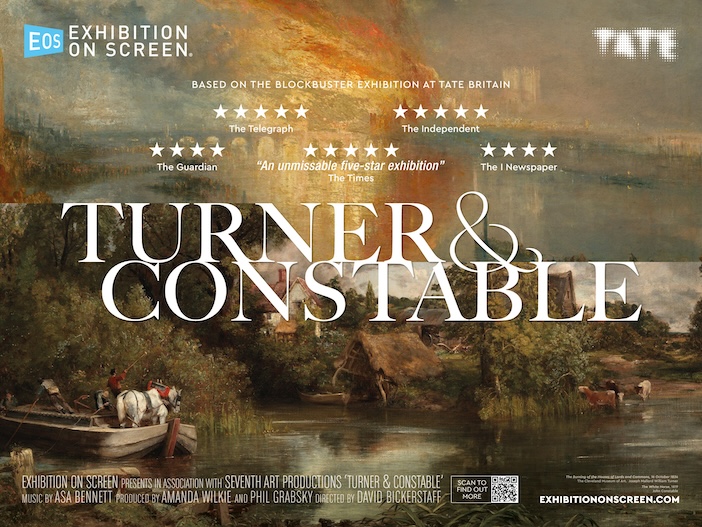
Joseph Mallord William Turner and John Constable were born just a year apart, in 1775 and 1776 respectively. Although they came from very different backgrounds, both studied at the Royal Academy of Arts and both achieved fame in their lifetimes for the remarkable work they created.
The Tate exhibition reveals two gifted painters who were artistic rivals. In the 90-minute film, four specialists guide the viewer through their lives and work: Amy Concannon, curator of the Tate Britain exhibition and Manton Senior Curator of Historic British Art; Nicola Moorby, Curator of British Art 1750–1850 at Tate; Richard Johns, art historian at the University of York; and the Scottish artist, writer and broadcaster Lachlan Goudie. Together, they offer insight into both the men and their art.
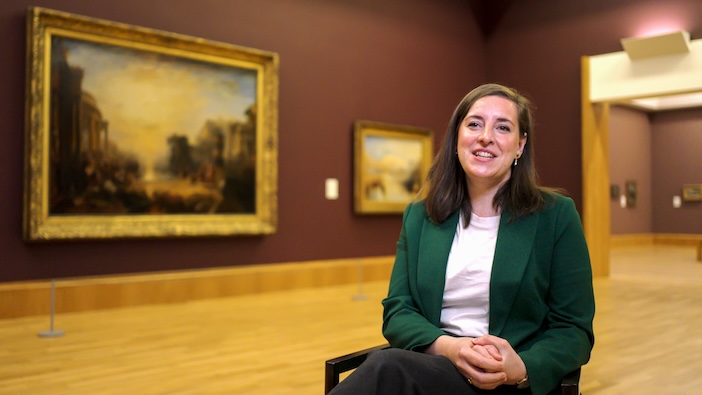
Exhibition curator Amy Concannon interviewed at Tate Britiain for the film
What happens when these two artists are placed side by side? Were they competitive? How did their working methods differ? How did they choose their subjects, and what shaped their reputations at the Royal Academy? The film addresses these questions with clarity and curiosity, revealing the men behind the masterpieces and complementing the exhibition beautifully.
Turner was a Londoner, born in Covent Garden, where his father — a wigmaker and hairdresser — was immensely proud of his son’s early artistic talent. Turner entered the Royal Academy Schools at just fourteen and became a full Academician at twenty-seven, the youngest ever to do so. Constable, by contrast, grew up in a wealthy Suffolk mill-owning family and worked in the mills from the age of sixteen. His keen eye for weather, seasonal change and rural life would define his art, as seen in works such as Dedham Lock and Mill, c.1818. He entered the Royal Academy at twenty-three, relatively late for an artist, and was elected a full member only in 1829, at the age of fifty-two — twenty-six years after Turner.
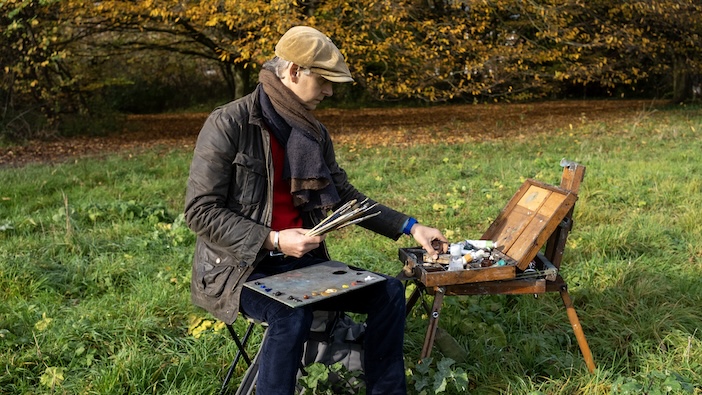
While Concannon, Johns and Moorby — filmed in Turner’s beautiful villa, Sandycombe Lodge in Twickenham — share their expertise lightly and engagingly, Lachlan Goudie focuses on the practical challenges of painting outdoors in the late eighteenth and early nineteenth centuries. Handling a portable easel, brushes and paint in a ‘show and tell’ demonstration, Goudie shows just how demanding plein-air painting could be. Weather was not the only obstacle: paint itself posed problems. Since the sixteenth century, liquid paint had been stored in pigs’ bladders, pricked to release a small amount and resealed with a pin — a cumbersome solution at best. Goudie explains how, in 1780, the London colourman William Reeves transformed outdoor sketching by producing small, portable blocks of dried watercolour.
Turner and Constable’s sketchbooks — on display in the exhibition and shown in exquisite detail in the film — reveal how vital these innovations were. Turner travelled widely across Europe, preferring to sketch on site and complete paintings later in the studio. Constable focused on the English countryside, particularly Suffolk and Hampstead, and often painted outdoors in oils. Goudie describes how Constable added ‘sparkle’ to his paintings to capture shifting light — an effect derided by some critics as ‘snow’. The film explores how both artists achieved their success by painting light itself: on clouds, water, trees, buildings, and landscapes both rural and urban.
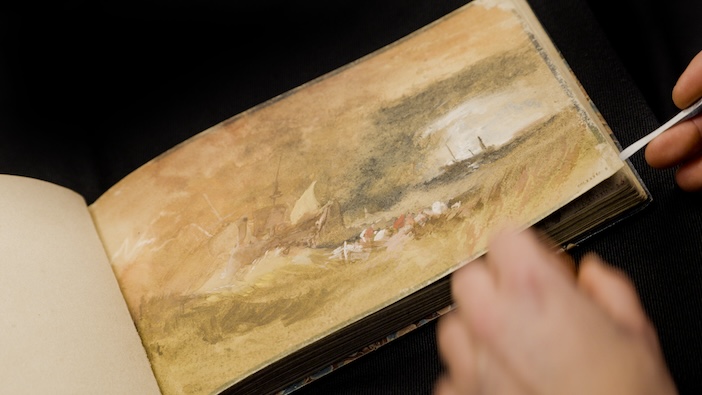
JMW Turner’s sketchbook
Turner & Constable is the latest release in the Exhibition on Screen series from Seventh Art Productions. After watching it, I wanted to revisit the Tate exhibition to study more closely the paintings — and sketchbooks — featured in the film. One great advantage of cinema is director David Bickerstaff’s ability to zoom in on details: the horse standing patiently on a barge in Constable’s The White Horse, 1819, for example, or the way Turner draws the eye along the Thames towards Westminster Bridge in The Burning of the Houses of Lords and Commons, 16 October 1834. Turner then pulls our attention back to the crowds gathered on the riverbanks, witnessing the spectacle. Both artists captured moments in time: Turner excelled at the transitory, as in Keelmen Heaving in Coals by Moonlight, c.1835, while Constable mastered the long, contemplative gaze. The film captures both approaches with sensitivity.
Some visitors enter the Tate exhibition preferring Turner to Constable, only to leave with a changed perspective. The film may challenge their views again. Preferences aside, the extraordinary talent of both artists is unmistakable. For many, Turner and Constable remain the greatest British landscape painters of all time — and both the exhibition and the film emphatically confirm it.
The film ‘Turner & Constable’ is released on 10th March 2026 on ‘Exhibition on Screen’ in association with ‘Seventh Art Productions’. For more information, please visit www.exhibitiononscreen.com.
The exhibition ‘Turner and Constable: Rivals and Originals’ is on now at Tate Britain until 12 April 2026. For more information, please click the link: Turner & Constable | Tate Britain.
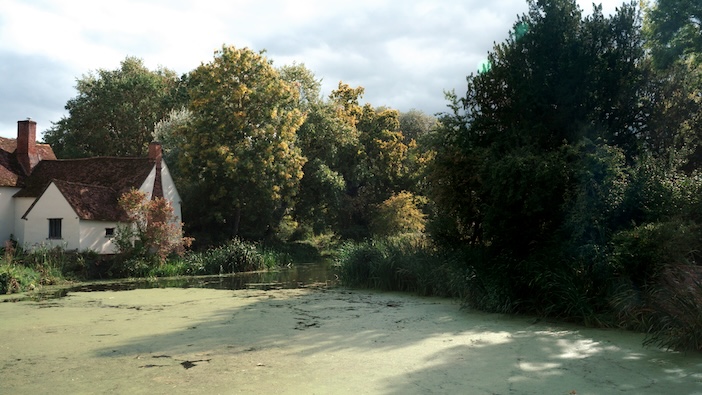
Header image: Willy Lots Cottage, as featured in The Hay Wain, by John Constable.
Photos courtesy of David Bickerstaff.