As Britain marks the three-hundredth anniversary of Sir John Vanbrugh’s death, Rosalind Ormiston visits Vanbrugh: The Drama of Architecture at Sir John Soane’s Museum — a fascinating exploration of the life and work of the man once dubbed the “rockstar of the English Baroque”…
He has been described as “the rockstar of the English Baroque” and the original “starchitect”, the designer of sumptuous houses and castles for the wealthy in late seventeenth- and early eighteenth-century England. Knighted in 1714, Sir John Vanbrugh was an extraordinary figure: a spy, dramatist and architect. In 2026, three hundred years after his death, a series of Vanbrugh300 events across England celebrates the life and legacy of this remarkable and unconventional figure.
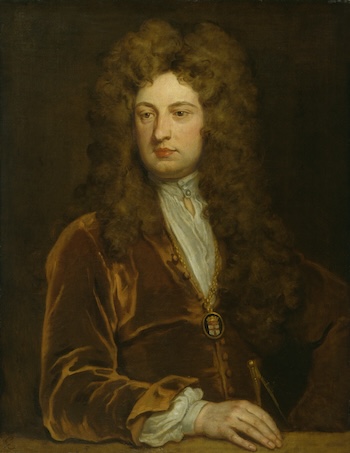
Portrait of Sir John Vanbrugh, c. 1705, by Sir Godfrey Kneller, oil on canvas © National Portrait Gallery
Vanbrugh was born in the City of London to prosperous parents, the grandson of a Flemish refugee merchant. The family moved to Cheshire the following year, and while little is known of his education, as a young man he began work as a wine merchant with a cousin, later moving on to employment with the East India Company before joining the army.
His early life was far from uneventful. In 1688 he became involved in a failed plot in Holland to overthrow King James II. Not yet twenty-five, Vanbrugh was arrested on suspicion of spying and spent four years imprisoned in the Bastille in Paris. After his release he returned to London and turned his energies to writing for the stage. Two comedies were quickly performed to great acclaim — The Relapse (or Virtue in Danger) and The Provok’d Wife. Their success established Vanbrugh as a playwright, and more comedies soon followed.
By now a successful dramatist, Vanbrugh was also a leading member of the celebrated Kit-Cat Club, a London dining society whose members included politicians, aristocrats and influential cultural figures. While a member he sat for a portrait by the German-born painter Sir Godfrey Kneller, which hung alongside portraits of fellow members. It was most likely through these connections that Vanbrugh met Charles Howard, 3rd Earl of Carlisle — a meeting that would transform the course of his career.
In 1699 the Earl commissioned Vanbrugh — together with the English architect Nicholas Hawksmoor as assistant-partner — to design a palatial residence in Yorkshire. The brief was ambitious: to create a grand house and estate on the Howard family lands at Henderskelfe in North Yorkshire. The architectural style chosen was Baroque, the theatrical interpretation of classical architecture that had emerged in Italy during the late sixteenth century.
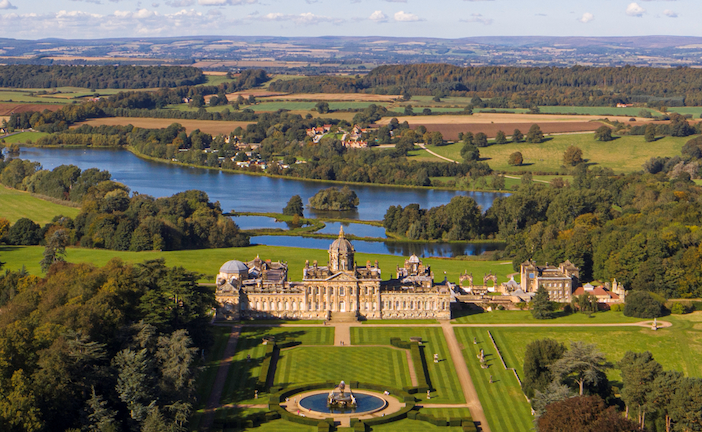
Castle Howard (photo courtesy of Castle Howard estate)
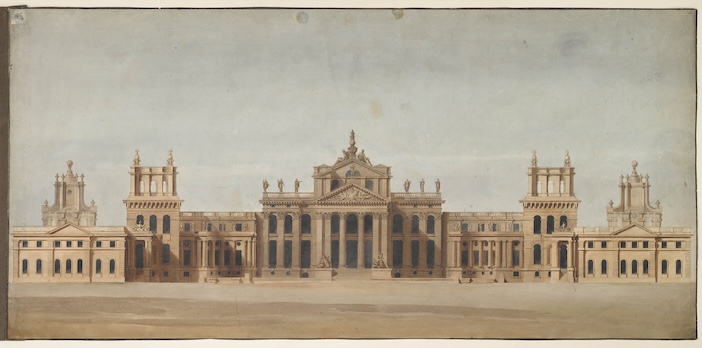
The result was the spectacular Castle Howard. Many will recognise it today as a filming location for the Netflix series Bridgerton. The house reveals what would become Vanbrugh’s signature style: a bold architectural drama created through monumental forms and a striking play of light and shadow. A further commission soon followed from the Duke of Marlborough, resulting in the equally magnificent Blenheim Palace in Woodstock, Oxfordshire. England still boasts numerous examples of Vanbrugh’s architecture, including his own residence, Vanbrugh Castle, built in 1719 on Maze Hill in Greenwich.
Among the admirers of Vanbrugh’s architecture was the English architect Sir John Soane, later Professor of Architecture at the Royal Academy. Soane considered Vanbrugh one of his greatest influences, praising his work as possessing “all the fire and power of Michelangelo and Bernini”.
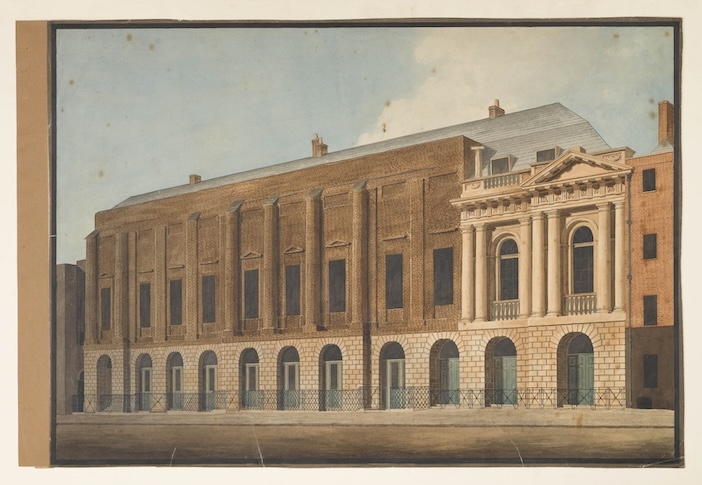
Queen’s Theatre, Haymarket, 1801 (Royal Academy Lecture Drawing)
At Sir John Soane’s Museum in Lincoln’s Inn Fields — an absolute must-visit in London — a fascinating exhibition titled Vanbrugh: The Drama of Architecture explores this legacy. Curated by Charles Saumarez Smith and architect Roz Barr, the exhibition brings together Vanbrugh’s portrait by Kneller alongside building plans, drawings and elevations from major commissions including Castle Howard and Blenheim Palace, as well as several lesser-known projects.
One intriguing example is the small detached Baroque house Vanbrugh built for himself on the edge of Whitehall in 1701, later destroyed. The writer Jonathan Swift famously nicknamed it “Goose-Pie House” in a poem written in 1703: “At length they in the rubbish spy / A thing resembling a goose-py.” The name perhaps alluded to the layered complexity of the design. Vanbrugh’s architecturally inventive house shared elements with the north wing designs of Castle Howard. At the Soane Museum, drawings reveal both this lost building and his family home, Vanbrugh Castle.
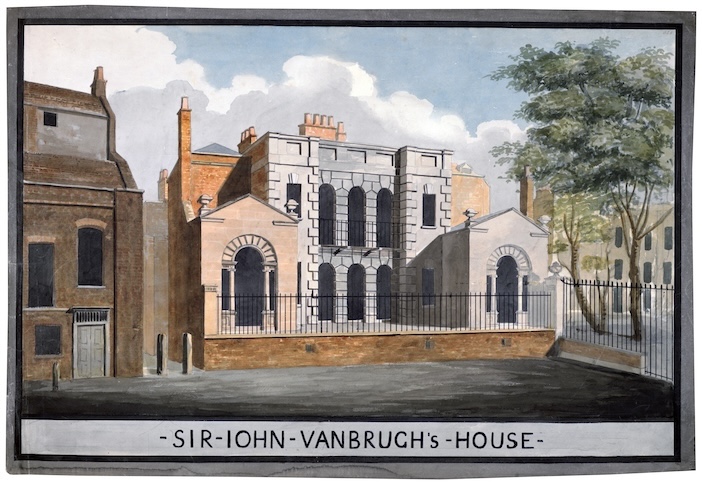
‘Goose-Pie House’, Whitehall, London (Royal Academy Lecture Drawing)
Vanbrugh: The Drama of Architecture offers a fascinating insight into the life and work of one of England’s most influential architects. Visitors should also look out for the short film A Day at Blenheim Palace, created by Anita Naughton and Jim Venturi, son of the American Post-Modern architects Robert Venturi and Denise Scott Brown. The film shows his parents walking around Blenheim Palace while reflecting on its architectural brilliance.
Robert Venturi recalls arriving in England at the age of twenty-three and making his first visit to Blenheim almost immediately. As he and Scott Brown discuss the building, they highlight its Baroque features — broken pediments, dramatic light and shadow, and the warm yellow Bath stone. “The rhythm is just beautiful,” Venturi remarks. His admiration is unmistakable, and it is clear that Blenheim left a lasting impression. Indeed, its influence can be seen in Venturi and Scott Brown’s Post-Modern design for the Sainsbury Wing extension of London’s National Gallery.
Vanbrugh: The Drama of Architecture is free to visit at Sir John Soane’s Museum (Lincoln’s Inn Fields London WC2), and runs from 4th March to 28th June 2026. For more information, please visit www.soane.org.
Other Vanbrugh300 celebrations across the UK include Blueprints of Power at Blenheim Palace (Woodstock, Oxfordshire) until 10 April and Vanbrugh300, from 20th March-26th October at Castle Howard Estate, York, Yorkshire YO60 7DA. FOr more information about VanBrugh300, please visit Vanbrugh300.
Header image: Drawing of Blenheim Palace by Sir John Vanbrugh (Royal Academy)