The great choreographer of the golden age of Russian ballet, Marius Petipa, is probably best known today for his full-length story ballets – Swan Lake, The Sleeping Beauty, The Nutcracker, Giselle and so many more. While these are all still performed around the world, some of his other creations, also three act ballets, are now known mostly from excerpts, the virtuoso highlights that showcase dancers’ talent. This is certainly true of Don Quixote and no one knows this better than Carlos Acosta who was rocketed to fame as a 16-year-old when he gave a showstopping performance of the Act III solo of Basilio and won the gold medal at the prestigious Prix de Lausanne in 1990.
It is a ballet that has stayed close to his heart and he has since made it his own in a reshaping of the entire three acts, first in a production for the Royal Ballet in 2013 and again in 2022 for the Birmingham Royal Ballet of which he’s now director. Acosta has kept what he loves about the ballet – its sunniness and Spanish rhythms – while tightening up the rather loose plotting of the original with not just some beautiful new choreography (notably the Act II duet for Kitri and Basilio) but such unexpected extras as on-stage guitars, flying tankards and dancers with voices (dancers can speak? Who knew?). No longer does the corps just stand around watching the action. There is movement everywhere, fluttering fans, rustling skirts, conversations at the sidelines. Acosta has a gift for creating character.
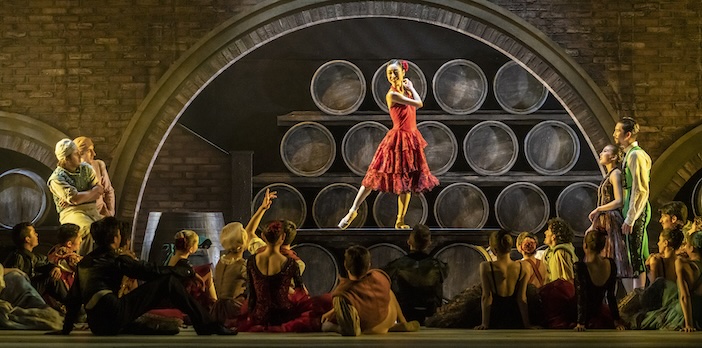
Whether it’s the market square or the gypsy encampment, it comes across as all heat and action – and this is a triumph when you consider this thinnest of story lines (Acosta calls it a rom-com). Although Don Quixote is the name of the ballet, his actual character is far from central. At the heart of the tale is Kitri whose father wants her to marry for money while her heart is set on Basilio – this is one of ballet’s few happy endings. How they get there is, frankly, unimportant in terms of plot but the dancing that comes with it is virtuoso all the way. There are dryads and gypsies, toreadors and tumbling street boys and even comparatively minor roles have their show-stopping moments. This company does not disappoint and everyone here demonstrates a razor-sharp technique.
It all looks beautiful, too. The sets and costumes by Tim Hatley are quite superb, from the dark richness of the gypsies’ skirts to the exquisite white and gold dryads’ tutus and there’s a rather convincing video from Nina Dunn of monstrous windmills. Rory Mackay makes a charmingly vague Don Quixote and his Sancho Panza, Alfie-Lee Hall, gives a fine comic turn. Rafael Bejarano Vidal as Gamache makes an excellently foppish rival to Basilio and Max Maslen plays the matador Espada as a peacock, smoothing his hair to make the village maidens swoon between virtuoso dancing and infuriating his girlfriend Mercedes (a feisty Yaoqian Shang). As Amour – normally a female role – Tzu-Chao Chou brought the house down with a combination of a cheeky smile and a fleetness of foot that is rarely seen.
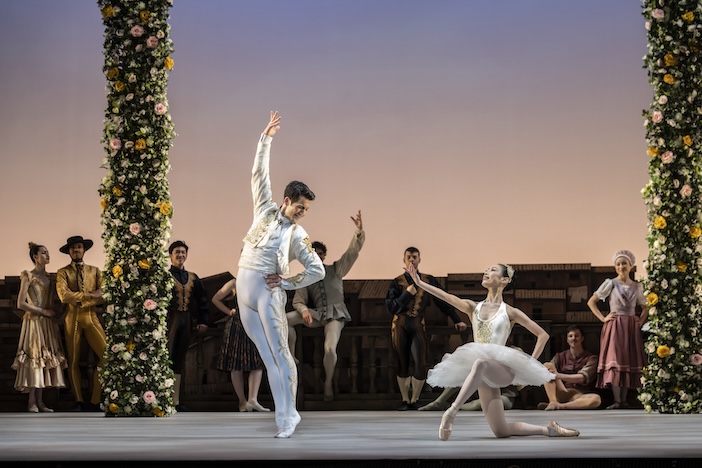
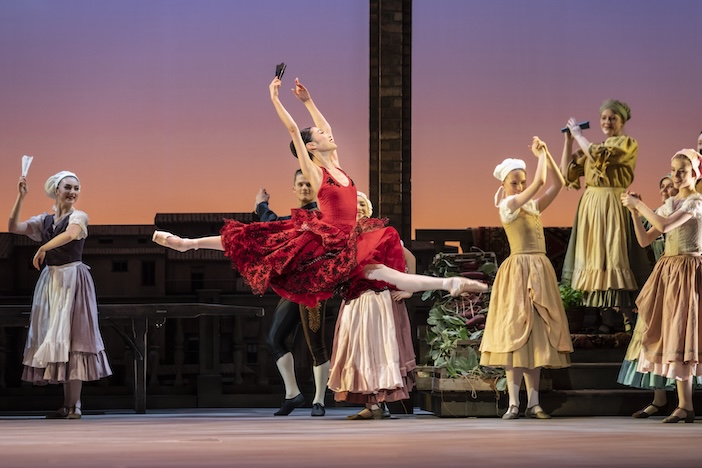
At the heart of it all, though, are Kitri and her Basilio – and the technical demands they face are formidable. Mathias Dingman has all the necessary strength and razzle-dazzle for his big moments and partners Momoko Hirata beautifully. She is a feather-light Kitri, gently flirtatious in the first act and with an extraordinary technique – her third act fouettés will leave you breathless.
Virtuoso performances, a daft plot and a shot of Spanish warmth – a perfect mix for a chilly spring evening.
Remaining performances of Birmingham Royal Ballet’s Don Quixote are at Sadlers’ Wells on 24th April at 7.30pm and 25th April at 2.30pm and 7.30pm. For more information, and for tickets, please visit www.sadlerswells.com.
Photos by Johan Persson