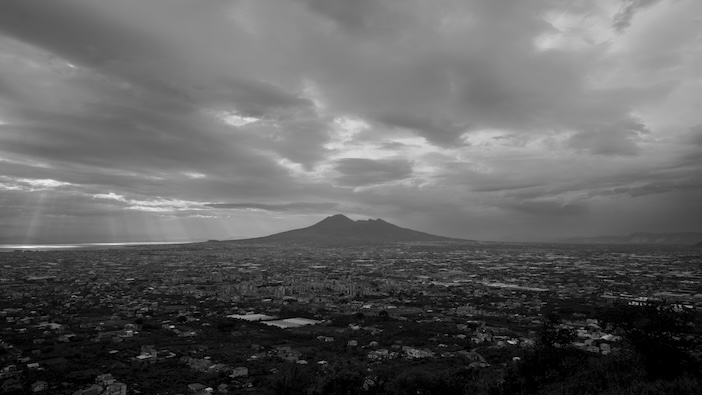
With the release of Gianfranco Rosi’s hauntingly beautiful documentary, Rosalind Ormiston is absorbed by this meditation on life lived in the shadow of Vesuvius, where past and present coexist in a fragile balance…
A ravishingly beautiful documentary, Pompei: Below the Clouds, written and directed by the Oscar-nominated filmmaker Gianfranco Rosi, is a richly layered portrait of lives in Naples, Italy, in the vicinity of the active volcano Vesuvius and the ancient city of Pompei. The British composer Daniel Blumberg, an Academy Award winner, adds a masterful layer of mystery with a surreal musical score.
The film won the Special Jury Prize at the 2025 Venice Film Festival, giving you an indication of its appeal. Filmed in black and white, Rosi constructs a human narrative of Naples residents living under the shadow of an active volcano. Each earth tremor, every fumarole of gas emitted from the Phlegraean Fields, brings uncertainty and a heightened awareness of the volatile mass beneath their feet. The residents of Naples live with it. Their lives continue. Rosi shows us how.
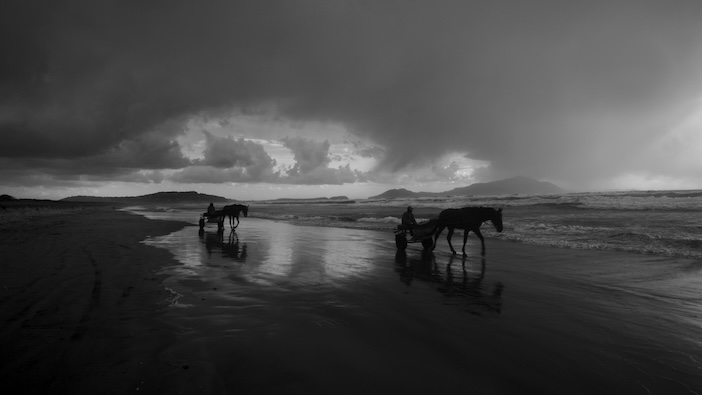
Cinematically, he leads us in by following two harness horse racers slowly exercising their horses through the serene, shallow seawaters of the Bay of Naples. It is an idyllic scene that links directly to Naples’ ancient past 2,000 years ago, when Roman harness racers would have exercised their horses before racing later in the day. It symbolises Rosi’s focus: creating a connection between past and present, from ancient Pompei — destroyed by the eruption of Vesuvius in AD79 — to the present-day lives of Neapolitans.
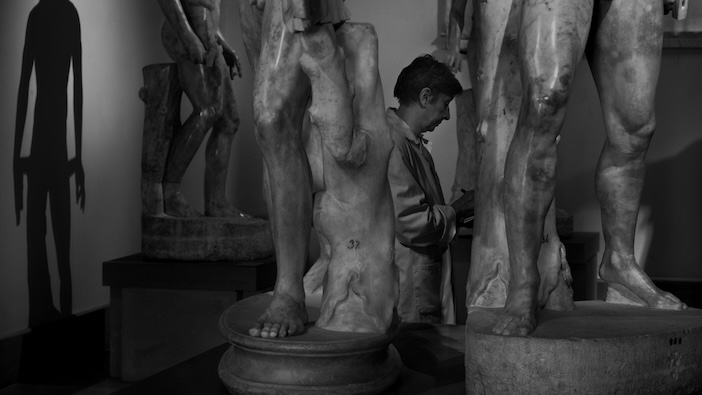
Rosi spent three years in Naples researching and filming. The result is an exquisite time capsule of everyday life, from a local teacher with a wide age range of schoolchildren, to port workers unloading 32,000 tonnes of Ukrainian grain from a vast ship, concerned that its next port of call will be a return to war-torn Ukraine. He observes the workers carefully sweeping up every last grain, while in ancient Pompei a present-day archaeologist delicately brushes away soil deposits thousands of years old to uncover the past.
To document everyday life, Rosi takes us deep below ground, where he quietly links ancient and modern. He accompanies teams of firemen crawling through man-made tunnels created by present-day tomb robbers searching for ancient artefacts. The firemen move through tunnels kilometres long, fitted by thieves with electric lighting systems; they find the robbers’ equipment in situ — spades, wheelbarrows, and a long, two-handled metal tool, like a divining rod, used to probe the ground for hollow spaces and hidden rooms. On one exploration, the firemen are forced to stop as oxygen levels fall.
In another underground chamber, hundreds of feet below ground, archaeologists stand within an ancient house, noting that thieves have hacked away frescoed walls, removed sculptures and lifted mosaic floors to sell on. These moments, varied and revealing, accumulate into a broader picture of Naples, past and present.
Above ground, officials survey by helicopter where 21st-century thieves are entering the ancient city. At ground level, in the fire service control room, on-call operators answer calls dealing with present-day concerns: a woman advised to lock herself in a room to avoid a drunken husband as police are dispatched, or a local resident who calls each evening simply to ask the time.
 Many calls come from fearful residents who feel tremors from Vesuvius beneath their feet; some report their walls shaking. Regularly, callers ask about the magnitude of tremors on the Richter scale. The handlers calm their fears. Did ancient Neapolitans feel such tremors? Did they voice similar concerns before the eruption of Vesuvius in AD79? Rosi’s subtle connections prompt reflection.
“A cloud rose up. It was not clear from which mountain. It was found afterwards to be Vesuvius.” The Roman writer Pliny the Younger, in two letters (AD107–108) to the historian Tacitus, recorded his eyewitness account of the eruption around 11am on 24 August, AD79. Within two days, lava flows obliterated nearby Herculaneum. A pyroclastic surge buried Pompei in ash and destroyed Stabiae several kilometres from the volcano, its intense heat killing humans and animals instantly. Tables remained set for breakfast; guard dogs remained tethered, their final moments preserved in ash and molten debris. The towns ceased to exist.
Around sixteen centuries later, the ancient municipalities and their interred bodies began to be rediscovered. Excavations continue today; parts of the ancient city remain beneath the sea.
In this superb documentary, Rosi – through gentle, investigative immersion, living for months within local communities – uncovers past histories and present-day lives. Speaking to those who live and work in Pompei and Naples, he crafts a sublime human narrative that lingers long in the memory.
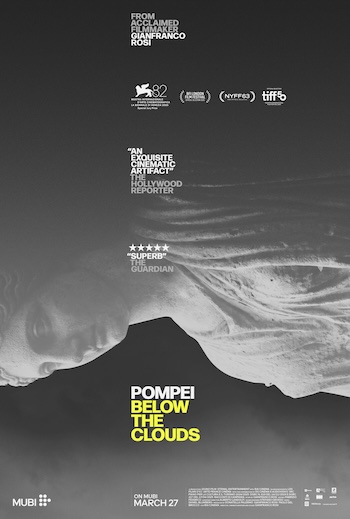
Pompeii: Above the Clouds is out now, streaming exclusively through MUBI across the world. View the trailer on YouTube to whet your appetite.