As a longtime admirer and researcher of Winston Churchill, I was thrilled to attend the press preview of ‘Winston Churchill: The Painter’ at the Wallace Collection yesterday. Opening this Saturday 23rd May until 29th November, this major exhibition curated by Dr Lucy Davis and Dr Xavier Bray (Director of the Wallace Collection) brings together more than 50 works in a chronological retrospective that is the first of its kind since Sir Winston Churchill’s death in 1965.
Not only one of the most important figures of the 20th century in Britain and around the world, the politician-statesman-writer-turned-artist once said, “We cannot aspire to masterpieces; we may content ourselves with a joy ride in a paint-box. And for this Audacity is the only ticket,” this is a dazzling collection which defies Churchill’s critics and celebrates his largely overlooked talent. With around half the paintings on loan from private collections, many of which have never been on public view before now, the impressive line-up provides invaluable context to Churchill’s journey as an artist.
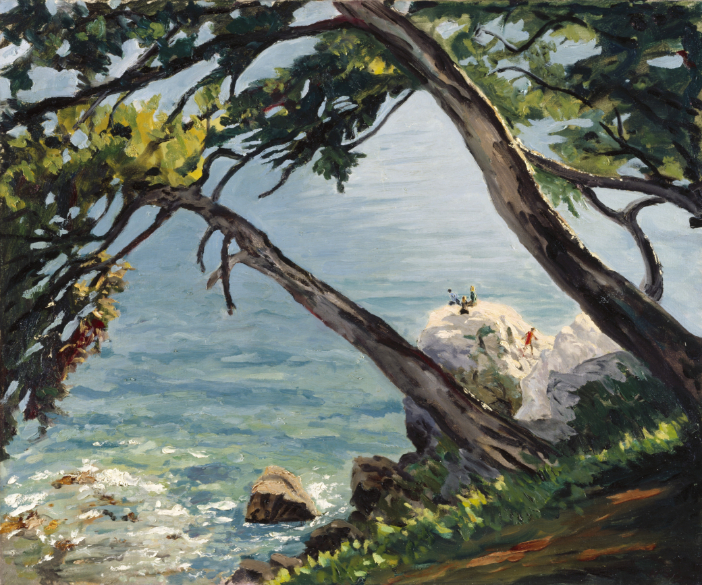
Sir Winston Churchill, Cap d’Ail, Alpes-Maritimes C489, 1952 Royal Academy of Arts, London © Churchill Heritage
Aside from offering a fascinating insight into Churchill’s home life at Chartwell, his extensive travels, his inimitable and defiant personality, and his wry sense of humour, the exhibition showcases his abundant versatility and artistic technique, with a host of landscapes and interiors, self-portraits and still lifes, including one of his most reproduced works, ‘Bottlescape,’ a witty collection of empty Pol Roger champagne, port and whisky bottles, along with cigar boxes, commenced on Boxing Day 1932 at Chartwell and recalling Churchill’s playful retort when questioned about his drinking, “I have taken more out of alcohol than alcohol has taken out of me.”
This beautifully curated exhibition offers everything from harrowing paintings of the front line in Belgium during World War I, to the panoramic views of Kent as seen from Chartwell, which are symbolic of the ‘green and pleasant land’ that Churchill was trying to protect from invasion during World War II. From serene harbourside paintings of the South of France, to exotic cityscapes of Morocco, so vivid that we can almost hear the water lapping in the first instance, and a call to prayer in the other, nowhere do you sense his frustration when things didn’t turn out quite as he had envisaged, prompting him to liken painting to fighting a battle. His artworks are not only a wealth of light and shade, but a vital record of life seen through the unique vantage point of one of the most important figures in history. Although Churchill regarded himself as an amateur, generously gifting his paintings to friends and acquaintances, they did also find their went into the Royal collections, the Royal Academy, and the Metropolitan in New York.
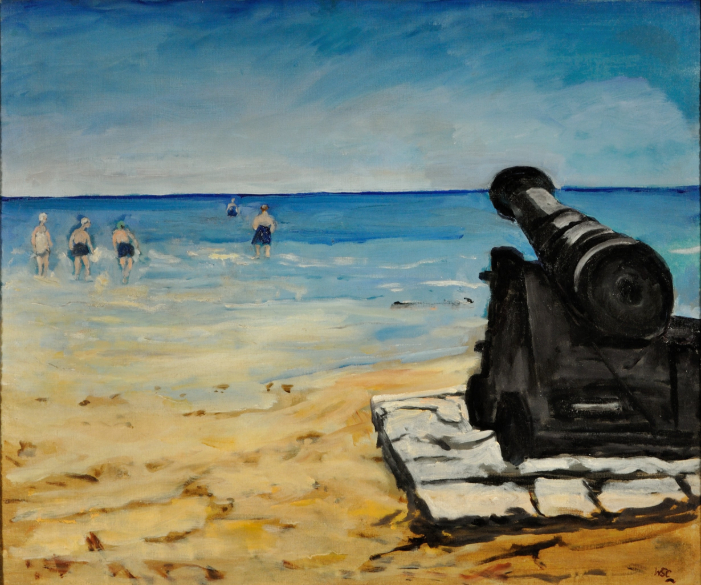
Sir Winston Churchill, The Beach at Walmer C316, 1938 America’s National Churchill Museum at Westminster College, Fulton, Missouri © Churchill Heritage
First turning to painting in 1915 after the Dardanelles debacle and during a moment of personal and national crisis, Churchill didn’t approach it as merely a pastime but something to bring him back from the brink of despair after being sacked as First Lord of the Admiralty. Purchasing a box of paints, legend has it that a downhearted Churchill stood in his garden in Surrey, dithering over how to paint the sky when Lady Lavery, the wife of the painter Sir John Lavery, arrived and, taking the largest paintbrush she could find, replicated the sky in an instant. Churchill later recounted, “The change from the intense executive activities of each day’s work at the Admiralty to the narrowly measured duties of a councillor left me gasping. Like a sea-beast fished up from the depths, or a diver too suddenly hoisted, my veins threatened to burst from the fall in pressure…And then it was that the Muse of Painting came to my rescue — out of charity and out of chivalry, because after all she had nothing to do with me — and said, ‘Are these toys any good to you?’ They amuse some people.”
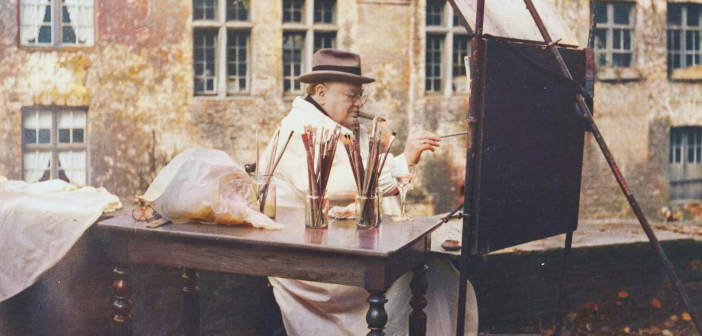
As a man who famously struggled with periods of depression and found that painting helped to keep the ‘Black Dog’ at bay, he was indebted to it: “Painting is complete as a distraction,” he explained, “I know of nothing which, without exhausting the body, more entirely absorbs the mind.” Whether painting in his custom-built studio at Chartwell or outdoors in the golden countryside of Provence, Churchill was a far more disciplined artist than many people realise. Equipped with a travel easel and parasol, wearing a blue smock to protect his clothes and smoking his trademark cigars while he worked, painting was an integral part of his busy routine, especially when holidaying. Publishing ‘Painting as a Pastime’ in 1948 with a text which had first appeared as a two-part essay in The Strand Magazine in 1921 and 1922, Churchill advised his readers to “Buy a paint box and have a try” and echoed Ruskin when enthusing, “Nature presents itself through the agency off these points of light, each of which sets up the vibrations peculiar to its colour. The brilliancy of a picture must therefore depend partly upon the frequency with which these points are found on any given area of the canvas, and partly on their just relation to one another.”
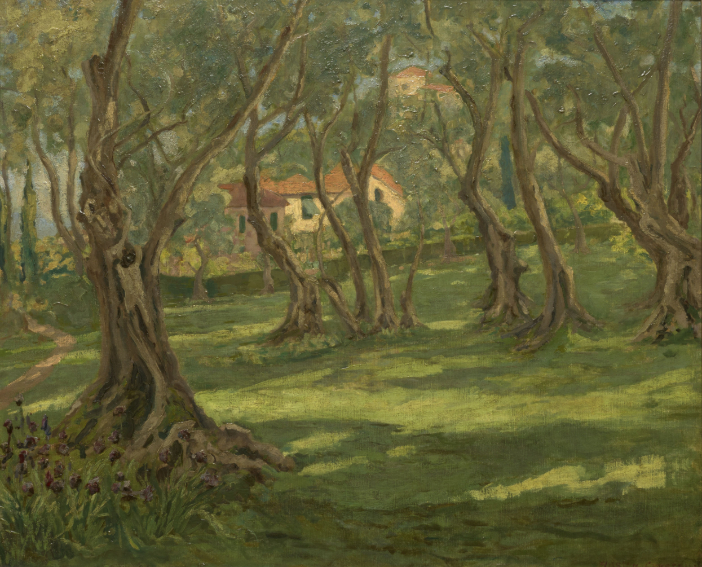
Sir Winston Churchill, La Dragonnière Cap Martin, 1930s, Private Collection © Churchill Heritage. Photograph by Howard Agriesti.
If you consider that there are an estimated 500 – 600 completed canvases (a large portion of which are housed at National Trust Chartwell) and that this exhibition features about 10% of his work, you get a clearer picture of Churchill’s devotion to art and his determination to keep improving. Don’t miss this celebration of Churchill’s passion and creativity as an artist, alongside personal items such as a bottle of his favourite Pol Roger champagne, and his spectacles, easel and brushes. The Wallace Museum’s curation makes us re-examine Churchill, not just the wartime leader, but a painter worthy of recognition. Having announced, “When I get to heaven, I mean to spend a considerable portion of my first million years in painting, and so get to the bottom of the subject,” I only hope that he can see that his contribution to British art of the 20th century is finally being appreciated.
Winston Churchill: The Painter at the Wallace Collection, Hertford House, Manchester Square, London W1U 3BN from 23rd May – 29th November 2026. Open daily 10:00 – 17:oo. For more information and tickets please visit the website.