In one of the hottest transfers of the year, Ava Pickett’s 1536 at The Ambassador’s Theatre is worth the hype. Whatever you’ve heard about this play already, be that from its original run at the Almeida Theatre, or the fact that it is co-produced by Margot Robbie, believe it to be true.
This is the best play I’ve seen in a very long time, second only to Kimberly Bellflowers’ John Proctor is the Villain (also due to transfer to the West End soon), and it’s no coincidence that the two present similar prevalent topics through an historical lens, proving that while it might be the ‘past’, it doesn’t negate the impact on the present day.
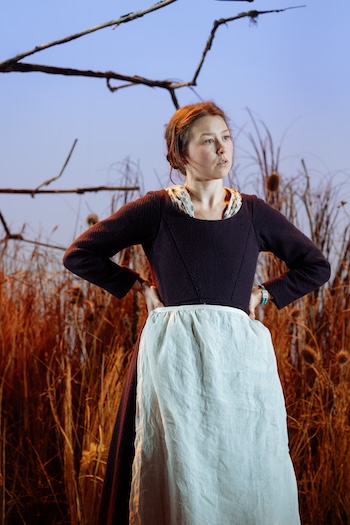 The play is set in 1536 (as you might expect). A pertinent year in British history if you can recall your Tudor monarchy from your school days. In a small village outside of London, three friends hear news from the capital that the King has imprisoned his Queen (Anne Boleyn) for suspected treason on account of adulterous behaviour.
While initially our main characters Mariella, Anna and Jane (no prizes for the relevance of the latter two) see this news merely as gossip to be pored over, Anna asking languidly “what does the King’s marriage have to do with you?”, they all come to find that despite being two days away (in terms of how quickly news travels), the impact of changes in London will be felt a lot closer to home.
What follows is an incredibly witty, acerbically topical exploration of power, politics, sexuality, gender, beauty and truth. Despite the historical setting, the script is in modern English, with a hefty dose of crude language and a quick sense of humour eliciting audience laughter, providing sharp contrast to the audience’s silence and gasps in moments of shocking relevance. It is urgent and compelling, aided in pacing by complete blackouts in between scenes and a subtly changing coloured screen behind a non changing barren landscape. This, as well as lighting from xxx, aids the evocation of lust, longing, and later an eerily chilling sense of destruction.
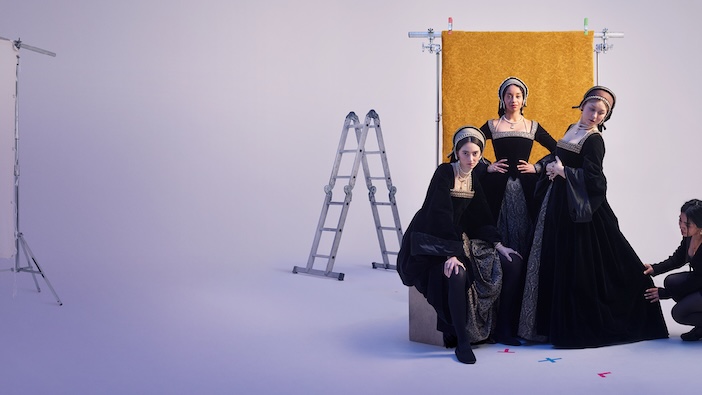
The trio of women who bring the main characters to life stand on the shoulders of the great women behind the scenes. Siena Kelly is incendiary as Anna, deftly balancing cutting humour, lascivious flirtation, moments of tenderness and rage that seeps into the audience. She is supported by Tanya Reynolds as Mariella, who toes the line of passivity and pain throughout and Liv Hill as Jane who, while absent for much of the latter half of the play, returns to the stage in a show-stopping moment of drama and devastation.
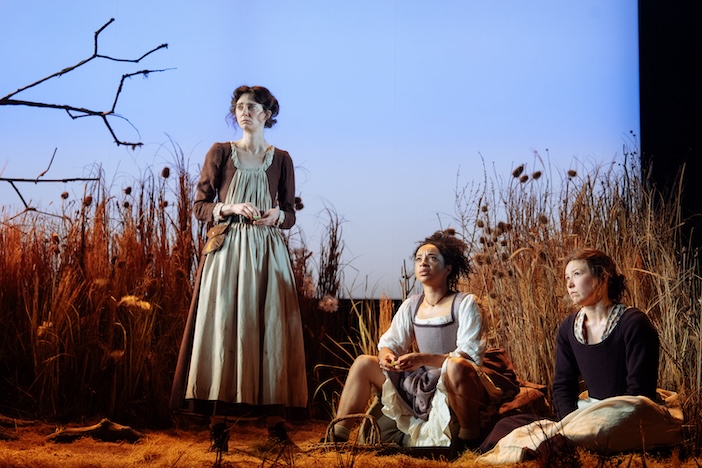
(L to R) Tanya Reynolds, Siena Kelly and Liv Hill
Lyndsey Turner’s direction is laser focused, with Pickett’s script deftly weaving between complex matters in a way that never feels jarring or laboured, despite the single act presentation. It is eminently quotable and devastatingly human. In one scene, Mariella muses on a world without men – she says she would be able to “…hear the birds more and look at the ground less” – a poignant reflection that might not pertain to ‘all men’, but I doubt you would find a woman who couldn’t resonate with that sentiment.
In a constantly connected world, I can’t recall the last time I have sat in such a captive audience. To the point that at a crucial moment of conflict somebody called out (in a thick Irish accent which only adds to the drama) “How dare you?!” Yet another encouraged louder shouting in a moment of compassionate anger two characters share. Far be it from me to encourage a call and response in a theatrical setting, but when an audience is so invested in a story that they are feeling every word in their core, it only serves to demonstrate the universality of the story being told, and the power of a shared experience.
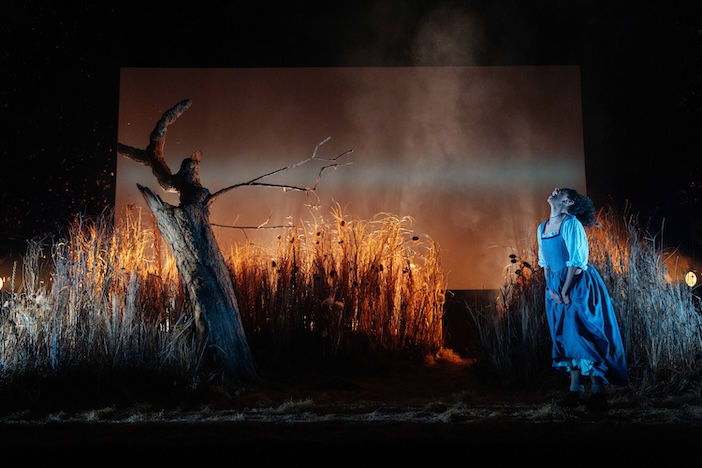
Throughout, there are references to the temperature, to how hot it is and how stifled the characters feel. And in the play’s final moments, this comes to a real crescendo. You feel a collective sense of oppression, a breath held for too long that in its finale releases into screams of anger, tears and rapturous applause.
Whether 1536 or 2026 these are necessary conversations and pervasively relevant issues. “How can we live this way? As if everything has already been written?” an exasperated Anna asks, when faced with the realisation of her lack of realworld agency (above and beyond that of her sexuality) in a world in which the rules are in flux. It is also a simultaneous warning to us to use our power; a powerful attempt to reclaim the narrative and a rallying cry to give voice to those who aren’t heard be that then or, nearly 500 years later, now.
1536 plays at The Ambassador’s Theatre until 1st August 2026. For more information, and for tickets, please visit www.theambassadorstheatre.co.uk.