Rob Rees heads to the Mull of Kintyre on an inaugural charter flight — one small part of a wider push to lobby government for a direct route and fresh investment in one of Scotland’s most overlooked corners. He discovers that the real luxury isn’t a five-star hotel or a rare malt, but the flight itself and the finest caddie on the West Coast…
There are few golfing pilgrimages in Britain that feel quite as adventurous as flying into Scotland’s Kintyre Peninsula on an inaugural flight. I leave the baking-hot Home Counties aboard a private charter from Gatwick and, less than two hours later, the Atlantic is crashing onto empty beaches, the scent of salt hangs in the air and the Hebridean islands of Islay, Jura and Gigha shimmer on the western horizon. 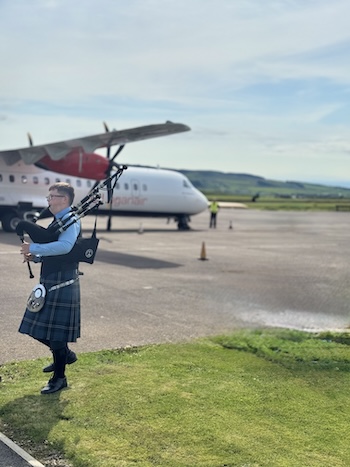 We are greeted by bagpipers Aiden and Aran in their Ramsay dress tartan, piping us into homespun Campbeltown Airport, on the site of the former RAF Machrihanish.
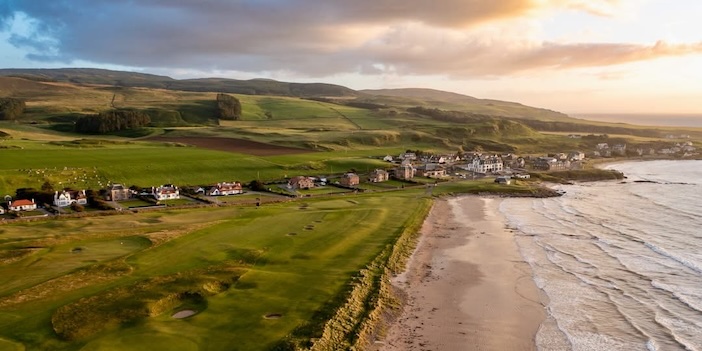
This is Scotland at its most elemental. Kintyre is a long finger of land stretching towards Northern Ireland, a place of fishing villages, white beaches, peat moorland, rare wildlife and some of the purest links golf ever conceived. It remains gloriously detached from mainstream tourism, which is precisely why those who make the journey rarely do so only once.
For centuries, this landscape has been woven into Highland folklore. The Gaelic storytellers spoke of it as a meeting place between earth and sky, where the winds carried the voice of Cailleach, the ancient goddess of the land. She certainly seemed to improve my golf, although the real credit belongs to my caddie, Eric Dunlea.
My base is the restored Ugadale Hotel, sitting almost within pitching-wedge distance of one of golf’s most famous opening tees. From my room I look directly across the Atlantic towards the opening hole of Machrihanish Golf Club, regarded as one of the finest first tee shots in world golf and reputedly Jack Nicklaus’s favourite.
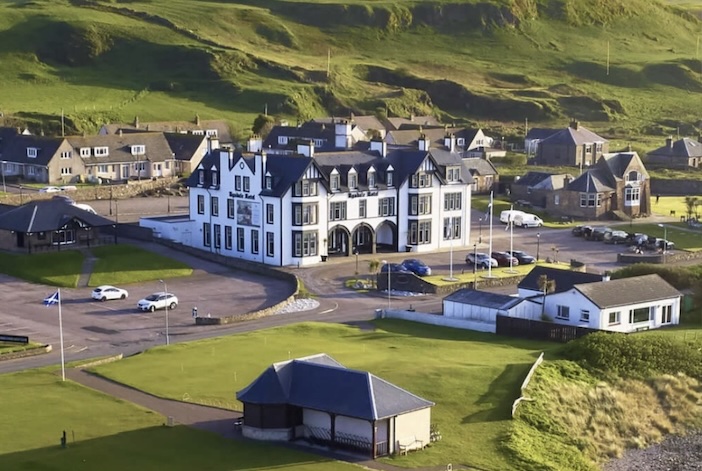
The grand old lady is Machrihanish Golf Club, currently celebrating its 150th anniversary. Founded in 1876 and remodelled by Old Tom Morris three years later, it remains one of the purest expressions of natural links golf. Morris allowed the land to dictate the golf rather than imposing golf upon the landscape.
It is 31 years since I last played here. Nothing quite prepares you for that opening drive. Standing high above the beach, the fairway sweeps around the Atlantic shoreline with the sand itself technically in play. Having safely navigated the iconic first, the course flows naturally through towering dunes, particularly from the 3rd through the 9th, where several holes possess the effortless rhythm that only centuries of wind and sea can create.
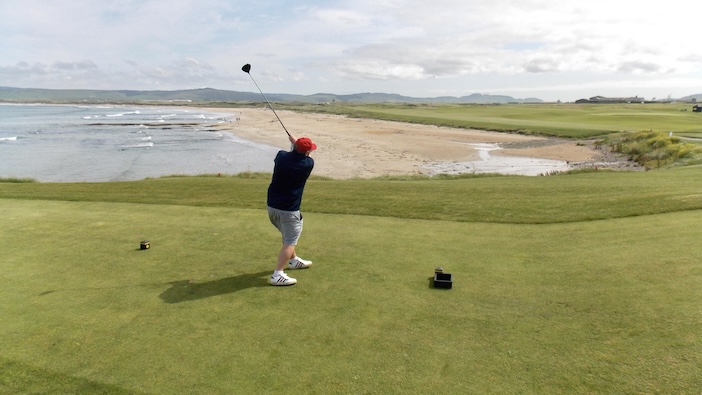
On former military land lies its younger sibling. Machrihanish Dunes opened in 2009 after architect David McLay Kidd worked within strict environmental constraints to create a championship links that disturbed remarkably little of the protected SSSI landscape. Only the greens and tees were built, altering just 7 acres of the 250-acre site . Everything else follows the natural folds, hollows and rumples shaped by nature over thousands of years.
The result feels astonishingly ancient, as though the course had lain undiscovered for centuries.
The Dunes rewards imagination rather than precision, which is my kind of golf. Blind drives, rumbling fairways, ocean-edge greens and vast natural amphitheatres create golf that feels wonderfully unpredictable. There are magnificent moments throughout, particularly where sloped greens perch beside the Atlantic with nothing beyond but sea and sky. It is links golf stripped back to its original essence.
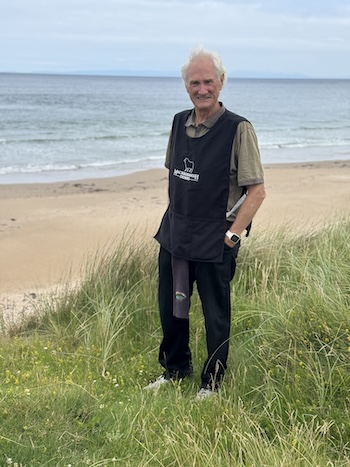 Yet the greatest revelation was my caddy Eric Dunlea.
Originally from Cork, Eric enjoyed a distinguished first career as a professional trumpeter with the BBC Scottish Symphony Orchestra before exchanging concert halls for fairways. After more than two decades in Kintyre, his knowledge of these links is extraordinary, but it is his understanding of golfers that truly sets him apart.
Like all great caddies, Eric is remembered as much for his warm company as for his yardages. He guided me around Machrihanish Dunes twice, gaining almost as much pleasure from a well-struck shot as I did. More importantly, he managed my emotions, simplified decisions, kept me positive and unlocked skills I had forgotten I possessed.
He is worth his weight in gold.
Eric never tells you where to hit it; he tells you where not to hit it. He explains how today’s wind differs from yesterday’s, identifies the side of the fairway that opens up the green and constantly reminds you that links golf is played as much on the ground as through the air. Under his guidance I played to my handicap on day one and three shots better the following day.
That is no coincidence.
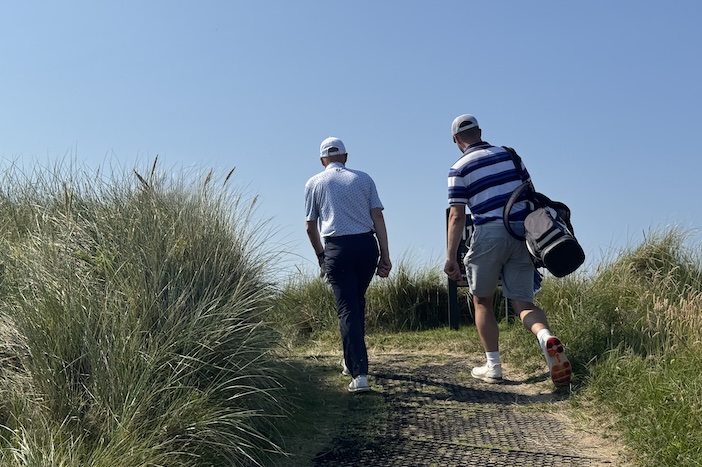
The best links caddies understand that golf is often a battle between the ears. Eric possesses the rare gift of simplifying difficult golf. By the end of the second round I was seeing shots differently, trusting contours and embracing the unpredictability that links golf demands. Oh what fun!
The wildlife adds another dimension. Kintyre is home to the pyramidal orchid, its elegant pink flower spikes appearing across the dunes in early summer. Feeding among them is the day-flying six-spot burnet moth, one of Britain’s most striking insects, its black wings punctuated by vivid red markings. You find yourself stopping as often to admire the flora and fauna as the golf.
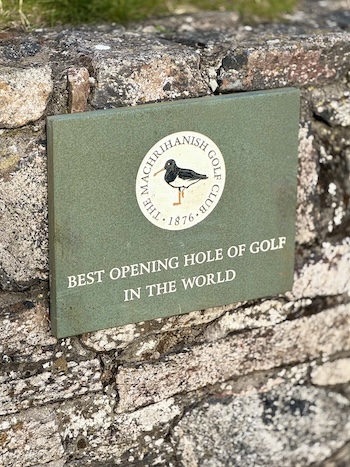 The oystercatcher, with its unmistakable orange bill, adorns the badge of Machrihanish Golf Club and patrols the shoreline beside the famous first tee. Seals can often be seen basking on offshore rocks, adding to the sense that nature remains firmly in charge here.
Off the course, Campbeltown offers another distinctly Scottish pleasure. Once known as the Whisky Capital of the World, with over 40 distilleries before Prohibition hit, the town remains one of Scotland’s five recognised whisky regions. Springbank, Glen Scotia and Glengyle continue to produce characterful maritime malts whose salty, coastal character seems inseparable from the landscape itself.
As evening falls, the Ugadale’s lounges become the perfect setting for a final dram. Outside, Atlantic rollers continue their endless procession onto the beach while that Nicklaus’ first tee waits only yards away.
This corner of Scotland has long attracted those seeking escape. In 1966 Paul McCartney bought nearby High Park Farm, finding sanctuary here far from the pressures of Beatlemania. A decade later he immortalised the landscape in Mull of Kintyre, a song that remains one of Britain’s great love letters to place.
It is easy to understand why.
Playing Machrihanish Golf Club and Machrihanish Dunes in the same visit ranks as one of the finest pairings in British golf in my opinion. The former sesquicentennial is one of Scotland’s oldest masterpieces; the other newbie a modern links so natural it feels prehistoric. Together they deliver everything that makes links golf utterly irresistible.
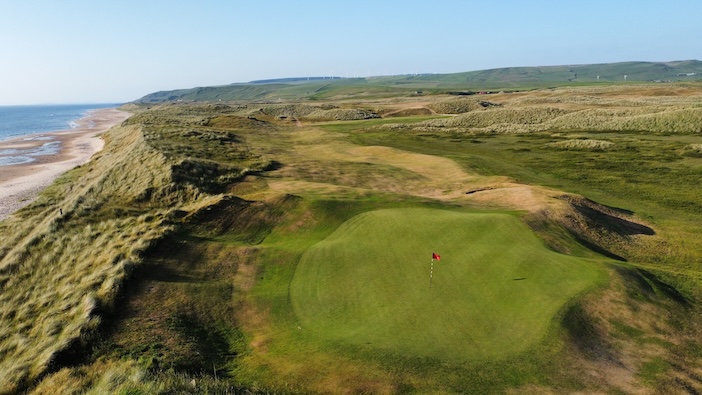
Two exceptional courses. A landscape rich in wildlife and legend. Genuine Scottish hospitality. And, above all, Eric Dunlea, the caddie who effortlessly transforms a round of golf into something far more memorable and infinitely more enjoyable.
If Logan Air’s proposed direct flight to Machrihanish becomes a regular fixture, many more golf addicts will discover what Kintyre has always known. This is links golf at its very best, wrapped in endless Scottish magic.
Irrespective of distance, the journey is worth making. But alas, I’ve already brought Eric home with me – he’s that good for my game!
Ugadale Hotel & Cottages & all golf can be booked via www.machrihanishdunes.com. Currently the only bookable Logan Air flights to Campbeltown (CAL) are via Glasgow www.loganair.co.uk but it’s hoped regular tri-weekly flights to CAL will start in Spring 2027. Two direct-charter golf & whisky trips will run again in August & October. Contact Ian Ferguson directly at ian@machdunes.com.