Everyone knows The Great Wave. At Dulwich, three impressions of it hang alongside the complete series of Thirty-six Views of Mount Fuji. Rosalind Ormiston is swept along…
‘I have been recreating the shapes of things since I was six years old,’ said the famous Japanese artist and printmaker Katsushika Hokusai (1760–1849), remarking too that he felt his art improved after he had reached the age of seventy. He called himself Gakyō Rōjin Manji, ‘The Old Man Mad About Art’, and wanted to live to 100 to perfect his work.
At Dulwich Picture Gallery in south London, a rare exhibition of Hokusai’s work has just opened. It focuses on his iconic series Thirty-six Views of Mount Fuji (1830–33), created when he was in his early seventies, with ten works later added by him. This is the first complete showing of the series in the UK, and it is rarely exhibited outside Japan. What is so special is that some of the rare prints are shown in different impressions, for comparison.
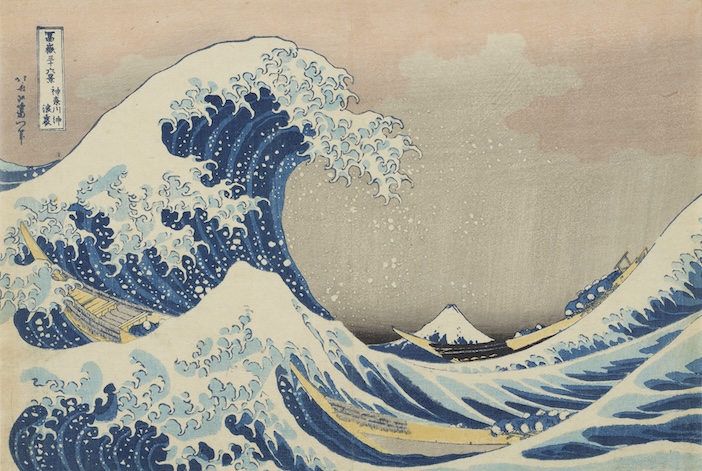
Katsushika Hokusai, ‘Under the Wave off Kanagawa’, 1830-33.
Under the Wave off Kanagawa, better known as The Great Wave, is shown in three impressions of Hokusai’s most famous print, revealing the minuscule differences and subtle variations of colour and line created by the handmade woodblock method, making each print edition unique. On show are well-preserved, rare early impressions, signed Hokusai Aratame Litsu (‘From the brush of Hokusai, who changed his name to Litsu’). Hokusai used the name Litsu because he had given his own name to a pupil. He used many names during his career, among them Gakyōjin, Litsu, Kakō, Manji, Sōri, Shunrō, Taito and Katsushika Hokusai.
Hokusai was adopted at the age of three by a mirror-maker, and worked as a book-rental delivery boy in Edo (now Tokyo) before gaining, aged seventeen, an apprenticeship with a woodblock maker. In 1777, aged nineteen, he joined the workshop of the respected painter and printmaker Katsukawa Shunshō, a master of ukiyo-e (a mix of realistic narrative and decorative design), where he would learn from the technical excellence of Katsukawa’s practice. Leaving the studio in 1794, he set up on his own as an independent artist. It was the beginning of a remarkable career and a challenging personal life, including the deaths of his wife and daughter, a period of poverty and great success, continuing to push the boundaries of ukiyo-e colour woodblock printing, with his creativity lasting until his death, aged 89, in 1849.
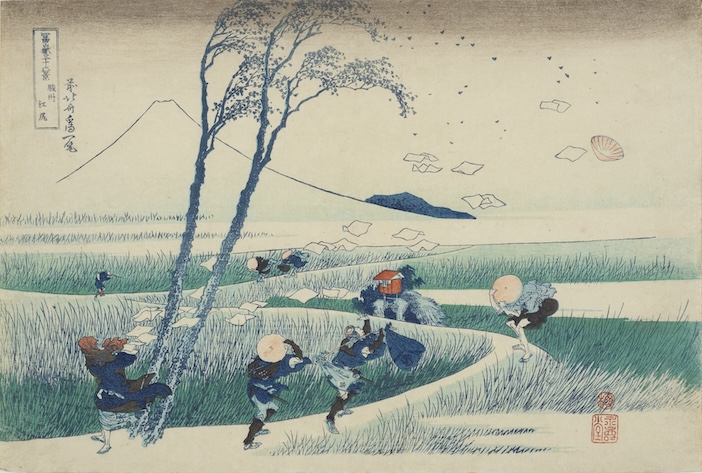
Katsushika Hokusai, Ejiri in Suruga Province, 1830-1833.
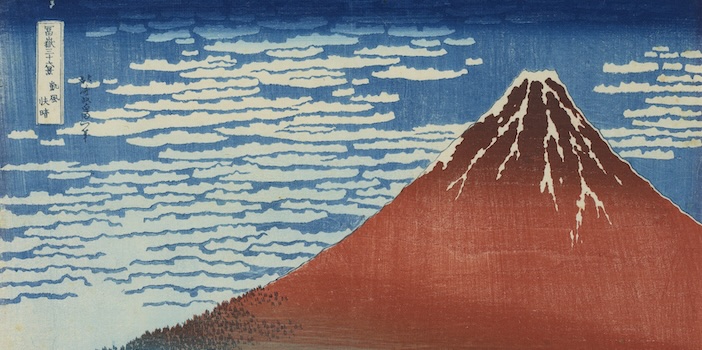
Mount Fuji is Japan’s highest mountain and an active stratovolcano on the island of Honshu. It reaches a height of 3,776 metres (12,389ft). Hokusai captures everyday life in Japan, as in Ejiri in Suruga Province, where the wind nearly overwhelms the field workers, the speed of the horse riders in Sekiya Village on the Sumida River, and visitors to the temple in Turban Shell Hall of the Five Hundred Arhat Temple, with Mount Fuji always included. It transformed genre woodblock printing in Japan. Studying the compositions, what hits the eye is the colour intensity, as in Clear Day with a Southern Breeze (Red Fuji), when the rising sun turns the mountain red. Hokusai depicts it in rich red, transformed again through decorative detail in Lightning on Mount Fuji and Sudden Shower Beneath the Summit.
It is fascinating to see how warm or cool colours change the atmosphere of the same landscape. Prussian blue pigment, known in Japan as burro, was imported during the 1700s but was expensive to use, and appeared in woodblock prints from the 1820s only when it became affordable. Clear Day with a Southern Breeze (Blue Fuji) reveals Hokusai’s enormous colour intuition, creating a different atmosphere through varied tonal colours in this ethereal mountain landscape. It captured a trend for azuri-e blue prints, so beautifully illustrated in Umezawa Manor in Sagami Province.
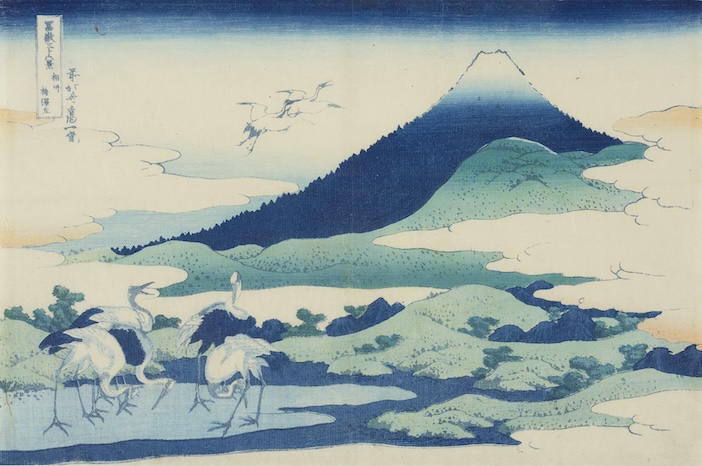
Katsushika Hokusai, Umezawa Manor in Sagami Province, 1830-1833.
The prints were produced during a significant era in Japan, when the printing industry was at its height. It is known that between 3,000 and 5,000 impressions were made of Hokusai’s most popular works. The large quantities made prints affordable, and they were usually sold through ezōshiya (print and book stores). In the second gallery at Dulwich, ‘The Art of Collaboration’ explores how Hokusai’s prints were created through the collaboration of the artist, the block cutter, the printer and the publisher working together.
At the time of Hokusai’s death in 1849, Japan was still intentionally closed to the Western world, apart from limited trade with Dutch merchants. Although Hokusai had knowledge of Western art, the art of Japan, and ukiyo-e artists in particular, was not known in Europe until the trade barriers were lowered in 1853. Hokusai’s prints travelled to Europe, particularly to France, where artists in Paris were mesmerised by the flat Japanese style of painting, which informed the avant-garde artists of the mid-to-late nineteenth century, particularly Édouard Manet, Vincent van Gogh, Claude Monet, Henri Matisse and many others, spreading the art of Edo and Japan, and Katsushika Hokusai, ‘the old man mad about art’, across Europe.
HOKUSAI: Thirty-Six Views of Mount Fuji from the Iuchi Collection runs until 17th January 2027 at Dulwich Picture Gallery, Gallery Road, London SE21 7AD. For more information, and for tickets, please visit www.dulwichpicturegallery.org.uk. All works pictured from The Iuchi Collection, on deposit at The National Museum of Western Art, Tokyo.
Artwork photos by Norihiro Ueno
Header image: Detail from Clear Day with a Southern Breeze (‘Red Fuji’), 1830-1833.