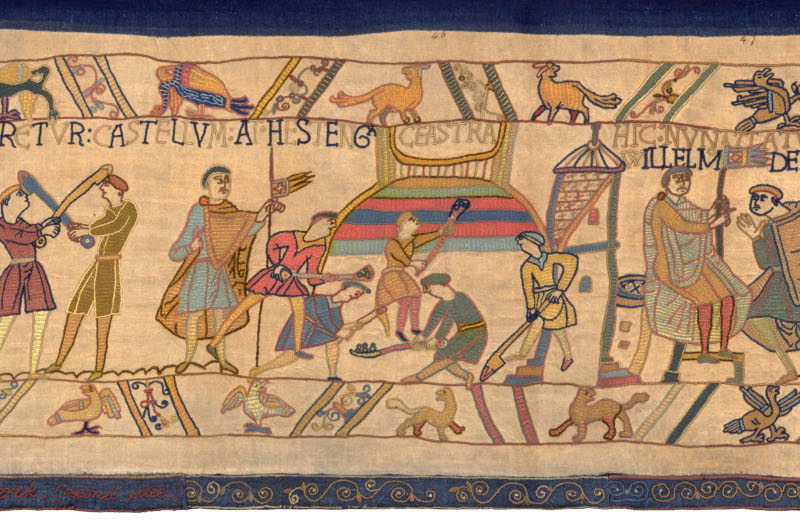
While the original draws sell-out crowds at the British Museum, Reading Museum holds a full-size, hand-stitched Victorian copy of the Bayeux Tapestry, complete with the missing ending – and underpants. Rosalind Ormiston investigates…
On 10 September 2026, the near-1,000-year-old Bayeux Tapestry, 70 metres (230ft) of embroidered linen owned by the City of Bayeux, France, went on public view at the British Museum, London. The tapestry is thought to have been commissioned by Bishop Odo of Bayeux, half-brother of William, Duke of Normandy, and created in a monastery in Kent around 1067–77. It is first recorded in the inventory of Bayeux cathedral in 1476. Timed tickets to view it for forty minutes sold out within days of the first release. More go on sale from 21 October and in January 2027, and the exhibition runs until 10 July 2027. A pleasurable alternative is to visit Reading, in Berkshire, around half an hour’s train journey from London, to see the stunning, hand-embroidered, exact-size replica, also 70 metres, at Reading Museum. It’s worth it.
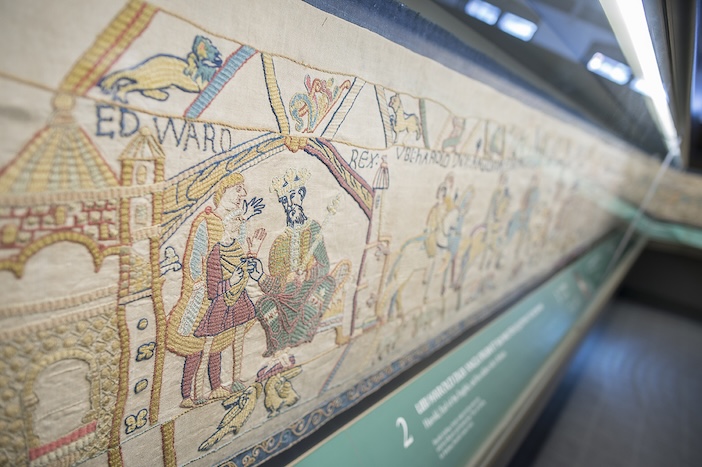
Reading Museum, free to visit, is next to the Town Hall and a three-minute walk from Reading rail station. The museum’s remarkable replica was hand-sewn by a group of English needlewomen. It came about when Thomas and Elizabeth Wardle, of Leek, Staffordshire, visited the tapestry in Bayeux in 1885. On seeing it, Elizabeth felt that England should have its own copy.
The South Kensington Museum (now the Victoria & Albert Museum) in London had a set of hand-coloured photographs of the tapestry, and the Wardles were friends of its director, Philip Cunliffe-Owen. He allowed them to trace the photographic illustrations and transfer them to linen. Thomas Wardle, a silk dyer, produced woollen yarns dyed to match the original exactly, and Elizabeth, an accomplished embroiderer, together with 35 skilled needlewomen of the Leek Embroidery Society, living in Leek, Birmingham, Derbyshire and London, hand-sewed a full-size replica in just over a year.
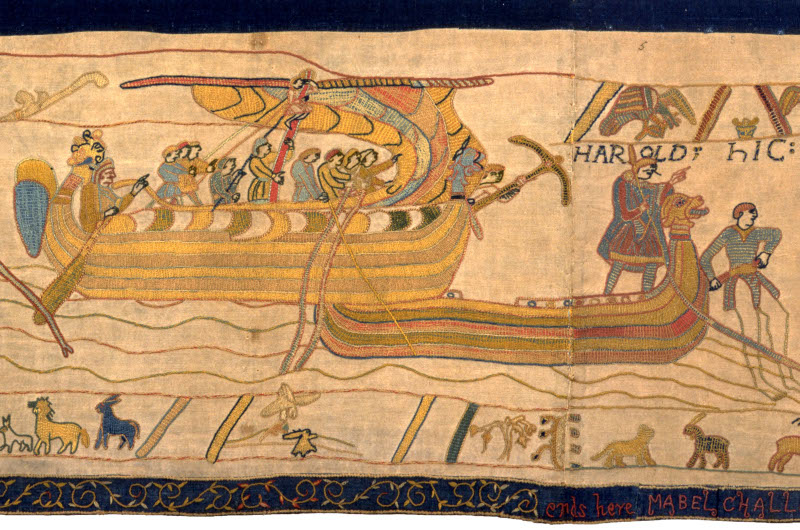
On completion, the tapestry went on show in Leek with such success (1,200 ticket-paying visitors) that the Society was able to become a Company. It then went on a national tour, visiting Newcastle-upon-Tyne, Chester, Stoke-on-Trent, Worcester and Tewkesbury, and also the USA and Germany. From 1887 it was further exhibited in major exhibitions in England, ending in Reading in June 1895. The possibility of purchase was raised, and the Mayor of Reading, Alderman Arthur Hill, bought it for £300 as a gift for the town (and showed it to Queen Victoria, who lived close by at Windsor). It was hung in Reading Town Hall and in the 1920s transferred to dust-proof glass cases, which allowed it to be taken on tour through England and to South Africa. When a new museum was created in Reading in 1993, the replica stopped touring and found a permanent home.
The original tapestry has 628 human figures, 190 horses, 35 dogs, 306 birds and animals, plus 33 buildings and 37 ships. Trees are used to separate the illustrated storytelling. There are 57 Latin inscriptions. The Reading replica follows the original with one slight exception: the nude males in the original were given underpants (for modesty). Reading Museum’s curators have added translations of the Latin texts embroidered on the linen panels, and a comprehensive telling of the narrative, which begins with Harold and Edward the Confessor possibly discussing Harold’s travelling to France to meet William, Duke of Normandy.
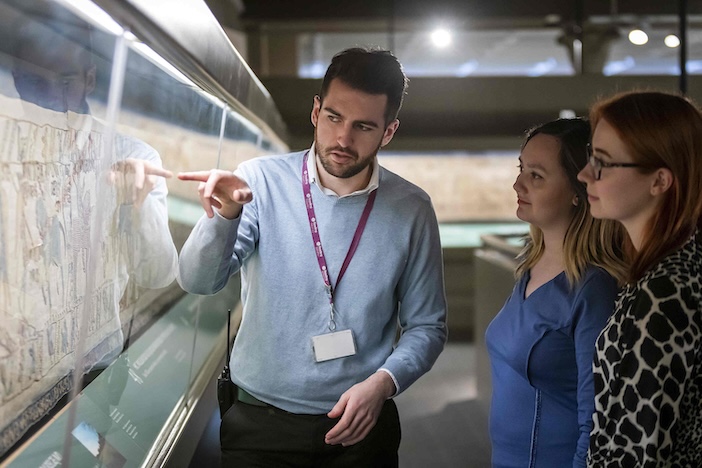
It ends with the death of Harold, but three metres (about 10ft) are missing from the original. Historians consider that this would have shown William ‘the Conqueror’ being crowned king, an event recorded in the Anglo-Saxon Chronicle for 1066. At Reading Museum, a reconstruction of the missing three metres illustrates this scene. Created by the embroiderer Jan Messent in 1997, it has become a famous piece of work, and has toured to Falaise Castle in France, the birthplace of William the Conqueror. Messent is also the author of The Bayeux Tapestry Embroiderers’ Story. Her reconstruction is an extra highlight of a visit.
As everyone who studied English history at school will know, the ‘tapestry’ is really an embroidery in thick wool. It illustrates the defeat of King Harold Godwinson of England at the end of a day-long battle between his soldiers and William, Duke of Normandy, plus thousands of Normans: French, Breton and Flemish horsemen and foot soldiers. They had crossed from France in ships, landing on the Sussex coast at Pevensey, to claim the English crown for William after the death of the late king, Edward the Confessor. They brought their armour, weapons, horses and provisions (including wine).
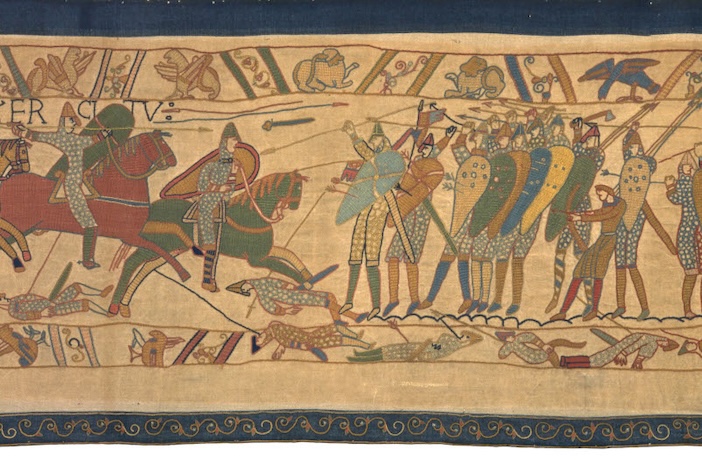
The battle took place near Hastings on a steep rise of a hill, in a place now called Battle in commemoration of that day, 14 October 1066. King Harold was killed in late afternoon (some accounts state from an arrow through his eye, others that he was decapitated and his body butchered), which led to the surrender of the English soldiers to the Norman troops. William was crowned king of England about ten weeks later, in Westminster Abbey on 25 December 1066. At his side was his half-brother Bishop Odo, who features strongly in the tapestry. It is believed that Odo commissioned it to display in Bayeux cathedral.
The Bayeux Museum in France has displayed the tapestry since 1983. It closed in September 2025 for a two-year renovation, and the tapestry will be returned by the British Museum in time to celebrate the 1,000th anniversary of the birth of William, Duke of Normandy (c.1027/28–1087), in autumn 2027. Meanwhile, at Reading Museum, England’s own fabulous copy remains.
It’s a must-see.
Reading Museum, Blagrave Street, Reading RG11QH. For more information about the Bayeux replica, including details of talks and tours, please visit www.readingmuseum.org.uk. The book, ‘The Bayeux Tapestry Embroiderers’ Story’ by Jan Messent is available now from Waterstones and all good stockists.