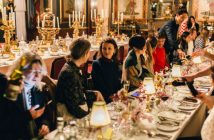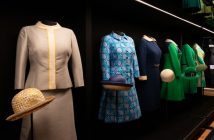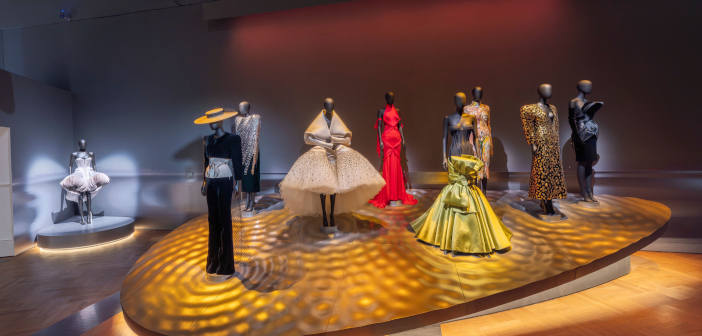
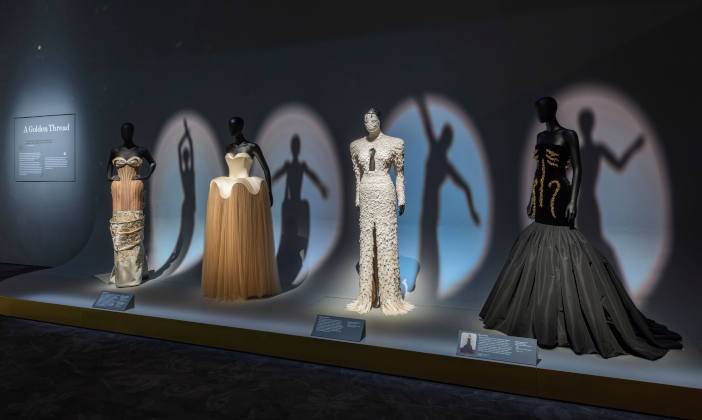
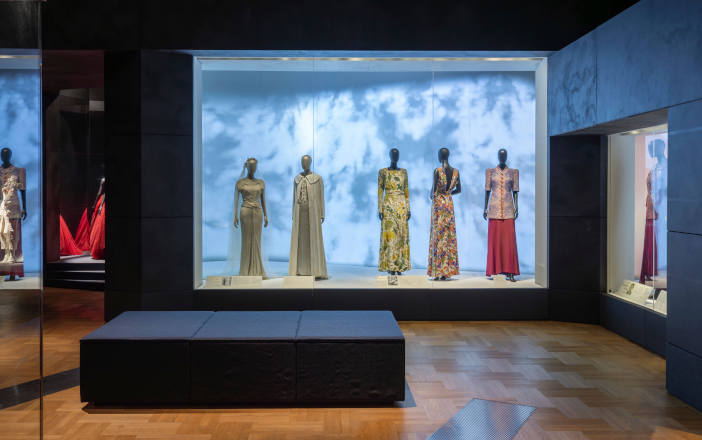
The V&A’s new exhibition, Schiaparelli: Fashion Becomes Art, is the first UK event of its kind dedicated to Maison Schiaparelli and the groundbreaking Italian fashion designer Elsa Schiaparelli (1890 – 1973) who boasted, “For me, dress designing is not a profession but an art.” Drawing on new research undertaken by curators, the exhibition, which takes place in the museum’s large Sainsbury Gallery and moves throughout the various rooms chronologically from the 1920s to 2026.
Offers visitors a fascinating trajectory from the origins of the fashion house through to the company today, this exhibition is a tribute to one of the most pioneering female entrepreneurs of the 20th century. 400 objects, including 100 strikingly innovative ensembles, are positioned to their best advantage; from accessories, jewellery and perfumes to photographs, artworks, furniture and archival material, the V&A have achieved a remarkable overview of Elsa Schiaparelli’s talent and allow us, probably for the first time, to fully understand her legacy – more as an artist than a fashion designer.
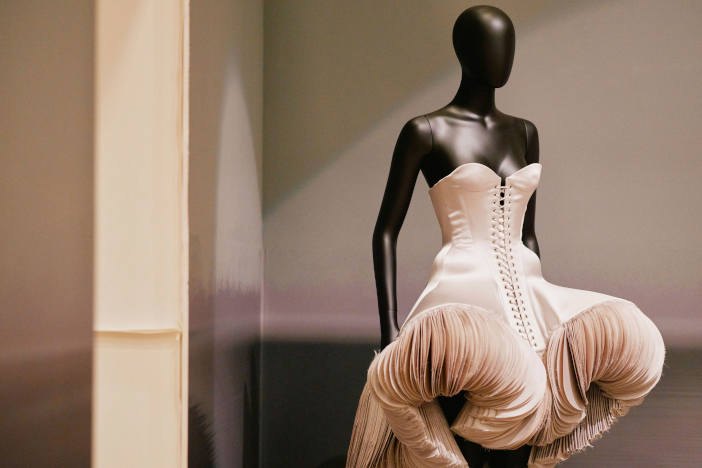
Born in Rome in 1890 to an aristocratic mother and scholar father, it’s easy to conjecture that Elsa Schiaparelli’s fearlessness as a fashion designer was partly due to her own standing in the world; a woman who was not only designing dresses for her peers but the international upper-class society, into which she had been born and was comfortable to exist. The eminent social position of her Italian family coupled with financial security were important factors in Elsa’s sense of creative freedom, liberated as she was from fears of destitution should her business fail and happy to risk her reputation when she believed in a new design.
Prior to launching her own fashion house Schiaparelli, Elsa or “Schiap” to her friends, had already led a colourful life, having studied philosophy at the University of Rome and published a book of sensual poetry which shocked her parents so much that they sent her to a convent where she went on a hunger strike until she was permitted to leave at the age of 22.
She went on to bolt from the Russian suitor her parents had lined up for her to marry; relocating to London where she took a job as a nanny and attended lectures, she met and fell in love with the theosophist Count William de Wendt de Kerlor, known as the “World Famous Dr. W. de Kerlor” whom she married in 1914. But marriage proved just as turbulent as had the run-up, with the pair forced to leave England the following year when de Kerlor was deported after being convicted for practising the then-illegal trade of fortune-telling.
The couple travelled to New York where Elsa gave birth to a daughter, Maria Luisa Yvonne Radha de Wendt de Kerlor in — (better known as Gogo Schiaparelli), and Elsa began working with Gaby Picabia, the ex-wife of French Dadaist artist Francis Picabia and owner of a boutique selling French fashions in New York. It was here that Elsa met artists like Man Ray; in 1922, due to her husband’s unfaithfulness, deciding to follow Picabia and Man Ray to Paris where she would shortly become internationally known. Later writing in her autobiography, ‘Shocking Life’, Elsa claimed: “Many men admire strong women but they don’t love them. Some women succeed at being strong and also tender, but most of those who have intended to walk alone, making their own way, have lost their happiness.”
Encouraged by her “generous mentor”, the couturier Paul Poirot, Elsa launched a line of sweaters, one of which, a black sweater featuring a surrealist trompe l’oeil scarf at the neck, was selected to appear in Vogue. When the coveted style sold out, Elsa employed a team of Armenian immigrants to knit the sweaters in order to satisfy demand, something which led to her opening her first boutique, House of Schiaparelli in 1927, where she sold her ready-to-wear line, “pour le Sport”, including bathing suits, ski-wear and linen dresses.
Gaining notoriety when Lili Álvarez attended the 1931 Wimbledon tennis tournament in a divided skirt, something we now identify as ‘culottes’, Elsa Schiaparelli understood the value in dressing influential celebrities and their ability to continually keep the fashion house in the public eye. Perhaps it was with this in mind that, come 1931, Elsa began using the silks of Robert Perrier for her first evening-wear collection; a decision which greatly increased business. Undeterred by the fact that she had no formal training in the technical skills of pattern making and garment construction, Schiaparelli allowed designs to evolve by draping fabric directly onto the body and sometimes offered herself as the model to ensure that each of her designs would be wearable for the client.
In 1932 Schiaparelli dressed Amy Johnson for her first solo flight to Cape Town, while the Lobster dress made it into American divorcee Wallis Simpson’s trousseau for her wedding to the Duke of Windsor, the former King Edward VIII who had caused an international scandal when he abdicated the British throne in order to marry her. It was thanks to such prestigious clients as the newly styled Duchess of Windsor that Schiaparelli relocated from Rue de la Paix to 21 Place Vendôme in 1935, while a new 98-room salon with work studio at Hôtel de Fontpertuis became known as the “Schiap Shop”.
The first collection presented at the new Place Vendôme location was named ‘Stop, Look and Listen’; a reflection of Elsa’s derision of how “Women dress alike all over the world.” Over the following years she would launch the provocative styles for which she became known throughout the fashion world, incorporating her famous wit and ingenuity into every stitch. Believing that all women “dress to be annoying to other women,” Elsa challenged her rich and famous clientele to wear increasingly daring garments and by the late 1930’s had become a foremost designer, with fashion-conscious celebrities such as Wallis Simpson discovering that a dress from the House of Schiaparelli would not only deflect fashion kudos on the wearer but guarantee comment in society magazines,
Lauded by Cristóbal Balenciaga as the “only real artist in couture”, British fashion journalist Alison Settle observed that Elsa Schiaparelli’s “…clothes were universally sought as the perfect expression of the ideas of her age…She has for years been quicker to see into the future than any other designer.” Believing that “dresses that are truly beautiful are never unfashionable” Elsa was heavily inspired by Surrealist artists of the day and collaborated with Man Ray, Jean Cocteau, Salvador Dalí, Leonor Fini and Alberto Giacometti on pieces which blurred the lines between fashion and art.
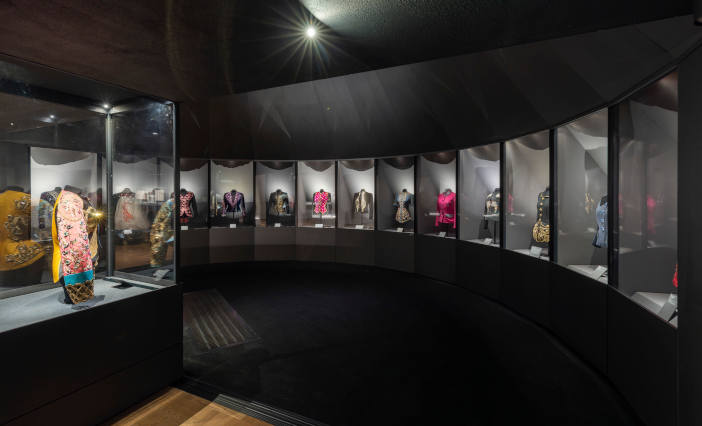
Exhibition highlights include a 1937 evening coat featuring a reverse of embroidered faces which Elsa designed with Jean Cocteau, along with the 1938 ‘Tears’ and ‘Skeleton’ dresses she designed with Salvador Dali. The humour of the collaboration is never more apparent than when arriving at the famous ‘Lobster Telephone’ (also 1938) or the upside down ‘Shoe’ hat which she also designed with Dali; uniting skill, imagination and wit to create conversation pieces that we continue to discuss and muse over.
Maisin Schiaparelli, still located at the original 21 Place Vendôme address, is now under the visionary creative director Daniel Roseberry who ensures faithfulness to the female founder who strove to offer clients and the wider fashion world something unique and distinctive. If ever dresses and their accoutrements deserved to be displayed behind glass in a museum – like the works of artists with whom Elsa collaborated – then Schiaparelli’s designs, past and present, most certainly do.
Schiaparelli: Fashion Becomes Art at the V&A South Kensington, Cromwell Road,until Sunday 8th November 2026. An illustrated hardback book of the same name has been published to accompany the exhibition. Tickets £28 weekdays, £30 weekends, concessions apply. Free to V&A members. Advance booking is recommended. For more information and tickets please visit the website. Exhibition photos by Jamie Stoker.