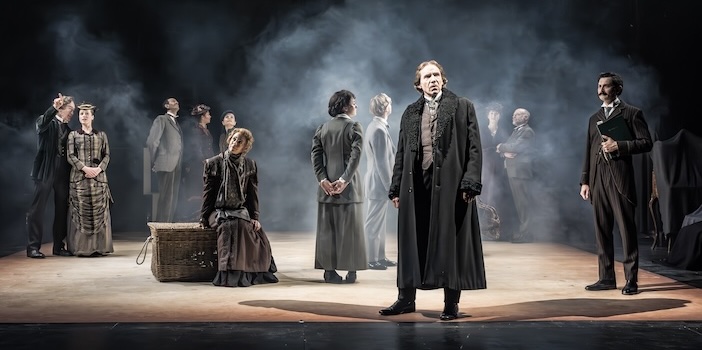
David Hare’s new play (his 32nd), Grace Pervades, a sweeping, century-straddling meditation on the lives of Victorian theatrical titans Sir Henry Irving and Ellen Terry, has opened at the fittingly historic Theatre Royal Haymarket following a successful premiere at Theatre Royal Bath. An ambitious work examining stagecraft through the lives of two iconic actors, it stretches from 1878 to the mid-20th century, allowing Hare to muse on whether the ephemeral nature of performance justifies the personal sacrifice and the wreckage of relationships so often left in its wake.
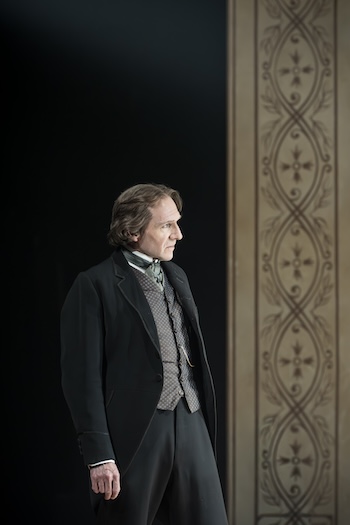 Ralph Fiennes is an obvious choice to play the dour workaholic actor-manager Henry Irving, whom he inhabits with a hawkish restlessness; so consumed by his duties at the Lyceum Theatre that he seems to have forgotten how to exist in the world outside. Miranda Raison’s Ellen Terry is not majestic, yet captures the elusive, girlish vitality that made Terry the highest-paid actress in England — a success juxtaposed with the irremediable toll her work took on her personal life, one that surpassed even her most complex Shakespearean roles.
From two scandalous and doomed relationships with men considerably older than herself — a failed marriage (when she was aged just 17) to the painter George Frederick Watts, who was 30 years her senior, was followed by six or seven years ‘living in sin’ in the countryside with the eccentric architect Edward William Godwin, with whom she had two illegitimate children — it’s easy to see how Terry’s industrious years at the Lyceum led to her daughter Edith (Ruby Ashbourne Serkis) and son Edward Gordon Craig (Jordan Metcalfe) feeling neglected. Nor is it surprising that the resentment which both children harboured led to a rebellion against their mother’s world.
Edward Gordon Craig’s own career as a set designer challenged the opulence of Irving’s productions in favour of a pared-back aesthetic focussing on light and shadow. Prone to over-intellectualising to the point of tedium, Hare shows that whilst Irving and Terry built the modern profession, they also inadvertently birthed the very forces that would eventually render their style obsolete.
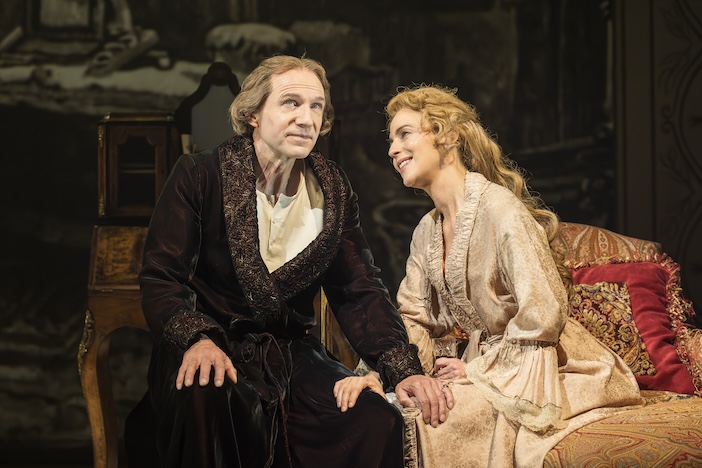
Bob Crowley’s design, which leans heavily on stage furniture and oft-changing costumes — not least the famous green dress worn by Terry as Lady Macbeth and captured in a portrait by John Singer Sargent — adds colour and interest when needed, with director Jeremy Herrin maintaining the pace as best he can given Hare’s didactic speeches. Examining the purpose of theatre, one of the most transient art forms, he reminds us that creators are left with nothing but the experience and the memory.
With a premise promising fireworks but barely delivering the bang of a Christmas cracker, this is largely due to Hare prioritising the intellectual over the emotional; telling the audience of the “magic” created by — and existing between — Irving and Terry far more than allowing them to experience it. His interpretation of this breakthrough moment for theatre and the public’s esteem of acting as a profession will be a missed opportunity to anyone who understands Victorian society and the undercurrents of pseudo-morality and class which underpinned the years of Queen Victoria’s reign. But the nail in the coffin (no Dracula reference intended) is the unnatural dialogue, lacking the wit of Hare’s earlier polemics and as stiff as a corpse. It’s tremendously ironic that this mellow retrospective of two of the most important figures in the history of the British stage are now the central characters of such a thoroughly dull play.
Grace Pervades at Theatre Royal Haymarket, London, SW1Y 4HT, until 11th July 2026. Running time 2 hours 30 minutes including an interval. For more information and tickets, please visit www.trh.co.uk.
Photos by Mark Brenner