Surrealism’s master of the visual riddle gets a four-gallery tribute in Mayfair, alongside the artists who have been puzzling over him ever since. Rosalind Ormiston reviews…
Until 12 December 2026, London visitors can see a fabulous exhibition at the Gagosian in Grosvenor Hill: This Is Not a Pipe: The Afterlife of Magritte, which shows more than fifty works by the Belgian Surrealist René Magritte. Spread across four gallery spaces, the show features many of his best-known works, including his conceptual self-portrait La Lampe philosophique (1936); a signature Magritte cloud-filled sky in La Malédiction (1931), where the sky appears without landscape or horizon; and that large green apple in La Chambre d’écoute (1958).
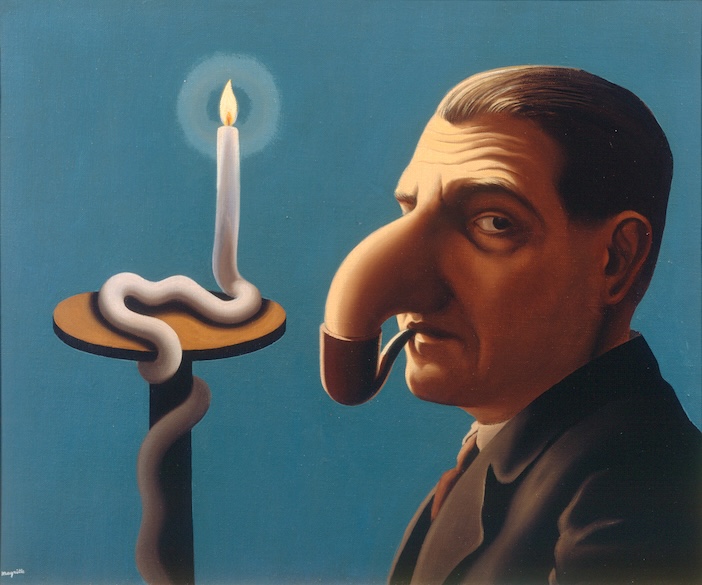
Renee Magritte ‘La Lampe Philosiphique’, 1936 (C.Herscovici/ARS, New York)
The show also explores Magritte’s legacy through the work of more than forty artists informed by his Surrealist concepts and philosophy, among them Matthew Barney, Mona Hatoum, Maurizio Cattelan, Sarah Lucas, Ed Ruscha and Yoko Ono. Some pieces have been produced specially for the Gagosian. Look out for Allison Katz’s wonderful Brussels sprout (and Philip) No.4, proof that Surrealists continue to explore the art of the unconscious mind.
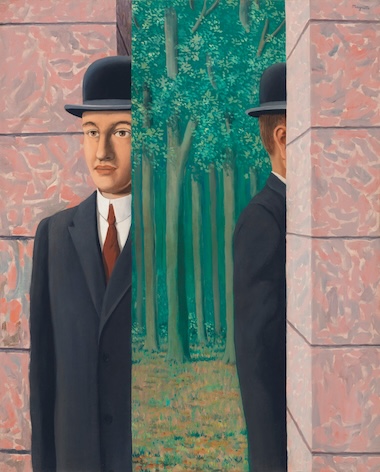
Renee Magritte, La Lieu Commun, 1964 (AGADP, Paris, and DACS, London)
The exhibition is a collaboration between the Gagosian and the Fondation Magritte, Brussels. Its title plays on a caption in Magritte’s The Treachery of Images (1929), a painting of a tobacco pipe inscribed Ceci n’est pas une pipe (‘This is not a pipe’). And it isn’t: it is a painting of a pipe, a joke that questions representation and reality and characterises the subversive humour of the Belgian Surrealist. Magritte was one of a group of artists and writers, working in literature, poetry, prose, art and photography, initiated in 1924 by the Belgian biochemist and Surrealist Paul Nougé, in parallel with the ‘new art’ in France led by the French writer and poet André Breton, the ‘Pope of Surrealism’.
Born in Lessines, Belgium, in 1898, one of three brothers, René Magritte began drawing lessons in 1910 and studied at the Academy of Fine Arts in Brussels from 1916 to 1920, developing his ideas on abstract art. After military service in 1920-21, he worked as a graphic designer for the Peters-Lacroix wallpaper factory in Haren, then as a designer of posters and advertisements.
His own work was influenced by Max Ernst and, particularly, Giorgio de Chirico, whose The Song of Love (1914) he saw in 1922. Magritte had been part of the Dada group with Francis Picabia when he met Nougé in 1924, and the two became good friends and collaborators. He considered his first Surrealist work to be the collage The Lost Jockey (1926), exhibited in his first solo show; signing a contract with a gallery then allowed him to become a full-time professional painter.
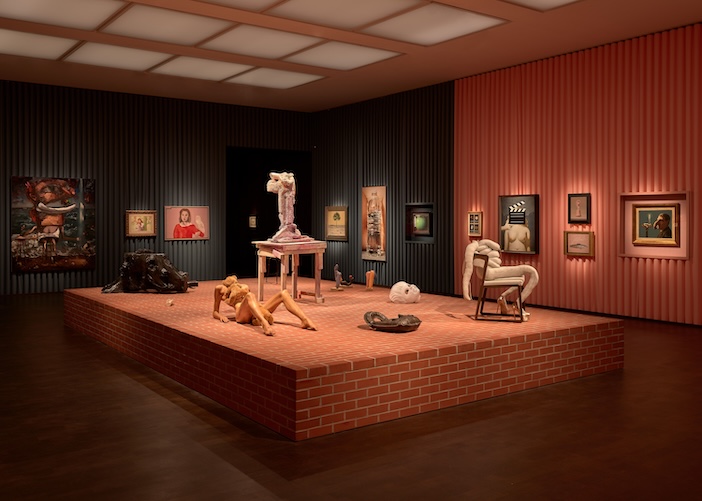
Some of the works on show have special histories of their own. Le Parfum de l’abîme (1928) was once owned by André Breton; Les Fleurs du voyage (1926), among the earliest paintings on show, was part of Magritte’s important first solo exhibition at Galerie La Centaure in Brussels in 1927; and L’Ombre céleste (1927) was exhibited in the landmark Fantastic Art, Dada, Surrealism show at the Museum of Modern Art in New York in 1936-37. Each exhibition aided Magritte’s rise to international fame. The owners of his paintings show how highly his work is regarded, too: La Clef des songes (1935) belongs to the American Pop artist Jasper Johns.
This Is Not a Pipe: The Afterlife of Magritte runs until 12 December 2026 at the Gagosian, 20 Grosvenor Hill, London W1K 3QD. Open Tuesday to Saturday. The Gagosian is free to visit. For more information, please visit www.gagosian.com.
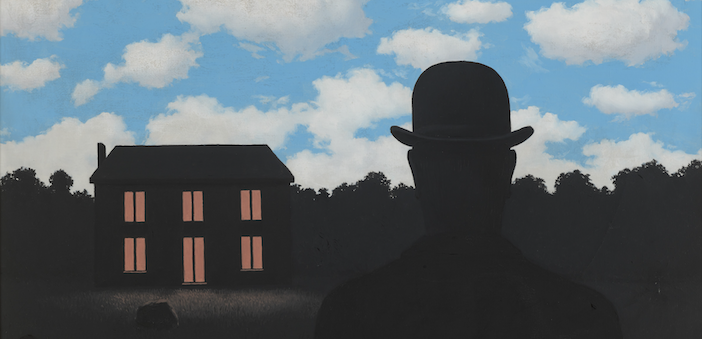
Header Image: Detail from ‘L’Empire des lumieres’ (1961)