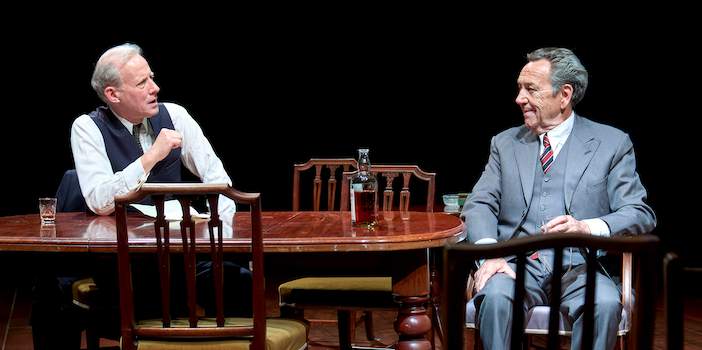
It’s become customary that a trip to the theatre these days should involve something grandiose – a star vehicle, a spectacular set, ‘the latest from’ – and, arguably, at today’s prices, you’d expect it. In an age when the small screen provides so much distraction, when one has little reason to leave one’s home, let alone the sofa, it’s reassuring that such a resolutely analogue art form should still be thriving. But that’s not to suggest every production need be a spectacle, or a special occasion; there does still exist room for theatre to be exactly what it was designed to be: something intimate, immersive, thought-provoking, and downright entertaining.
 For all the hyperbole of that opening, Springwood makes the case rather well. Its subject matter has the makings of something bigger – a Darkest Hour, or an Operation Mincemeat, in the current vogue for handsome WW2 retellings – yet it thrives by doing the opposite, working far better as kitchen-sink drama than as prestige spectacle. The play concerns an uncomfortable visit in June 1939 by King George VI and Queen Elizabeth (the future Queen Mother) to the United States, to meet President Roosevelt and appeal for support ahead of the impending conflict in Europe. It takes place at the Roosevelts’ country home – his mother’s, in fact, the ‘Springwood’ of the title, since Franklin never owned a home of his own – where the family are to entertain the royal couple ahead of the media circus of the visit proper. For such rich subject matter, you might wonder why it hasn’t been dramatised before.
Well, it has – by the same writer. Hyde Park on Hudson, starring Bill Murray, rather passed most cinema-goers by on its release, perhaps missing the current appetite for this material; Springwood breathes new life into the story, riding the crest of the present WW2 wave, and this time is also directed by its writer, Richard Nelson – already a dab hand at this kind of domestic lens, courtesy of his award-winning Apple and Gabriel Family plays. What’s extraordinary is that, bar the obvious dramatic embellishment and imagined dialogue, this is a story rooted firmly in fact.
Nelson’s research draws in part on the letters of Margaret ‘Daisy’ Suckley – Roosevelt’s distant cousin and confidante, whom Nelson had himself met – discovered in a suitcase under her bed only after her death in 1991. It’s that intimate correspondence, rather than the official record, that allows Nelson to build such a human, unguarded portrait of the Roosevelts, rather than the grander historical narrative the subject matter might otherwise invite. It’s a credit to his writing that one can well imagine these are the exact exchanges that might have taken place. But that alone doesn’t make for compelling viewing; that comes down to the performances of this cast – and an unlikely one at that.
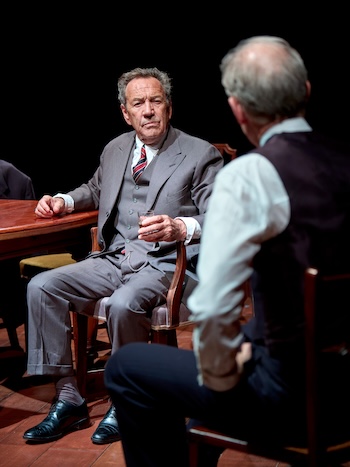
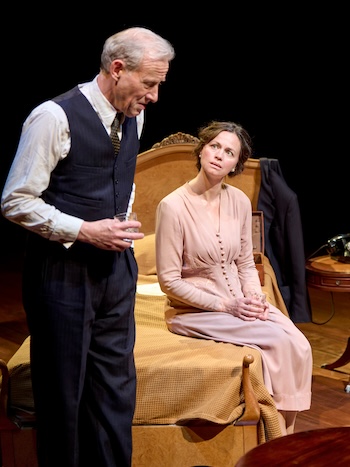 Robert Lindsay is not how you might have imagined Roosevelt, but he plays it personable and nuanced, right down to a subtle mid-Atlantic accent; Jemma Redgrave is equally absorbing as Eleanor, providing the audience’s inner thoughts and questions. On the British side, Rebecca Night brings a brittle, put-upon poise to Elizabeth, but the greatest credit must go to Andrew Havill as ‘Bertie’ – the stammer, masterfully done, often manifesting as frustrated rage, and a priggish awkwardness that never tips into caricature.
One might imagine the subject matter to be a little dry. And, indeed, on its own – a diplomatic visit by, let’s face it, unexciting royals – it might not sound the most compelling of stories. But Nelson draws on the dynamics between the two couples to construct a thoroughly entertaining narrative. Roosevelt’s mistresses are well-documented; Eleanor’s own attachments are, equally, no great secret; but Nelson wisely keeps these as undercurrents rather than plot points (bar one obvious blunder – no spoilers), in the interests of keeping the story properly intimate rather than grandiose. Instead, he plays on the subtler cultural differences – the perceived louche informality of the Americans against the stiff-collared properness of British aristocracy – addressing the ‘us and them’ of it all, the superiority-versus-vulgarity, and injects a thoroughly entertaining seam of class comedy.
It’s these threads that make the drama so compelling, and rich fodder for its funniest moments. Nelson never lets them overwhelm the story, concentrating instead on the small stuff, which gives the characters far greater human relatability. Much is made of the thinness of the walls, the overhearing of private goings-on accounting for the next day’s awkward exchanges; the debates between couples over how one is expected to behave, most amusingly played out in the near-constant, mounting dread over how, exactly, one is meant to eat a hot dog.
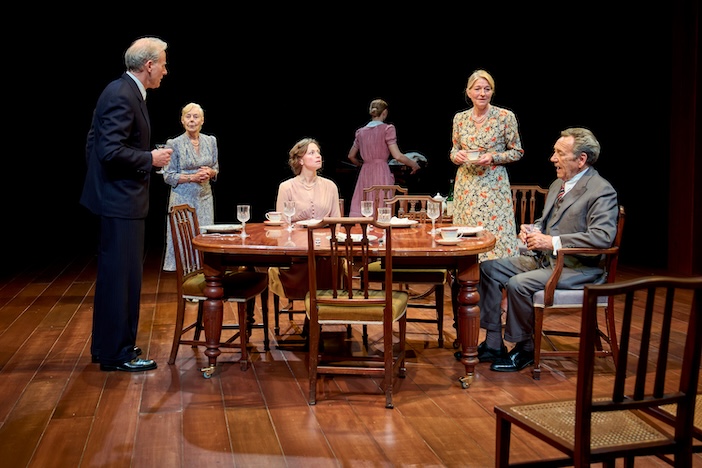
It’s testament to the writing, the performances, and the staging – played in the round, with an almost defiant minimalism, no elaborate set or backdrop, just the cast themselves shifting furniture between scenes – that Springwood delivers such an intimate, engaging comedy of manners. That it does so using two of the most consequential double-acts of the twentieth century, on the cusp of one of the greatest tragedies to engulf the world, only makes the achievement more striking. Having Nelson both write and direct clearly matters here: it’s his hand alone shaping how intimate this stays, resisting any pull towards the grander, more spectacular version of this story that another director might have preferred. Which rather proves the point; theatre doesn’t need to be big to be brilliant. Sometimes, a country house, six actors, and a stubborn argument about hot dogs is all it takes.
Springwood runs at Hampstead Theatre until 25 July. For more information, and for tickets, please visit www.hampsteadtheatre.com.