Rosalind Ormiston visits Bruges’ ambitious new fine arts museum — a landmark building that arrives bearing two extraordinary opening exhibitions…
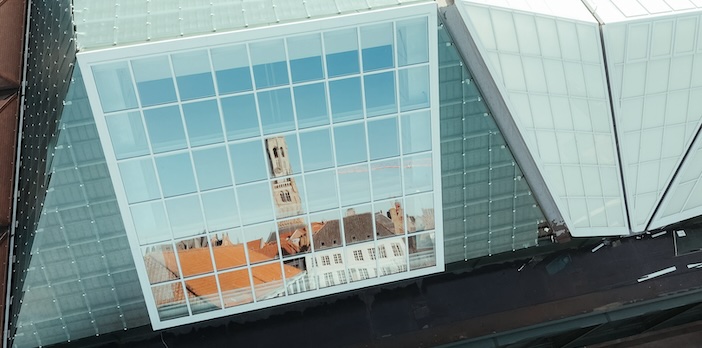
BRUSK is the brand new arts museum of Musea Brugge. Its name is an acronym: BRU for Bruges, and SK for Schone Kunsten, the Flemish for Fine Arts. The logic of the name matches the fluidity of the architecture, immediately evident in the transparent glass ground floor that softens the building’s boundaries. Situated at the heart of Bruges, BRUSK’s modernity is a confident addition to the city’s architectural heritage.
The eco-friendly building took seven years to realise — from design and planning through to construction and completion — by Belgian practices Robbrecht and Daem Architects and Olivier Salens Architects. The complex comprises BRUSK, the exhibitions building, and BRON, the adjacent research and art restoration centre. A landscaped park is in progress. The public opening was celebrated by near-everyone in Bruges on 8th May 2026, with two major exhibitions fully installed and ready to visit.
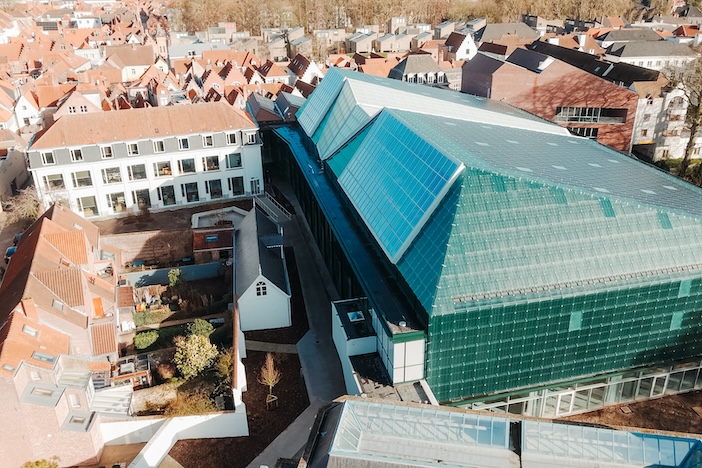
BRUSK sits at the heart of the museum quarter, with two entrances from pathways on different sides of the building. It is a two-minute walk from the much-visited Groeningemuseum; from the south-west, a winding path lined with plants guides visitors towards the museum’s urban square and its all-glass entrance. The ultra-modern building occupies the site of a former U-shaped school; when that moved to a new location some 300 metres away, plans for the art museum were laid.
Green spaces now surround BRUSK, and swans and ducks continue to inhabit a quiet canal running parallel to the building. Private houses and a retirement home are its neighbours — all residents, along with the wider Bruges community, having welcomed the contemporary design and its setting. By 2031, a museum park will complete the picture: a green meeting place connecting the city to BRUSK.
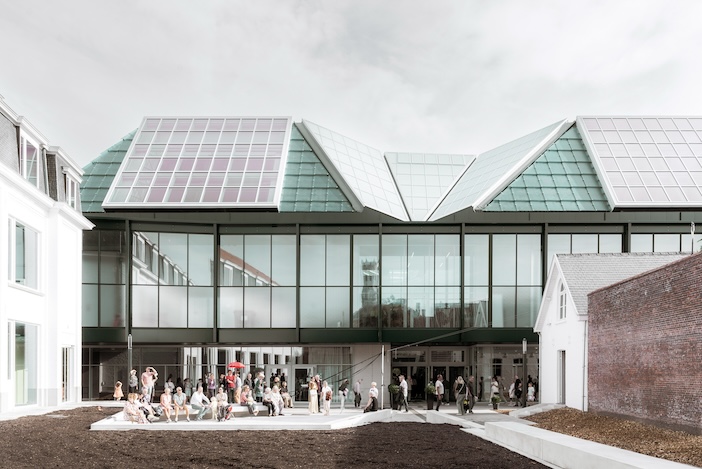
Inside, the entrance opens onto a wide walkway that runs directly from north to south through the building. In this light-filled space, the ticket office, cloakrooms, lockers, a schools area, café Bar Brusk and the museum shop are all immediately visible. It is an incredibly relaxing environment. The vast height of the interior draws the eye upward to a monumental 350m² four-part permanent fresco — The Whispering Walls Rêve (2026) — created for the central staircase by French-born artist Laure Prouvost (born 1978), a former Turner Prize winner (2013) now living in Belgium. The fresco can be admired from ground level or studied more closely as one ascends La Scala Grande — so named by the designers — the broad staircase leading to the upper level and two monumental exhibition halls. It is simply awesome.
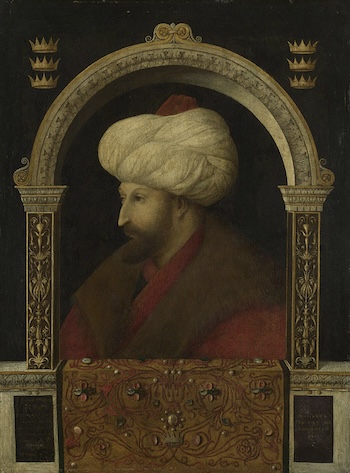
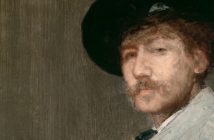
Gentile Bellini, Sultan Mehmet II, 1480 (London, The National Gallery)
The two opening exhibitions could hardly be more different in scope or sensibility. For the first, the City of Bruges and Musea Brugge have chosen a sweeping cultural history: Bigger Picture: Connected Worlds of Bruges 900–1550, curated by Professor Peter Frankopan of Oxford University and Jan Dumolyn, Professor of Medieval History at Ghent University. Together they have created a remarkable account of the city’s growth from the tenth century, when the Counts of Flanders and its merchant inhabitants built wealth through trade across Europe and with Constantinople, Jerusalem, and the Near and Far East.
At its zenith, Bruges appeared to be the epicentre of the world. International loans of key artefacts — rare maps, manuscripts and books, jewellery and armour — bring the city’s archaeology and art history vividly to life. Among the highlights are Hans Memling’s Passion of Christ from the Museo Torino and Bellini’s Portrait of Mehmet II from the National Gallery, London. The exhibition takes visitors on a chronological journey through Bruges’ origins and its rise as a global commercial hub — a story that peaked in the mid-sixteenth century, when the silting of tidal rivers vital to its North Sea trade routes led to a decline in maritime access. Trade and wealth shifted to Antwerp, leaving Bruges as the bejewelled time-capsule city it remains today.
The second exhibition transports visitors to the twenty-first century and the world of AI. Refik Anadol: Latent City is a large-scale installation by the acclaimed Turkish-American media artist Refik Anadol (born 1985), a pioneer of data visualisation whose work has been shown in over sixty cities across six continents. This is his Belgian premiere. Working from his Los Angeles studio (founded 2014), Anadol has trained AI models on more than five million images of global cities, creating algorithms that transform them into urban imaginations.
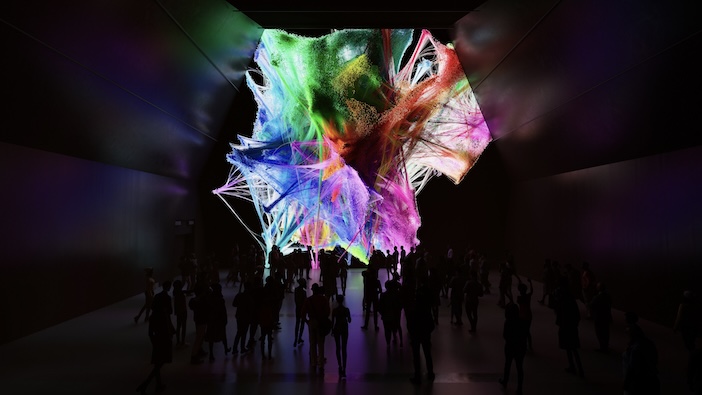
Refik Anadol. Latent City, Simulation in BRUSK, 2026, Refik Anadol Studio
For this work, images of Bruges — its streets, buildings, art and everyday rhythms — have been fed into that process. The result is a breathtaking sensory audio-visual installation: a hallucinatory sculptural form ten metres high, perfectly scaled to BRUSK’s cathedral-high ceilings and vast gallery space. It is astonishing. Anadol’s work poses a provocative question: if a machine can learn, can it dream? Visitors may find the answer here.
BRUSK, Dijver 12, 8000 Bruges, Belgium. General admission to BRUSK is free; a ticket is required for temporary exhibitions. Beyond the exhibitions, BRUSK’s programme encompasses concerts and lectures tied to the temporary shows, alongside workshops, introductory tours, debates, and a wide range of activities for children. For more information, please visit www.bruskbrugge.be.
EXHIBITIONS: Bigger Picture: Connected Worlds of Bruges 900-1550 and Refik Anadol: Latent City, both run until 8th November 2026.
Photos by Studio Woester (unless otherwise stated)