At Somerset House in London, a landmark show traces how a shy Dutch graphic artist, inspired by the tessellated tiles of the Alhambra, became the unlikely godfather of computer science — Rosalind Ormiston steps inside the illusion…
It is remarkable to think that the art of Dutch-born graphic artist Maurits Cornelis Escher — he liked to be called MC — is credited by many mathematicians with inspiring computer science. In the Embankment Galleries at Somerset House, London, a fantastic exploration of MC’s life and work includes around 150 artworks and interactive installations that will intrigue adults, teenagers and children alike, art lovers, mathematicians and computer scientists among them. Federico Giudiceandrea, curator of M.C. Escher: The Exhibition, maps out an extraordinary voyage into the mind of a genius of geometry and the fourth dimension.
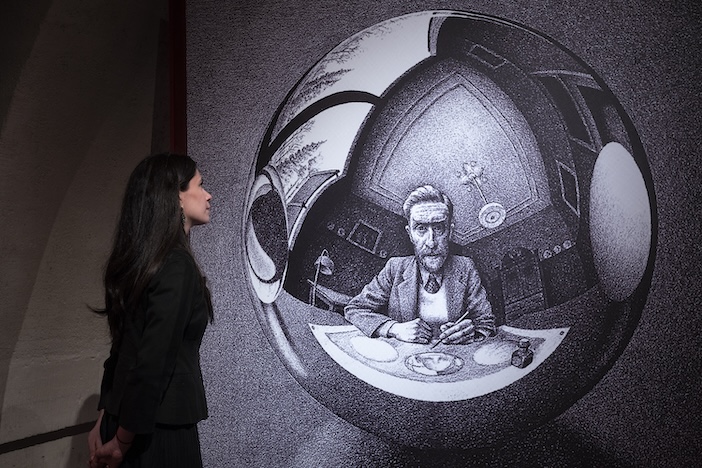
Installation view of ‘Three Spheres II’, 1946. (Photo by Stephen Chung for Fever / Arthemisia)
Born in Leeuwarden, Holland, into a family of civil engineers, physicists and mathematicians, MC was the youngest of four brothers. He greatly admired his family’s professional expertise: “My father and three of my brothers were all trained in the exact sciences of engineering,” he said, remarking on his own disinterest. In 1919, MC studied at Haarlem’s School of Architecture and Decorative Arts. There, under the mentorship of the Dutch graphic artist and printmaker Samuel Jesserun de Mesquita, he was taught woodcut techniques — the foundation of his career.
The complex geometry for which MC is best known stemmed from a visit in October 1922 to Granada, Spain, and the palatine city of Alhambra, famous for its Islamic architecture and art. There, MC was struck by the symmetrical tessellations and geometric decorative patterns. Illusion and geometric abstraction became the fundamental themes of his own work, challenging “what is seen and what is known”. In this exhibition, nothing is really as it seems.
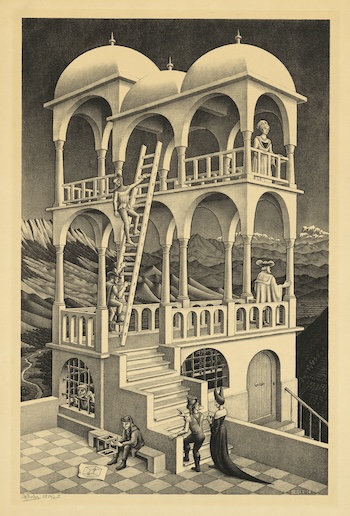 MC Escher fans — and there are millions of them — will have their favourite works: the woodcut Day and Night (1938); the unblinking, all-seeing Eye (1946); the bizarre architectural elements of Relativity (1963). In Belvedere (1958), the complexity is astonishing. The architecture looks genuine, yet the second floor is set at a 90-degree angle to the third, creating an impossible design. To sell the illusion, a seated man at ground level studies a geometric drawing while holding a Necker cube that proves the paradox.
MC admired the work of the Italian archaeologist, architect and artist Giovanni Piranesi, whose complex architectural drawings clearly informed his own. In his multifaceted geometric solids, he also looked to the Italian mathematician Luca de Pacioli, who published De divina proportione in 1509. That influence can be seen in Stars (1948) where MC illustrated three interconnected octahedra, transformed into a climbing frame for two chameleons.
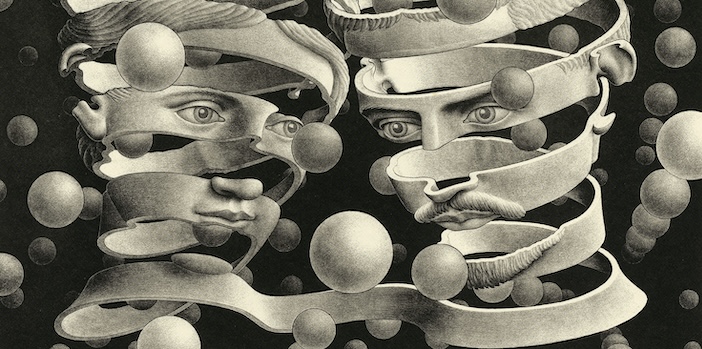
This is a chance to study MC’s work up close: the lithograph Reptiles, 1943, where lizards emerge from a two-dimensional tessellation to become three-dimensional, climbing onto a book on zoology and across a dodecahedron before returning to the tessellated paper. Don’t miss the female head Rind (1955), and the two heads of Bond of Union (1956), both inspired by H.G. Wells’s 1897 story The Invisible Man, in which a man rendered invisible by an undefined potion wraps his head in bandages in order to be seen. Here, MC peels the bandage ribbons away.
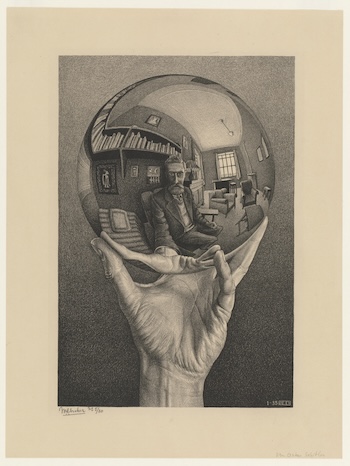 M.C. Escher: The Exhibition is a collaboration between the Italian company Arthemisia, recognised for major art experiences, and Fever, the culture-tech platform for live shows that reached over 300 million people across 40 countries worldwide last year. The virtual reality elements here are genuinely remarkable: step into one of Escher’s paintings in real time, standing in the street outside a gallery to look through the windows at his work; walk through rooms where the floor is an optical illusion; or position your phone’s camera to replicate one of Escher’s most famous works, Hand with Reflecting Sphere, from 1935, where a hand holds up a clear glass globe in which Escher sits in a room in his house in Rome, cupping that same globe in his outstretched hand. It is surreal — and thought to be a metaphor for Escher holding up himself and his work to the world. Like the rest of this exhibition, it’s not to be missed.
M.C. ESCHER: THE EXHIBITION is on now (until 6th September 2026) at Somerset House, Embankment Galleries, Strand, London WC2R 1LA. For more information, and for tickets, please visit the website.
Main image: detail from ‘Bond of Union’ (1956)