Rosalind Ormiston finds a jaw-dropping spectacular at the Hayward Gallery, as Anish Kapoor returns home in blood-red triumph for Ralph Rugoff’s swansong show…
In spring this year, the American curator Ralph Rugoff stepped down after twenty years as director of the Hayward Gallery on London’s Southbank — he will be a hard act to follow. His choice of shows has been consistently outstanding, always questioning what art can be. Anyone who has visited the Hayward over the last two decades will have a favourite: who can forget the white balloon in 2014’s Martin Creed: What’s the Point of It?, or all that sand in Mike Nelson’s Extinction Beckons exhibition in 2023, and Yoshitomo Nara last year, among many others.
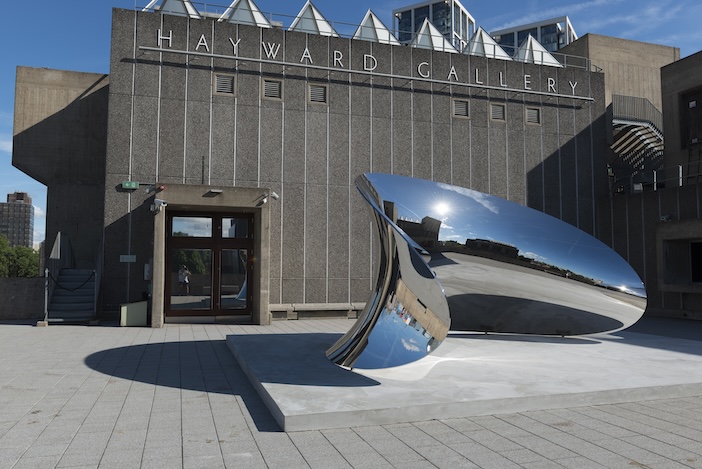
Installation view of Anish Kapoor, Tsunami (2025)
Now, in a fitting crown to Rugoff’s tenure, his friend Anish Kapoor, the British-Indian sculptor, returns to the Hayward twenty-eight years after his first show there — a homecoming that coincides with the Southbank Centre’s 75th anniversary. This time Kapoor has filled the gallery’s interior spaces and two exterior terraces with extraordinary installations and paintings.
Anyone who knows the Hayward knows its vacant, high-ceilinged Brutalist rooms are at their best when filled — with monumental sculpture, vast paintings and rich colour set against the concrete. Rugoff has always used the space to amaze visitors, and this show is no exception, delivering Kapoor’s visceral bloodbath of red. In counterpoint, a cool room is dedicated to the void, in works made using Vantablack, the blackest black, while the exterior installations gleam in shiny, reflective materials.
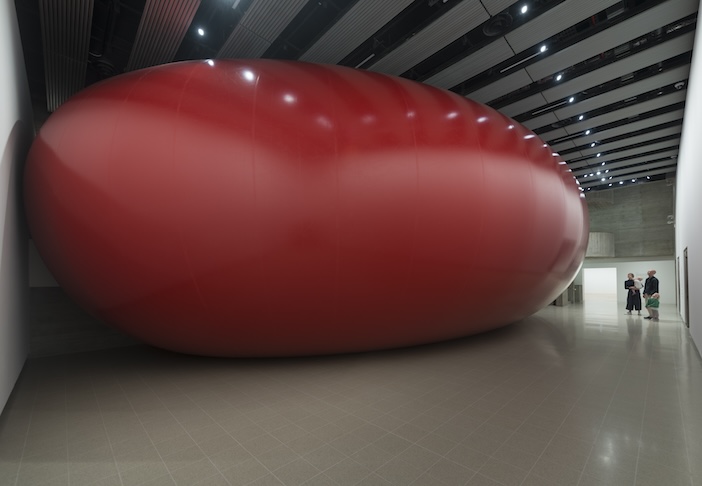
‘All of Nothing’ (2026)
Rugoff — his voice so quiet one has to listen carefully to catch his words — states that visitors can feel “ripples of violence echo through the show.” At least, I think that’s what he said. Certainly some works challenge perception simply by being unnerving and enthralling in the same breath. A vast floor-to-ceiling sculpture, All of Nothing (2026), opens the show at ground level: a scarlet, shiny inflatable that looks almost soft, impossible to walk around, wedged as if under pressure into the six-metre-high gallery.
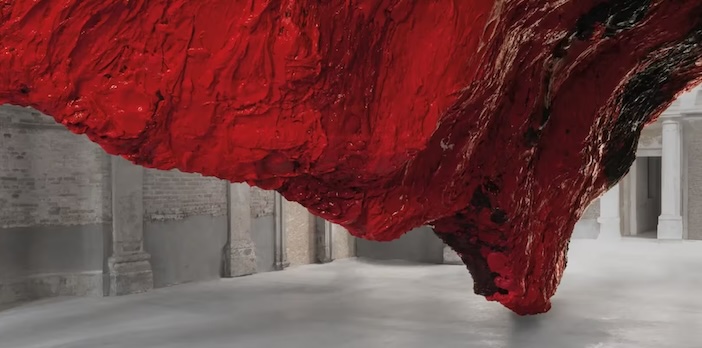
It’s a gigantic, blobby appetiser for the jagged, upside-down mountain that follows — Mount Moriah at the Gate of the Ghetto (2022), a suspended, blood-red mixed-media piece. The brilliance of colour against grey walls and apertures draws the eye to the space around the sculpture as much as the sculpture itself. Is this what Kapoor is exploring?
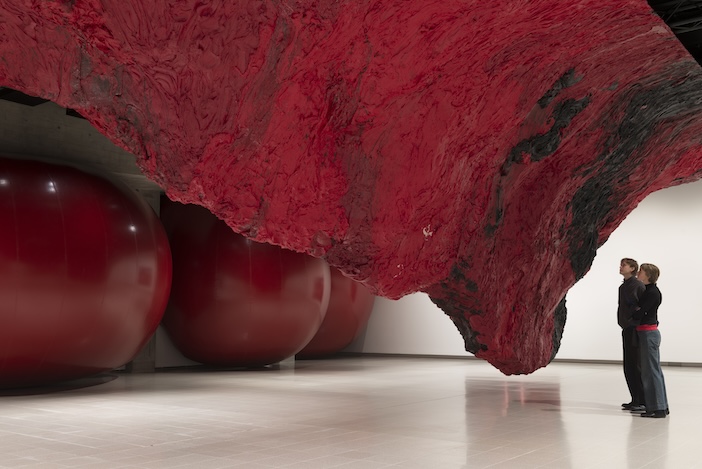
‘Mount Moriah at the Gate of the Ghetto’ (2022)
Kapoor is candid: just because a work is huge, he says, doesn’t make it good. What interests him is the void — the space around a body of work. The title of All of Nothing makes the point, an inflated balloon representing nothing in particular; it’s the viewer’s reaction that gives it meaning. That preoccupation with the void carries into the adjacent ground-floor gallery, focused on smaller works made in Vantablack.
One, resembling a painting, recalls Kazimir Malevich’s Black Square of 1915 — except here you can peer inside it. Other small installations, concave mirror works among them, invite interaction. And then there’s Descent into Limbo: does one descend into limbo via a circle of the blackest black? Is it a deep hole in the floor, or a trick of the eye? Surprisingly, it really is a deep, dark hole in the gallery floor.
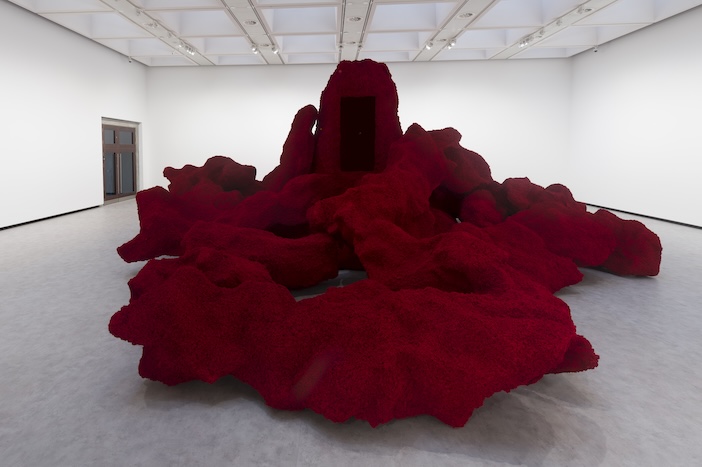
Installation view of ‘Ha Makom’ (2026)
Upstairs, the vast Ha Makom — Hebrew for “The Place” — is Kapoor’s latest work, built from thirty-one separate pieces; coating its rough, bobbled red surface required one of Kapoor’s assistants to don a hazmat suit to spray on fibres that cling to clothing if you stray too close. On the top floor, individual eruptions of “blood and guts” vaguely recall the stomach-churning moment in Alien (1976). Paintings here have to compete with the muscular presence of artificial offcuts, guts and membranes, seemingly discarded and trickling into a drain.
Kapoor is known for challenging sculptural convention — the effect perhaps not unlike Parisian critics’ reaction on first seeing Claude Monet’s Impression, Sunrise (1872). Like Monet’s, Kapoor’s work defies convention and tradition. Walking through, around and under his monumental pieces, or peering into dark voids, I was immersed in Kapoor’s inventive world, and amazed by his originality.
The show is a triumph — for Kapoor, and particularly for Ralph Rugoff and the Hayward Gallery. It’s a fitting final act for a director whose tenure has made the Hayward the place to see contemporary art in London, giving space to experiences that stay with you long after you leave.
Anish Kapoor at the Hayward Gallery runs until 18 Oct 2026. Southbank Centre, Belvedere Road, London SE1 8XX. For more information, and for tickets, please visit www.southbankcentre.co.uk.
Photos by Dave Morgan. Courtesy of the Hayward Gallery and the artist.
© Anish Kapoor. All rights reserved, DACS, 2026.