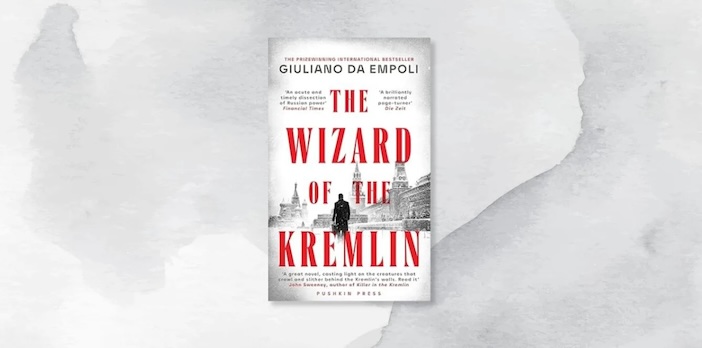
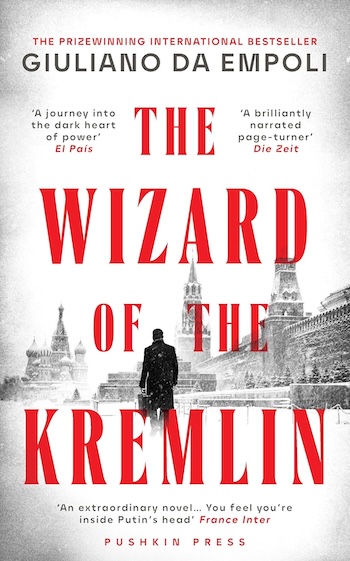
Sometimes a book almost seamlessly fits a moment in real time and flies off the shelves. The Wizard in the Kremlin written by Giuliano da Empoli, a Franco-Italian professor at the Institute of Political Studies (Sciences Po) in Paris, is such a book. It sold over half a million copies in France when first published in 2022 and has sold many more since being published in translation in almost thirty countries. It came close to winning the Prix Goncourt, was awarded the Grand Prix de Roman by the Academie Francaise and has now been turned into a film. Not bad for a first novel centred on the rise to power of Vladimir Putin and the role played by Vladislav Surkov, for many years Putin’s principal propagandist and ideologue.
 The conceit of the book is a meeting between Vadim Baranov, the retired Kremlin spin doctor (da Empoli’s version of Surkov), and a French journalist in Moscow researching the Russian writer Yevgeny Zamyatin. Their connection lies in a shared admiration for Zamyatin and his masterwork *We*. Their first contact occurs via an online forum devoted to the author, where Baranov identifies a kindred spirit and invites the journalist to his dacha in a forest outside Moscow.
Zamyatin’s appeal for Baranov lies in his courage in confronting Stalin—he is often regarded as the first Soviet dissident—and in his clear-eyed understanding of power, particularly how the suppression of dissent leads inexorably to repression. For da Empoli, through Baranov, it is precisely these realities of power that matter most. What unfolds during the evening at the dacha is essentially a long, reflective monologue in which Baranov recounts Putin’s rise, his own part in it, and his complex, sometimes distant relationship with the man at its centre. The result is a compelling narrative as Putin ascends the greasy pole and tightens his grip on power.
Da Empoli presents Putin as a man intent on restoring Russia after the humiliation of the Soviet collapse and the chaotic, free-for-all of the Yeltsin years. In this telling, he is a dedicated KGB officer driven by a desire for revenge against those—particularly the oligarchs—who profited from that period. The restoration of the Russian state’s authority and dignity becomes his overriding aim. This is pursued through the mobilisation of the siloviki, the security services, and the rebuilding of the armed forces. At the same time, the oligarchs are reminded that their wealth and autonomy now depend on loyalty to the new order. Power flows from the top down; loyalty outweighs competence; and those who misjudge Putin’s ruthlessness, like Boris Berezovsky, fall swiftly. The KGB, meanwhile, is reborn under a different name—the FSB.
Particularly striking is the way da Empoli shows Putin consolidating control step by step, with propaganda playing a central role. It is not enough to control the narrative; it must be created, even at great human cost. Hence the Moscow apartment bombings, attributed to Chechen terrorists but widely suspected of being orchestrated by the regime itself. Often described as Russia’s 9/11, they provided the pretext for Putin to emerge as a decisive leader — the guarantor of order and security, the father of the nation.
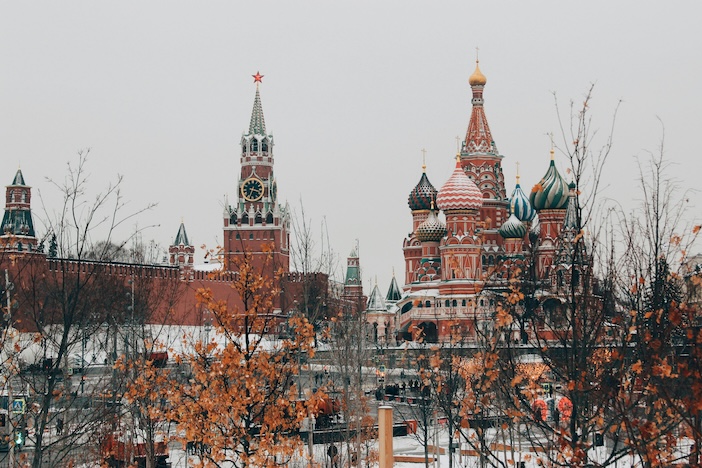
Photo by Michael Parulava (courtesy of Unsplash)
Some reviewers, particularly historians and Kremlin specialists, have criticised da Empoli’s portrayal of real figures and events, arguing that he reshapes them to fit his interpretation of Russian politics and power. Others have taken issue with his version of recent history. This is perhaps unsurprising: da Empoli is not a Russia specialist. Yet such criticisms need not detract from the book’s appeal. It is best read as an intelligent, thought-provoking piece of fiction whose atmosphere feels close enough to reality to be convincing. In this respect, it echoes themes found in works such as Peter Pomerantsev’s *Nothing is True and Everything is Possible* and Mikhail Shishkin’s *My Russia: War or Peace?*
There are moments of dark humour, including three classic Soviet-era jokes early on, which I will not spoil. They serve as a reminder that, despite the weight of authoritarian rule, Russians have long maintained a sardonic sense of humour. That said, *The Wizard of the Kremlin* is not a satirical black comedy in the vein of *The Death of Stalin*. Its tone is more measured and serious.
This seriousness carries a certain risk: the portrait da Empoli paints of Putin and his system is so persuasive that one can easily forget the book is a work of fiction. I found myself absorbed from the outset, drawn into its atmosphere and argument, and reluctant to put it down. Whether or not it offers a fully accurate account of Putin’s Russia, it remains an engaging and stimulating read.
The Wizard of the Kremlin by Giuliano da Empoli is out now, published by Pushkin Press. The film, starring Jude Law and Paul Dano, is released in selected cinemas tomorrow.