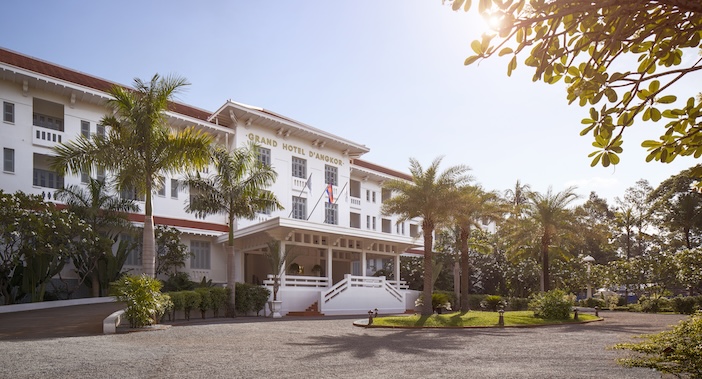
Opposite the Royal Independence Gardens in Siem Reap, Raffles Grand Hotel d’Angkor stands proud. Douglas Blyde discovers a building which endured neglect, erasure, and return, and learned how to work again without smoothing over what intervened…
At dusk, the Gardens begin to make themselves heard. A dry clicking gathers in the trees, spreading as fruit bats loosen from their holds. Wings brush leaves. Calls overlap, then thin, as the bats lift and move out across Siem Reap towards longan and tamarind beyond the town. The Gardens were laid out as civic ground, a signal that shared life could resume in public view. The bats were already here. They stayed.
From the edge of the park, it takes moments to cross the road into the hotel. Scooters stream past, then pause the instant a body steps forward. The building has stood here since 1932, positioned on the approach between Siem Reap and Angkor, aligned on a north–south axis which once linked gardens, palace, and temple. It was conceived for people who prevailed rather than passed through. Archaeologists working with the École Française d’Extrême-Orient lived here while surveying the temples. Administrators arrived on postings measured in years. Writers depended on repetition: the same desk, the same light, the same walk, day after day, to understand what lay around them. Early travel here required time, stamina, and attention. All three were assumed.
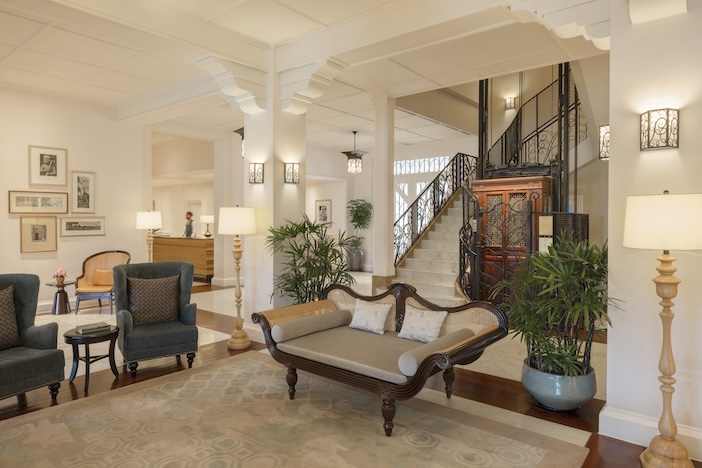
Its architect and planner, Ernest Hébrard, shaped the building for climate and duration. This was the same mind which laid out parts of Hanoi and Phnom Penh, working at the scale of cities as well as rooms, concerned with airflow, shade, and how bodies moved through heat over years rather than seasons. Long, low ranges sit close to the ground. Ceilings rise high enough for warmth to lift away. Shade functions because it is deliberate. The lawns are not for display; they create distance, air, and cooling space between the building and the road.
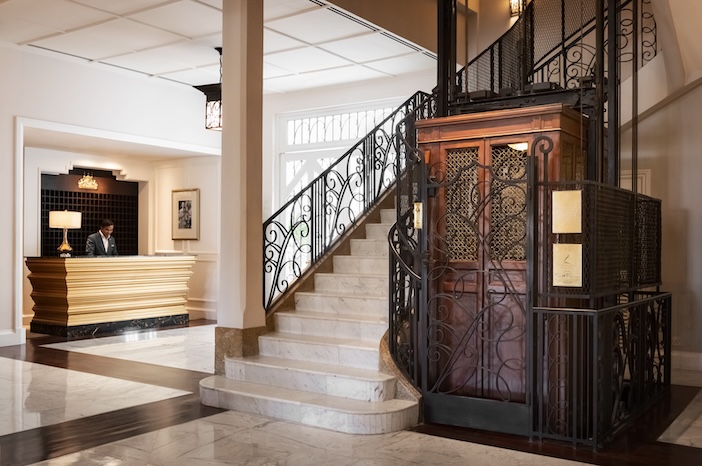
Inside, the wooden cage lift still moves at the pace for which it was designed. Floor by floor, steady and unchanged. It cannot be rushed. The building sets the tempo, and the visitor adjusts. In a country so often reduced to compressed itineraries, this insistence has consequence.
The twentieth century did not spare the hotel. It closed during the war years of the early 1970s. After 1975, tourism ceased entirely and Siem Reap was largely emptied. Hotels had no role in a country which rejected commerce and urban life. Furniture and fittings were removed. The building was left unused for long stretches, sometimes occupied in the most basic way, but no longer operating as hospitality. It was neither protected nor celebrated. It slipped beneath notice.
Angkor did not slip away. The temples retained symbolic force and remained standing, though not intact. Stone was prised loose, figures detached, fragments lifted and dispersed; metal was melted down, their later lives scattered through private hands and overseas collections. In places, trees closed in, taking carved walls back into themselves. Some pieces have since returned from Britain and the United States. Many have not. What stayed in place endured exposure rather than care.
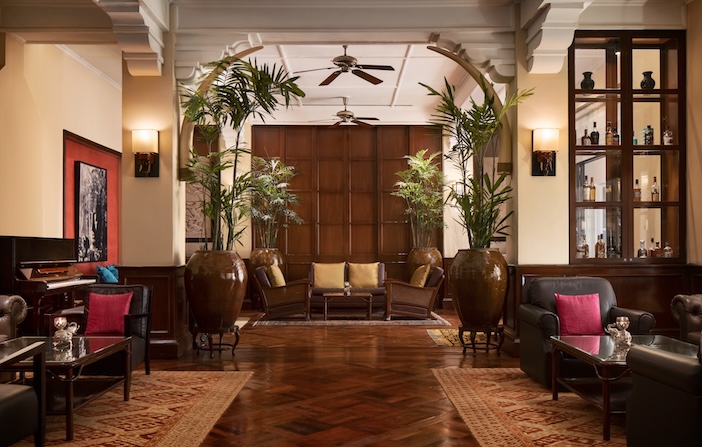
When Cambodia began reopening in the 1990s, what remained became the starting point. The hotel returned to use in 1997 under the Raffles name, and reopened again in 2022 after the long closure brought by the pandemic. Nothing essential was rewritten. It resumed its original task: receiving people, ordering days, allowing time to move forward rather than splinter.
The guest book records presence rather than display. Charlie Chaplin. Charles de Gaulle, whose name now runs along the boulevard outside. Jacqueline Kennedy, who came after her husband’s death. Cambodia has long drawn the world’s gaze. What it lacked was steadiness. The names remain, and then recede.
What holds visitors now is simpler and heavier. The building stands. It works. In a country which has had to begin again more than once, that fact carries weight.
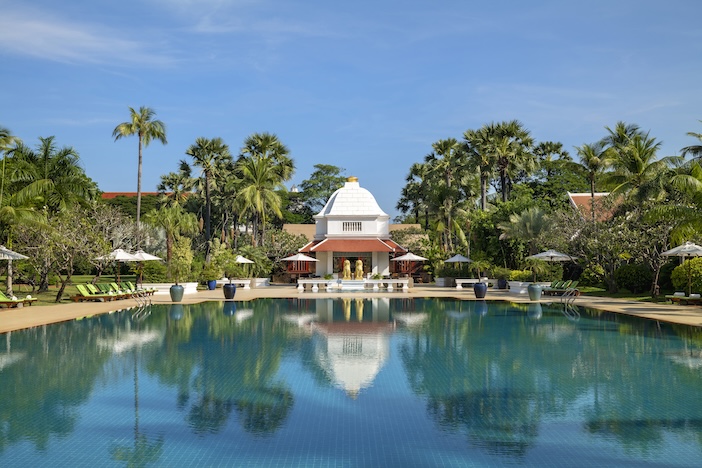
You feel it underfoot. The lawns hold their colour through the dry months. The swimming pool stretches long enough for proper laps rather than drifting, a length which returns the body to itself after days among heat, laterite, and stone. Guests either swim it seriously or leave it alone.
You feel it as evening settles. Bread carries pandan and palm sugar. Foie gras meets mango in a shell which breaks cleanly. Veal arrives rare with kroeung and Khmer pickles. Lamb comes pink. Then local chicken, firm-boned, with green tamarind, banana flower, and brown rice grown nearby. A Cos d’Estournel bottled for the house is poured by the glass. It sits easily in its surroundings.
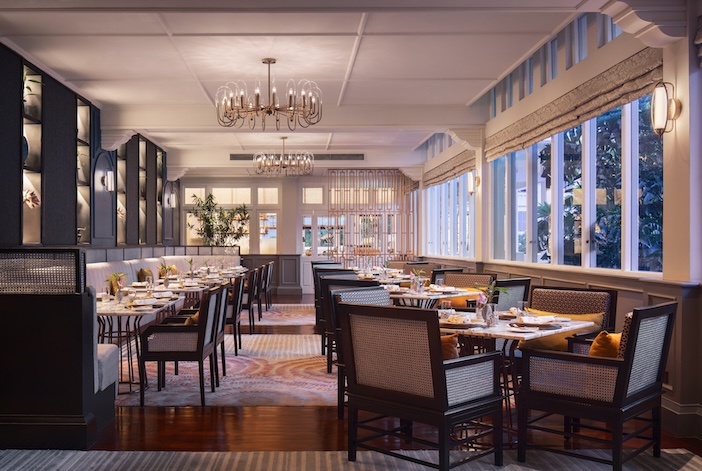
The people matter because they do not impose. Mehdi Oussedik, formerly a wine supplier, now oversees food and drink with the judgement of someone who understands when to intervene and when to step back. Joseph Colina, as general manager, keeps the hotel legible. David Eldridge cooks with care, letting Khmer seasoning speak. Raaol plays the piano in a way which carries the room without overtaking it. Cambodians do not signal effort. They apply it. Courtesy here is exact, shaped by history, and never squandered.
You also notice who is missing. Older Cambodians are few. This is arithmetic rather than feeling. Whole generations were taken. Skills, habits, and knowledge had to be rebuilt by those never meant to inherit them. That absence sits quietly in places like this, even when nobody names it.
Angkor explains why continuity matters. The apsaras carved across the temples are instruction rather than embellishment. Fingers placed deliberately. Wrists angled. Eyes trained. The dance survives because it is taught, corrected, and repeated. What lasts here does so through practice.
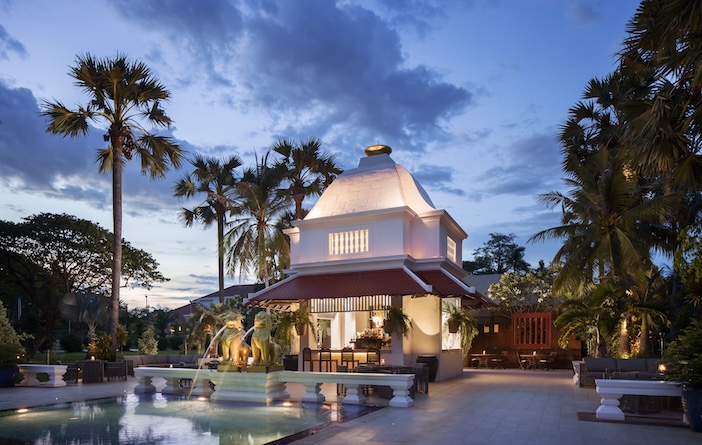
The hotel works in the same way. Corridors, shade, the lift which keeps its pace, the pool which insists on length, the manner of receiving a guest. None of this happens once. It happens again tomorrow. Cambodia’s future will arrive unevenly. Siem Reap will grow. Pressure will increase. Water and heat will decide more than slogans. The danger lies in flattening, in turning a country shaped by loss and learning into a surface.
This is why Raffles Grand Hotel d’Angkor matters. It keeps its form. It shows how care can be learned and sustained. It trusts repetition. It refuses haste. At dusk, the bats lift again from the Gardens, chattering as they go. The lawns hold. The lift keeps its pace. Absence remains. And still the country continues with what survived, keeping it in use, guarding it through daily work.
Seconds from the Gardens, on the road to Angkor, that work goes on, whether anyone is watching or not.
Raffles Grand Hotel d’Angkor – Vithei Charles de Gaulle, Krong Siem Reap, Cambodia. For more information, please visit www.raffles.com.