Expecting a mini Dubai of glass towers and gated luxury, Anwer Bati discovers a small Gulf kingdom with deep roots, street life, and a history that refuses to be buried…
I’m not much of an expert on the Gulf, so I expect Bahrain to be rather like Dubai: all glitz, high rises and expats enjoying the high life, with little in the way of ‘real’ life or history. What I do know is that it’s a small kingdom formed of islands between Saudi Arabia and Qatar, with a capital called Manama — and that’s where I’m heading.
I check in at the Ritz-Carlton, one of Bahrain’s most famous hotels and something of a local institution. It has everything: a dozen good restaurants (Indian, Thai and Italian among them), four pools, a luxurious spa, sandy beaches, tennis and squash courts — even its own private island. The site is enormous, spanning 70 acres, with golf buggies laid on for those who don’t fancy walking. Its 260 rooms are being revamped — though even the older ones are smart — and I note, slightly regretfully, that many of the new rooms lack bathtubs; essential, I feel, after a day out in the sweltering heat. The overall impression is that you never need to leave, and I’m told that many guests don’t, especially on short visits.
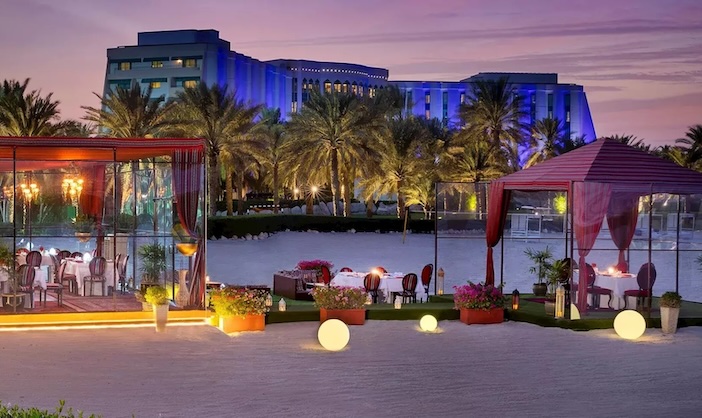
My first evening only reinforces that sense. Dinner is at Cantina Kahlo, the hotel’s Mexican restaurant, where the atmosphere is jolly thanks to cheerful staff and a couple of groups of American women in full party mode — almost certainly connected to the vast US naval base in Manama, home of the Fifth Fleet. There’s also a smaller British base here, incidentally. You can see the appeal: Bahrain is secure, familiar, and easy to settle into.
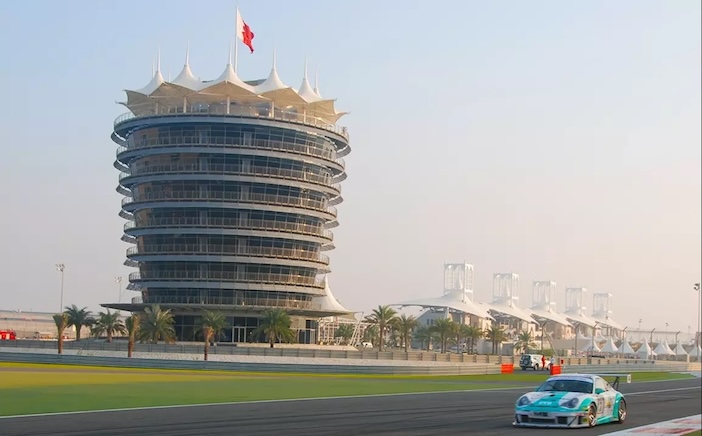
The following morning, though, I begin to glimpse something else entirely. I set off with my guide, Hussain — an erudite presence who teaches tourism at the university — to the Bahrain International Circuit. Opened 20 years ago, it seats 60,000 people and is a major draw when the Formula One Grand Prix comes to town each April. Even outside race season, fans arrive year-round, picking up souvenirs and soaking up the atmosphere. It’s impressive, immaculately run, and undeniably modern — but it’s only the first layer.
A short drive away, at the RAK Art Foundation, Bahrain’s past and present collide more subtly. Housed in the former home of Rashid Al Khalifa — a respected artist and member of the royal family — the 1920s white villa retains original gypsum walls and is arranged around a peaceful courtyard. Alongside Al Khalifa’s own modern works are pieces by Kandinsky, Yves Klein, Frank Stella and Bridget Riley. It’s an unexpectedly intimate, thoughtful space, far removed from the bombast I’d half-expected.
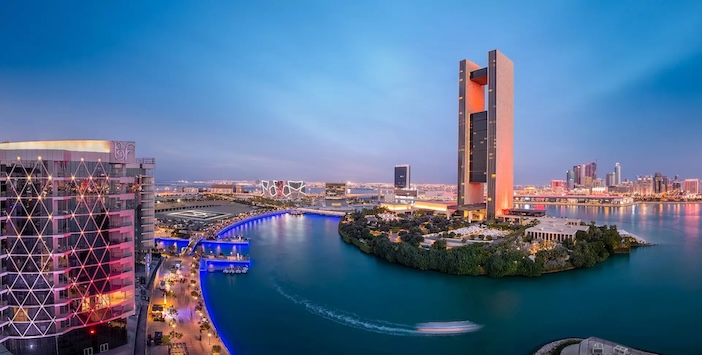
That sense of contrast deepens as we move through Bahrain Bay, a hyper-modern district built on reclaimed land. Here, the vast Avenues mall offers a dose of Dubai-style glamour, crowned by the extraordinary, shimmering Four Seasons hotel, which occupies its own island and private beach. I board a local ferry for a short trip across the water — not just a tourist novelty, Hussain tells me, but a practical way to get around. Bahrain, it turns out, is constantly remaking itself: there are now 33 artificial islands alongside 50 natural ones, and reclamation seems perpetual.
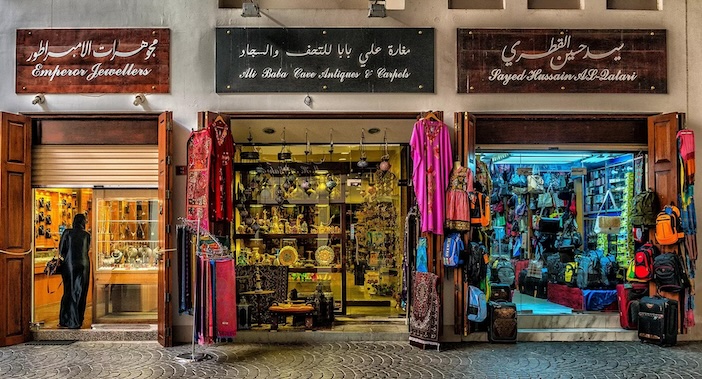
The contrast between the Bay district and Manama’s souq couldn’t be greater. We enter through the imposing Bab-al-Bahrain (Gate of Bahrain), built by the British, and once a government building. It’s the kind of place you won’t see in Dubai: a warren of old streets full of shops, selling gold, clothes, rugs and spices, as well as restaurants serving Indian or local cuisine. It’s a cosmopolitan spot, packed with shoppers and tourists on the hunt for bargains, real or illusory. And, as Hussain is keen to point out, an area of religious tolerance, as we walk by mosques (both Sunni and Shia), churches, a Hindu temple and even a synagogue – all within a few yards of each other.
This precedes dinner, where I’m recommended the cheerful Biba, serving Middle Eastern and Bahraini specialities (much influenced by proximity to Iran and India), including spicy Bahraini kebabs. It’s a favourite with shisha smokers, including Hussain. A number of the younger Bahraini women diners are wearing western clothes; all perfectly normal, he assures me.
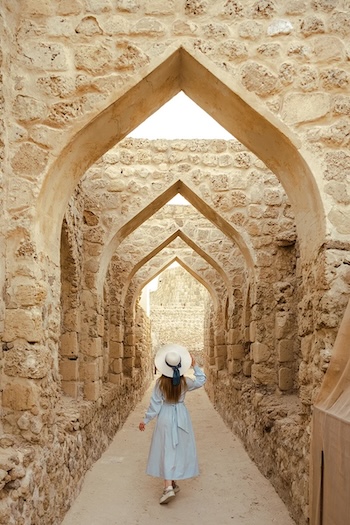 The next morning takes us deeper into Bahrain’s long history. Just ten minutes from the city centre stands Bahrain Fort, a UNESCO World Heritage site in a commanding position by the sea. Built largely by the Portuguese in the 16th century, it was only in the 1950s that excavations revealed far older layers beneath, tracing the site back some 4,000 years to the ancient Dilmun civilisation.
Nearby, a smart, airy museum displays artefacts from those digs with admirable clarity. Lunch follows at the Green Bar (not a bar, despite the name), where the terrace looks out over turquoise water and the fort’s weathered walls. Here, Hussain explains that Bahrain’s name — “two seas” — refers to the freshwater springs that bubble up offshore, popular with fishermen and swimmers alike.
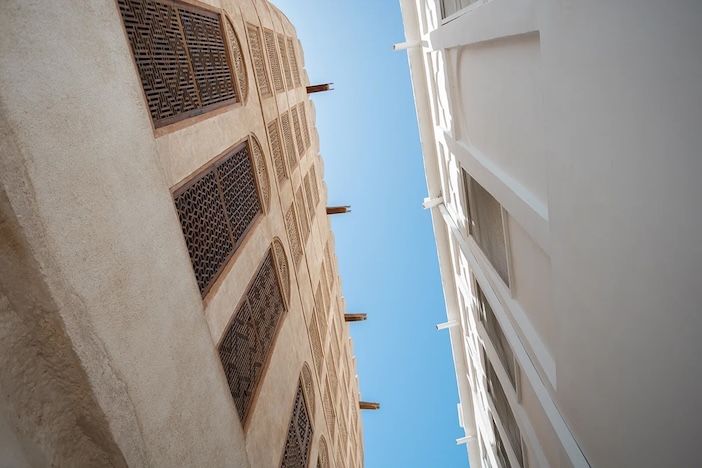
Before oil arrived in the 1970s, pearls were Bahrain’s main source of wealth, and that heritage is celebrated by the Pearling Path on Muharraq island, near the airport. The two-mile route winds through the old capital, passing 19th-century houses marked by pearl-shaped lamps. Built of coral stone and local clay, they once belonged to wealthy merchants and impoverished pearl divers alike. Each now serves as a small museum, examining different aspects of the trade. The walk ends at a former merchant’s house displaying exquisite pearl jewellery — and the revelation that Jacques Cartier visited Bahrain in 1912 in search of the finest pearls available. Several Cartier pieces are on display, elegant proof of Bahrain’s global reach long before oil.
By my final day, I’ve begun to understand that touring Bahrain is a slightly athletic pursuit. Even with Hussain’s tireless energy and impeccable timing, there’s still a sense that much remains unseen — another museum, another development, another layer of history just out of reach. We press on nonetheless.
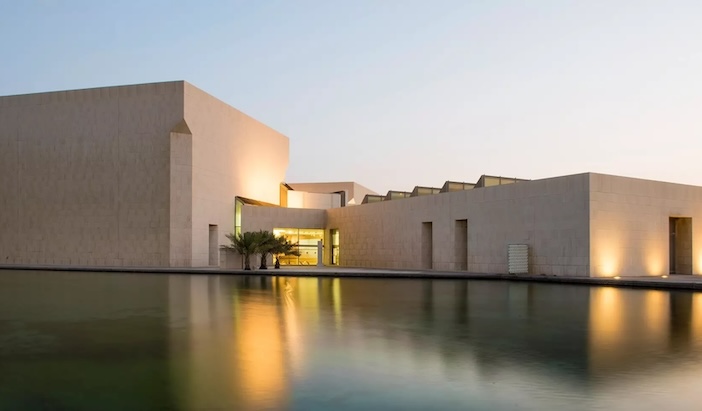
The morning is a brisk tour through modern Bahrain’s greatest hits. The gleaming, Danish-designed National Museum sits right on the waterfront, lucidly laying out the country’s story and reminding you how very different life was before oil arrived. Next door, the striking National Theatre — a 1,000-seat statement of cultural ambition — hosts opera and ballet as confidently as it does local productions. A short drive brings us to the Al-Fateh Mosque, the country’s largest: imposing but agreeably restrained, and a reminder that Bahrain’s confidence doesn’t tend to shout.
Lunch comes at the Time Out Market, where I have a surprisingly good and very reasonably priced Chinese meal, eaten on a stool among an array of other cuisines. It’s modern, efficient, global — entirely of the present. Back in the old town, we pass the plantation-style British Embassy, its generous garden once overlooking the sea, now stranded inland by decades of land reclamation.
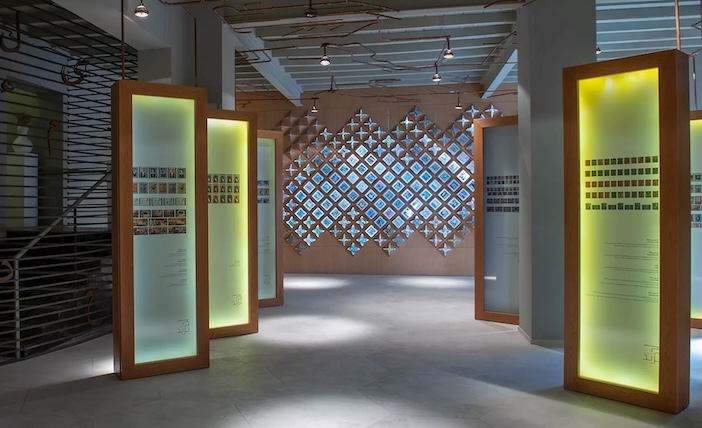
Nearby, the quirky Post Museum — housed in a former working office opposite Bab al-Bahrain — offers a quieter pleasure. Among old sorting equipment and some 4,000 stamps sits a Penny Black, alongside Bahrain’s own early issues: British monarchs overprinted with “Bahrain” and prices in Indian currency, a small but poignant reminder of the kingdom’s place in the Raj and its long trading relationship with the subcontinent.
And then, finally, the pace slows. We drive south, away from the city, until the landscape opens into a vast field scattered with thousands of low, rounded humps: the Dilmun burial mounds. Now protected by UNESCO, they stretch into the distance, some dating back more than 4,000 years. There are no cafés here, no information screens or ticket booths — just earth, sky and silence.
My suspicions about Bahrain were quite wrong. Yes, there are luxury hotels, immaculate beaches and flashes of conspicuous wealth. But this is not Dubai. The pace is different, the tone softer. There are expats, certainly, but many more locals, and a sense of street life that feels lived-in rather than staged. Most striking of all is how visible the past remains — not sealed off in museums alone, but threaded through daily life, from souks and stamps to burial mounds under open sky. Between its two seas, Bahrain has an identity that feels grounded, confident, and entirely its own.
For more information about Bahrain, and to start planning your trip, please visit the official tourism website at www.bahrain.com.
Photos courtesy of bahrain.com