With just eight rooms, a fiercely discreet clientele and an uncompromising architectural vision, Villa Nai has quietly become one of Europe’s most coveted hideaways. Larry sneaks away to this boutique retreat set within centuries-old olive groves on Croatia’s Adriatic coast…
There’s a reason Villa Nai is coveted by the glitterati. It isn’t flashy. It doesn’t announce itself. And unless you’re making use of the helipad (which many of its guests do), getting here requires a degree of commitment that instantly filters the field.
The route goes like this: fly into Split, drive 90 minutes north along the coast to Zadar – itself worth a wander through the old town while you wait for the ferry – then take the catamaran across to Dugi Otok, Croatia’s ‘long island’, for the final drive to your destination. And it’s all part of the prelude. Villa Nai is prized for its seclusion – and the effort required to reach it is more than repaid.
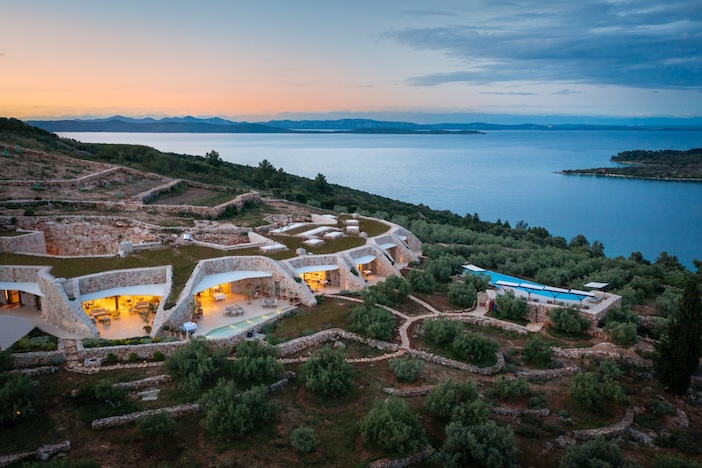
Set within an olive grove that has been in the same family for over 500 years, and surrounded by Aleppo pine and oak forests within three national parks, the hotel’s ethos is neatly summed up in its mantra: ‘Born in nature, made in nature’. That isn’t branding fluff, it’s a guiding principle.
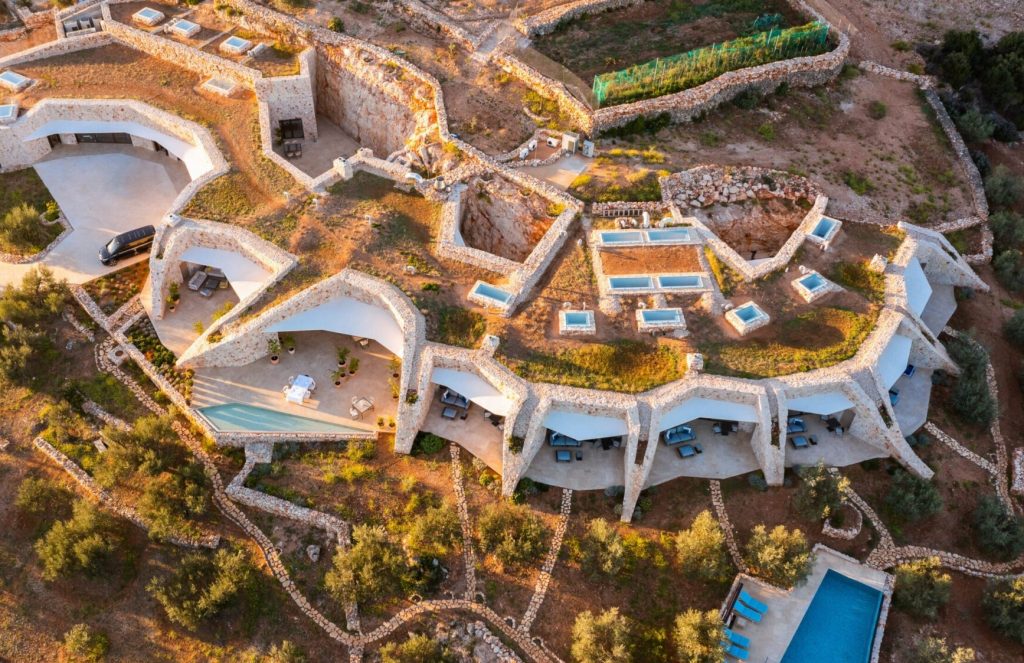
Built directly into a hilltop, the hotel takes its cues from the dry‑stone walls that terrace the surrounding olive groves. All excavated stone was reused in the construction, meaning the building feels less imposed on the landscape than revealed from it. Rough‑hewn stone walls mirror the rock face behind the Grotto restaurant; modern lines sit comfortably alongside ancient techniques. Villa Nai is the result of a close collaboration between the owner, an engineer by trade, and the architect Nicolai Bašić – the award‑winning mind behind Zadar’s Sea Organ – and you get the sense this was very much a passion project. It’s an architectural playground, albeit one with extraordinary restraint.
Opened in 2021, the property has just eight rooms – five deluxe rooms and three suites – making it one of the smallest hotels in the world. There’s a bar-cum-lounge-cum-dining space (and the aforementioned Grotto), a very compact spa, outdoor infinity pool, and a cigar lounge. That’s it. By conventional luxury‑hotel standards the offering is modest, but this is not a place for distractions. You come here to disappear. The privacy is total, even without a full buy‑out.
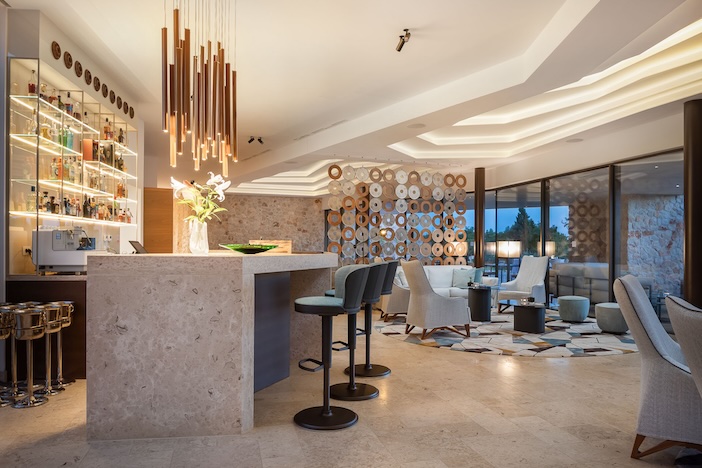
Inside, the aesthetic is impeccable. I spent an inordinate amount of time admiring (and sitting in, in multiple poses) a Giorgetti armchair that I would love to have at home, if not for the €4,000 price tag. Yet nothing feels ostentatious. Everything is chosen to recede, not compete, with the landscape outside. The lounge, in particular, has a sense of mise‑en‑scène that only really reveals itself on closer inspection.
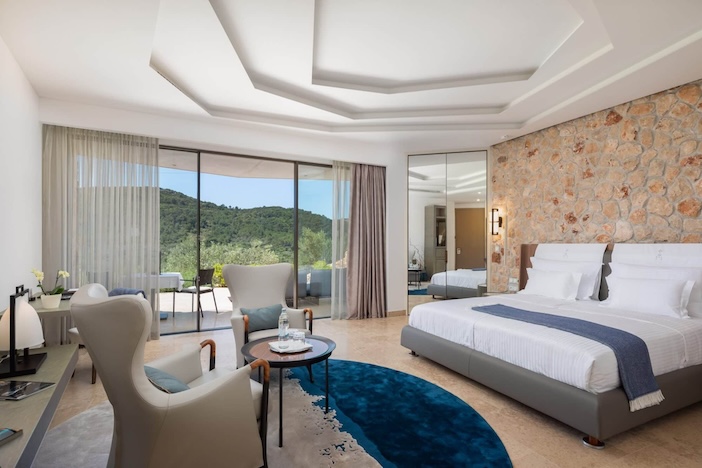
Despite the hotel’s elemental feel, my room is one of the most technologically advanced rooms I’ve stayed in – and that includes the Dolder Grand in Zurich. Lighting is exquisitely thought through: stitched‑leather pendant lamps by the bed, low‑level night lights activated bedside, discreet touchpads for room settings. I was so convinced everything was automated that I spent an hour trying to work out how to open the curtains, before the front desk politely came in and drew them by hand.
Olive oil, unsurprisingly, is at the heart of Villa Nai. The estate produces its own – and not just any oil. Nai oils have won more than 22 international awards in the past year alone. Nai itself means snow, while the celebrated ‘3.3’ in the hotel’s official name speaks to the minimum 3.3 days of snow required annually to produce it. Precision, again.
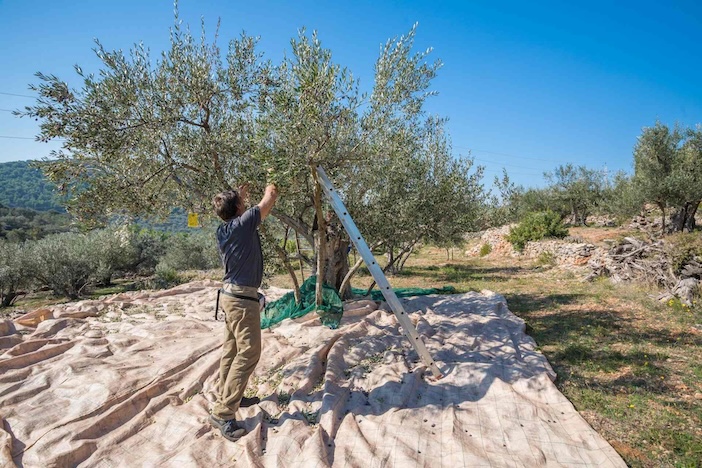
The hotel houses a state‑of‑the‑art olive mill next to the concierge – a sentence I never expected to write – using a centrifuge rather than a traditional press. Olives are harvested and selected by hand, never shaken from the trees. It’s about respecting the process, then applying technology to extract the best possible result. In October, guests can even take part in the harvest, tapping neatly into the current appetite for experiential travel.
Needless to say, that oil becomes ubiquitous; guests are welcomed with an olive‑oil ‘tea’, it appears in the hotel’s house martini, butter is made with it, and, of course, it runs through the kitchen. And nothing goes to waste; the olive pâté even finds its way into spa treatments.
Harvest-time aside, visiting in shoulder season has other advantages. You get the weather – I’d packed badly – but you also get space. The harbour at Sali could be mistaken for the 1950s: fishing boats, a few modest private yachts, and none of the vulgar gin palaces you’ll find elsewhere on the Med. And when you head out to the Kornati islands, your photographs won’t be crowded with the armada of boats that arrives in high summer.
Villa Nai excels at arranging bespoke excursions, often at very short notice. A fishing trip, for example, decided on a whim when I asked, was no problem – and what could be better than catching your own supper, destined for the Grotto’s peka grill with a generous slick of the world’s best olive oil?
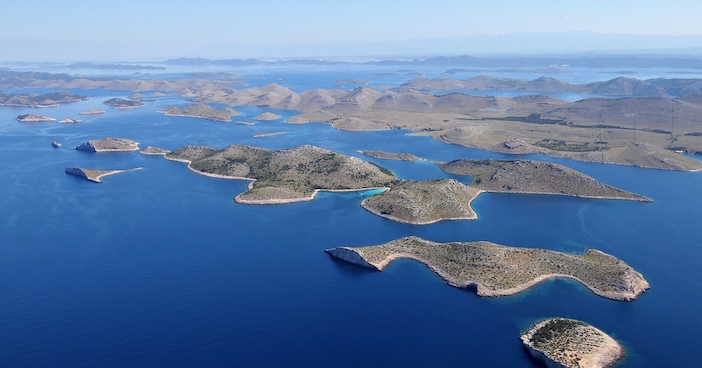
Thus, it proved more than a simple line‑fishing excursion. The hotel’s relative remoteness places it closer than anywhere else to the Kornati archipelago, widely considered the most beautiful stretch of the Dalmatian coast. Designated a national park, the islands are stark, elemental, and entirely undeveloped – ninety‑nine per cent of the land is protected. Kornati translates as ‘crowns’, a nod to the shapes of the islands’ hilltops – a name that makes perfect sense when you see them – this isn’t channel-hopping so much as skimming a flooded mountain range, weaving through what feel like submerged valleys and peaks.
Our captain, Tomic, set lines as we went. Each of us landed a handsome albacore, which was iced and stowed for the return journey. We dropped anchor in the sheltered Lojena Cove, picnicked between two yachts, and swam among our catch’s cousins in water as clear as glass.
There’s plenty to explore on land, too. Driving through the interior of Dugi Otok takes you past terraced olive groves, pine and holm oak forests, and into Telašćica Nature Park. The deep inlet of Telašćica Bay shelters a saltwater lake, Mir – Lake Peace – whose name feels entirely appropriate. A highlight is the viewpoint at the old Austro‑Hungarian Grpašćak fortress, with a small but beautifully presented visitor centre. Its exhibition, Between the Two Blues, explains how the islands were formed after sea levels rose following the last ice age – that flooded mountain range, then – and neatly contextualises the geography and history of this remarkable stretch of the Adriatic.
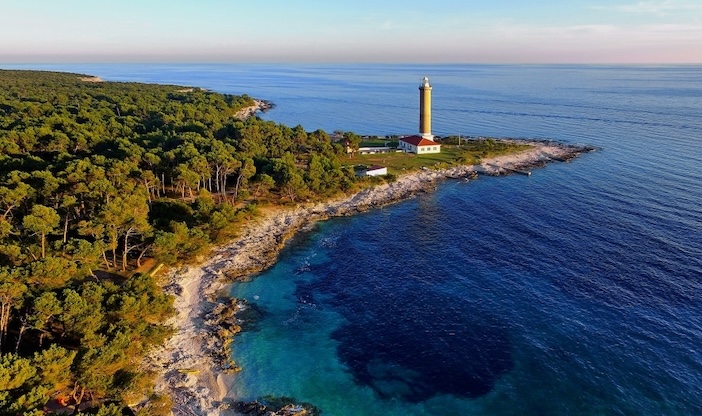
At the northern end of the island, a road runs along the spine of Dugi Otok, at times with sea visible on both sides. Traffic is so sparse you can count passing cars on one hand. Small villages cling to hillsides; unspoilt bays appear without warning. Eventually, you reach the Velirat lighthouse, built in 1849 and among the oldest in Croatia. With permission from the keeper, you can climb the 163 steps to the top for sweeping views across the peninsula – and a bracing reminder of how far removed this part of Europe feels from the modern rat race.
Back at the hotel, dinner provides a satisfying counterpoint to the day’s elemental pleasures. This is not rustic cooking alone. The fine‑dining restaurant is overseen by Michelin‑starred chef Santosh Yadav, hailing from high-end properties from the Maldives to the Middle East, whose tasting menu leans heavily into farm‑to‑fork principles without ever becoming worthy.
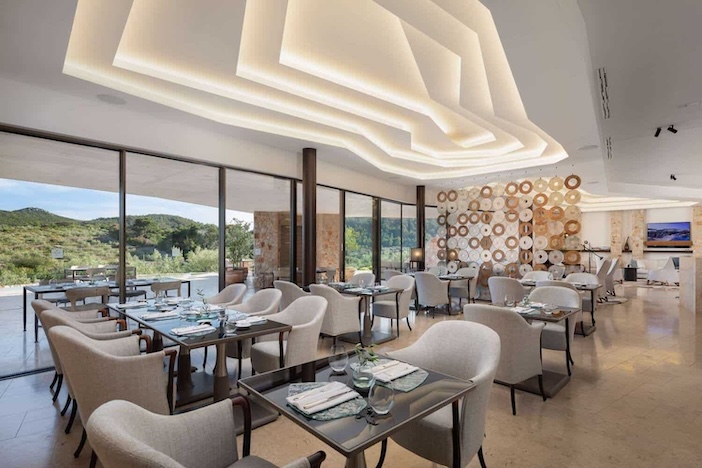
I dined with Simon, the hotel’s ebullient general manager, a Slovenian who speaks nine languages and is a formidable film buff – “particularly movies before 1975, Toby”. Over courses of salmorejo with olive oil ice cream and a deconstructed Dalmatian brudet fish stew, we debated Rex Harrison’s superiority over Richard Burton in Cleopatra, his love of The Longest Day, and his encyclopaedic command of Yes, Minister – even correcting my delivery of Jim Hacker’s newspaper monologue.
That rendition, as surreal at it seemed that a Communist era-raised eastern European might know British cultural staples better than a Brit, felt like the perfect expression of Villa Nai’s appeal: intellectually curious, quietly confident, deeply civilised. At the inaugural Michelin Key awards last October, Villa Nai was the only hotel in Europe nominated in the new Architecture and Design category, and took home a much coveted three Michelin Keys.
You don’t need me to sing its praises – that, dear reader, speaks for itself. Hard to reach it might be, but Villa Nai is impossible to forget.
Villa Nai is open from 1st April 2026, and prices start at €650 per night, including breakfast and taxes. For more information, including details of experiences, such as participating in the olive harvest, please visit www.villanai.com. Villa Nai is a member of the Leading Hotels of the World.