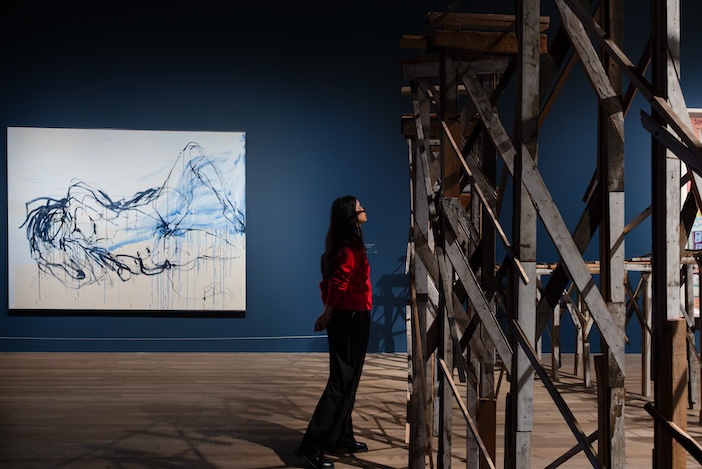
In what may fast become the must-see exhibition of the year, Rosalind Ormiston explores the new retrospective on Tracey Emin — an unflinching, deeply personal retrospective of one of Britain’s most provocative and powerful artists…
At Tate Modern, London, Tracey Emin: A Second Life unfolds as an intimate, at times searingly raw, autobiography. This is not simply an exhibition but an encounter — a deeply personal journey through the artist’s inner world. Emin’s self-expression plays out in works that provide a fragment of a life lived intensely and laid bare, in paintings, sculptures, films, drawings, photographs, neon lights and collages — even a death mask.
Dame Tracey Emin DBE RA first came to prominence as a member of the YBAs — the Young British Artists — collectively shown in Charles Saatchi’s now infamous Sensation exhibition in 1997 at the Royal Academy, London. Alongside Sarah Lucas, Damien Hirst, Matt Collishaw and Gavin Turk, she helped drive a generational shift, as modern art made space for a bold, unapologetic new voice. Emin was there at the beginning, and she has never retreated.
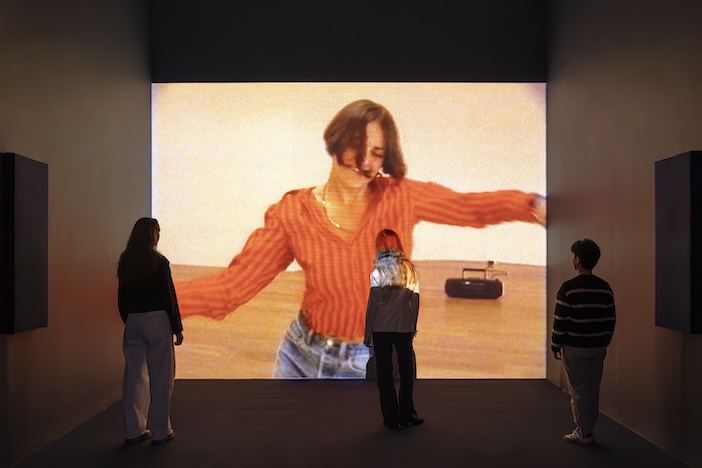
Installation view of ‘Why I Never Became a Dancer’ (1995). Photo © Tate Yili Liu
Curated by Maria Balshaw, the Tate exhibition reaches back to Emin’s early years in Margate and London. Her talent was evident from the start: accepted at Medway College of Design to study fashion, in 1989 she gained an MA from the Royal College of Art. These foundations underpin her present achievements. Her first solo show, My Major Retrospective, held at White Cube when she was just twenty, signalled striking ambition. In the exhibition’s introduction, her CV and passport are displayed — physical documents anchoring identity, proof of who she was and who she would become. A vibrant clip of Why I Never Became a Dancer captures the energy of her 1990s life. Throughout the galleries, biography and art are inseparable; each illuminates the other.
The title My Major Retrospective feels prophetic: a London-born girl growing up in Margate with her twin brother and single mother, who had to “work, work, work” to support the family, declaring her intent. Life was precarious, sometimes chaotic — as reflected in Mad Tracey from Margate: Everybody’s Been There. Moving through the exhibition, key life events surface again and again. Emin speaks with disarming openness about being raped at thirteen and about her relationships — from the now-destroyed Everyone I Have Ever Slept With tent, shown in Sensation, to My Bed, her Turner Prize nomination entry, which remains one of the most discussed works of its generation.
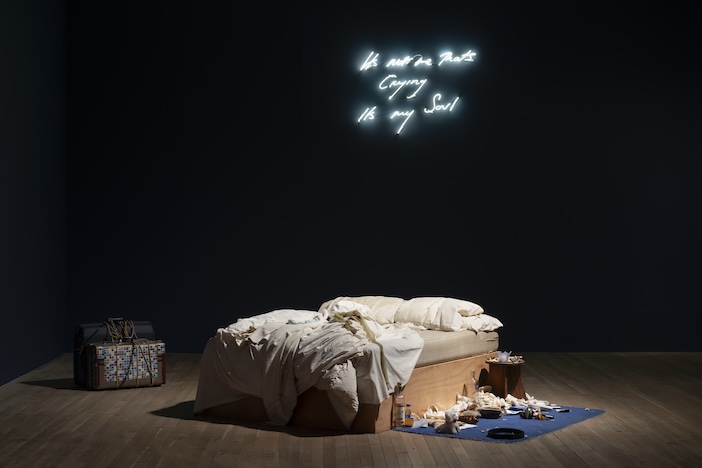
Tracey Emin, My Bed (1998). Photo © Tate (Jai Monaghan)
The Last of the Gold, emblazoned on quilted fabric and shown here for the first time, offers A–Z advice for women facing abortion, drawn from her own experience. The neon declaration I Could Have Loved My Innocence glows with regret and longing, while the embroidered calico Is This a Joke distils vulnerability into a single, piercing question. Words, in Emin’s hands, become as expressive as paint.
The most profound rupture in her life came with a diagnosis of near-terminal bladder cancer. Traumatic surgery and lasting disability altered her body irrevocably. She does not shield the viewer from this reality: unflinching photographs document her bleeding torso and stoma-bag body. They are difficult to confront — and deliberately so. In the large-scale painting The End of Love, emotion is poured directly onto canvas. It says what language cannot. What emerges is not self-pity, but resilience. One cannot help but admire not only the art, but the will behind it.
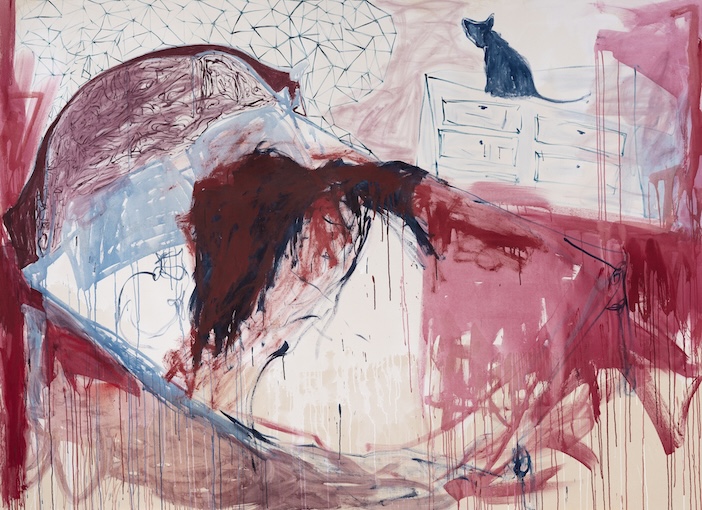
Tracey Emin, The End of Love (2024). Tate © Tracey Emin.
This exhibition traces Emin from student to major figure of the twenty-first century. She has said that she feels satisfied when viewers respond by talking about life rather than art — about their own experiences, prompted by hers. That impulse pulses throughout the show. The works resonate because they refuse detachment; they invite recognition. Walking through the galleries feels less like observing an artist at a distance and more like entering into conversation.
In the final gallery space stands a bronze Death Mask of Emin. It is a beautiful, delicate rendering of her features — high cheekbones and unmistakable lips — defining her more than any photograph or painted portrait. Created in 2002, it seems to stand metaphorically for the ending of one life and the continuation into a second: her body altered, but not her resolve. Her latest large-scale paintings provide emphatic proof that she continues to engage deeply with art.
A Second Life is both retrospective and reckoning — the autobiography of a remarkable woman still in motion. As Dame Tracey Emin has said: “I feel this show, ‘A Second Life’, will be a benchmark for me. A moment in my life when I look back and go forward. A true celebration of living.”
If there is a Tracey Emin fan club, I’ll join.
Tracey Emin: A Second Life runs at Tate Modern (Bankside, London SE1 9TG) from 27 February – 31 August 2026. Open daily 10.00–18.00, and until 21:00 every Friday and Saturday. Tickets available at tate.org.uk. Free for Members. Join at tate.org.uk/members. Follow @Tate #TraceyEmin
Header photo by Sonal Bakrania © Tate