Over 2,000 years ago the Roman poet Ovid wrote Metamorphoses, a sweeping narrative of what happens when immortal gods collide with mortal lives. In these tales, transformations occur on a whim: gods assume animal form, humans are turned into plants or beasts, statues come to life, and a fleeting divine touch alters destiny forever. Pygmalion, Arachne, Leda and the Swan, Apollo and Daphne, Narcissus, Medusa – stories that continue to echo across poetry, painting, and film, sustained by their timeless exploration of passion, desire, cunning, jealousy and power. As Ovid wrote: “All things change, but nothing ever dies.”
A remarkable exhibition currently on at Amsterdam’s Rijksmuseum brings these enduring myths vividly to life. With more than 80 masterpieces on loan from collections worldwide, it demonstrates how artists – from antiquity through the Renaissance to the present day – have continually reimagined Ovid’s epic. Created in collaboration with the Galleria Borghese, where a related exhibition will follow, the show underscores the poet’s lasting influence. As the Dutch artist and writer Karel van Mander once observed, Metamorphoses is a “bible for artists”- a claim amply borne out here.
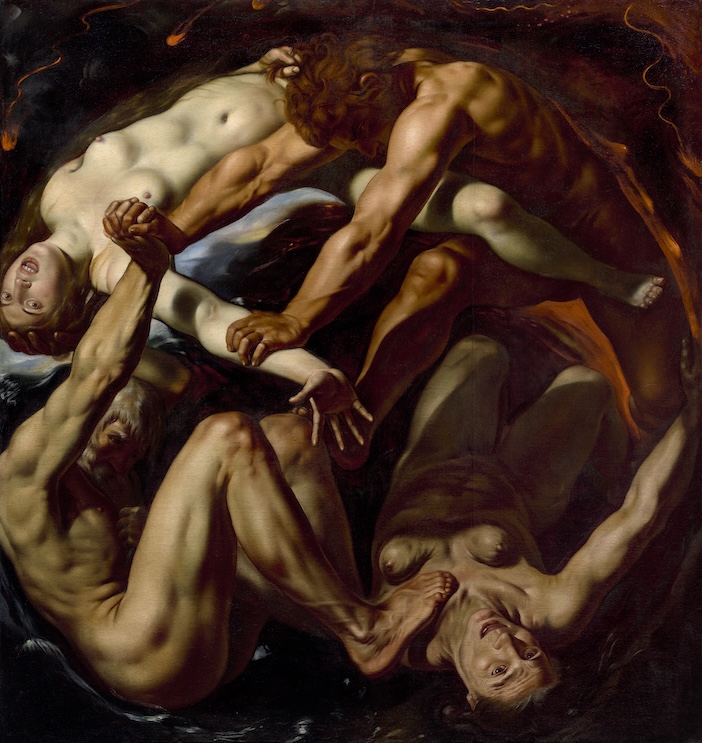
Louis Finson, The Four Elements, 1611. (Sarah Campbell Blaffer Foundation, The Museum of Fine Arts, Houston)
The exhibition opens with a vision of primordial chaos. Louis Finson’s The Four Elements (1611) swirls with contorted, interwoven bodies – Earth, Air, Wind and Fire rendered as a tumultuous mass of flesh that captures the violent birth of the world. In the next gallery, the mood shifts dramatically with Louise Bourgeois’s Spider Couple (2003), a monumental bronze through which visitors can walk.
Its spindly limbs shelter and threaten in equal measure, a fitting counterpart to Ovid’s tale of Arachne, the mortal weaver punished for daring to rival a goddess. This myth unfolds across striking interpretations: from Tintoretto and Peter Paul Rubens to the electrifying Arachne and Minerva (1695) by Luca Giordano, where the transformation is caught mid-metamorphosis – human fingers stretching into spindly legs.
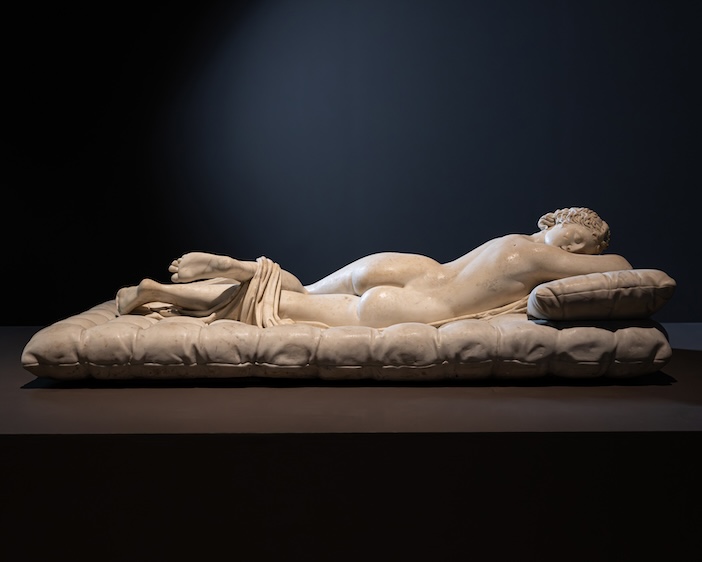
A highlight of the exhibition is the Sleeping Hermaphroditus, a Roman marble sculpture later transformed by Gian Lorenzo Bernini, who added a sumptuous carved mattress. The soft illusion of flesh sinking into marble reveals Bernini’s extraordinary gift for naturalism. The work visualises the myth of Hermaphroditus and the nymph Salmacis, whose bodies merge into one – a moment of transformation rendered both sensuous and unsettling. Nearby, Auguste Rodin offers a more explicit interpretation of fusion, underscoring how differently artists have approached the same tale.
Elsewhere, the richness of Ovid’s influence unfolds in dazzling variety. Correggio’s Jupiter and Io and Danaë shimmer with sensuality, while Titian revisits Danaë for a royal patron with equal intensity. The myth of Pygmalion appears in both painting and sculpture; Narcissus gazes into his own reflection in Caravaggio’s haunting canvas, a study in self-absorption; and Leda’s encounter with Jupiter – disguised as a swan – recurs from Renaissance masters to contemporary reinterpretations.
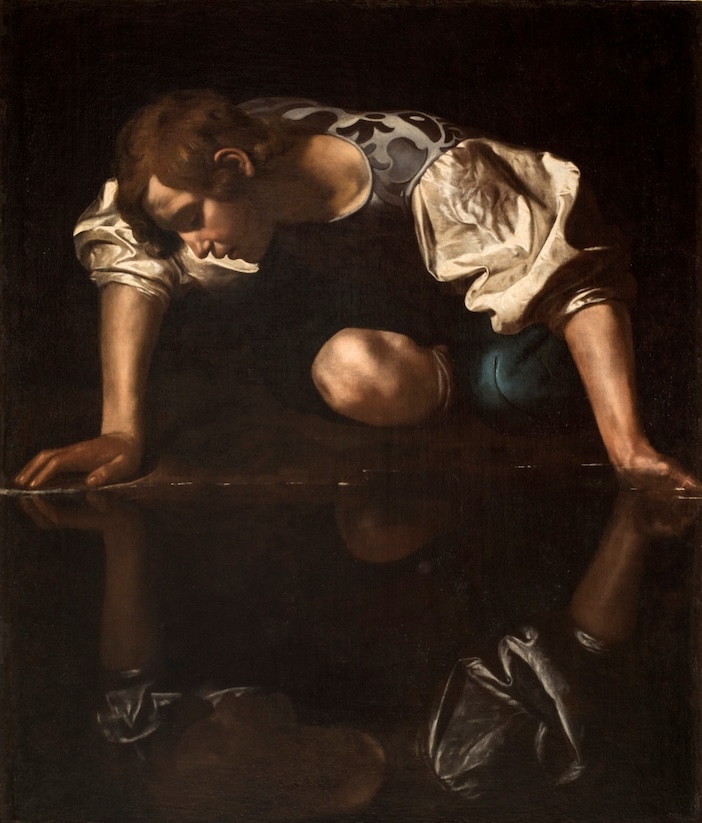
Caravaggio, Narcissus, ca. 1597–1598 (Palazzo Barberini, Rome)
Not all these stories sit comfortably. The Medusa myth – of a woman punished after being raped by Neptune in Minerva’s temple – resonates with unsettling modern parallels. As the exhibition’s curator notes, Ovid’s telling is strikingly offhand: the male god escapes blame, while the victim is transformed into a monster. A contemporary video installation by Juul Kraijer confronts this legacy head-on, presenting a human Medusa overwhelmed by writhing serpents—an image both hypnotic and disturbing.
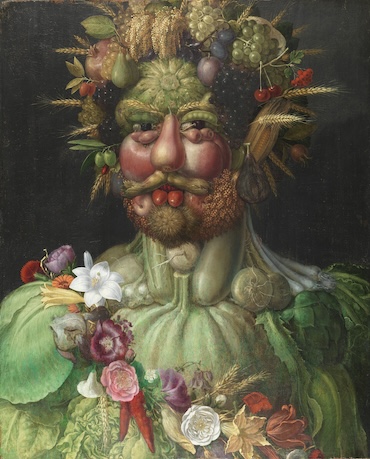
Giuseppe Arcimboldi, Emperor Rudolph II as Vertumnus (1590)
From the fantastical portrait of Emperor Rudolf II as Vertumnus by Giuseppe Arcimboldo to the surreal wit of René Magritte, the exhibition reveals just how far Ovid’s imagination has travelled. Across centuries and styles, his stories continue to provoke, inspire and transform.
And if your appetite for art is sated and hunger pangs begin to stir, the museum offers a fitting continuation of the experience. Within its walls, RIJKS® provides an epicurean counterpart to the exhibition. Led by chef Joris Bijdendijk, the Michelin-starred restaurant celebrates “Dutch cuisine of the Low Countries” with precision and creativity. Following its recent transformation, it offers not just a meal but a considered extension of the museum visit—another kind of metamorphosis, from visual to culinary pleasure.
This is an exhibition of rare ambition and breadth. It demonstrates not only the enduring power of Ovid’s vision but also the limitless capacity of artists to reinterpret it. Across two millennia, Metamorphoses remains what it has always been: a living, changing source of inspiration.
Metamorphoses: Ovid and the Arts is on at the Rijksmuseum, Amsterdam until 25th May 2026. For more information, please visit www.rijksmuseum.nl.
Metamorphoses: Ovid and the Arts runs at Galleria Borghese in Rome from 22nd June – 20th September 2026.
Header image: detail from Jupiter & Io (in situ)