At the Ashmolean Museum, Rosalind Ormiston explores ‘In Bloom: How Plants Changed Our World’, a new exhibition tracing the rich and often surprising story of plant exploration, and how centuries of discovery shaped Britain’s gardens, science and global trade…
What stories lie behind the plants we pass each day — in our gardens, on our windowsills, or arranged in a vase? Their origins are often more complex than we might imagine, shaped by centuries of exploration, exchange and scientific enquiry. At the Ashmolean Museum in Oxford, an outstanding exhibition curated by Francesca Leoni brings these histories into sharp focus; In Bloom: How Plants Changed Our World traces the journey from seventeenth-century plant hunters to the research shaping our understanding of plant life today.
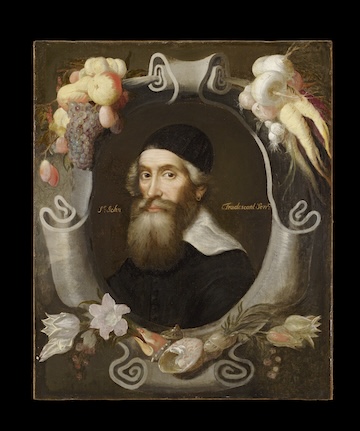
John Tradescant the Elder, attributed to Emanuel de Critz (1608–65), Ashmolean Museum
The exhibition opens in a low-lit gallery filled with rare paintings, books, maps and objects dating from the 1600s, introducing the emergence of plant exploration in England. It follows explorers, merchants and colonial agents seeking to import exotic species into Britain, alongside the botanists, gardeners and early collectors who drove this pursuit. Crucially, it also acknowledges the aristocratic patrons who financed these global expeditions, including Mary Somerset, first Duchess of Beaufort, and Jacob Bobart.
At the forefront were John Tradescant the Elder, naturalist and chief gardener to the Earl of Salisbury, and his son, John Tradescant the Younger, who undertook three voyages to Virginia in search of new species. The Ashmolean’s own collection partly originates from their work. The elder Tradescant travelled extensively across Europe and beyond, introducing species from larch trees to lilacs to Britain. Fine portraits here, including one attributed to Emanuel de Critz, depict him surrounded by the tools and symbols of his profession, while another shows his son in the role of gardener.
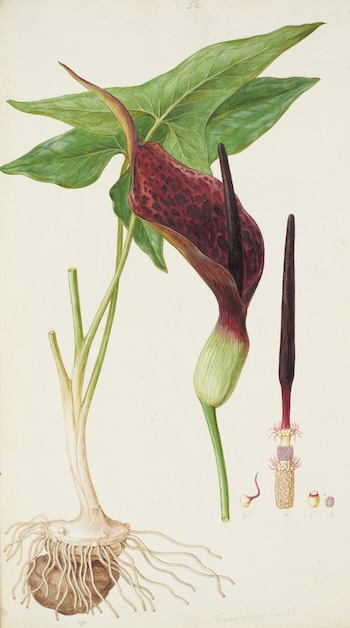
Ferdinand Bauer, Arum (Arum dioscoridis), 1788-1794, Bodleian Libraries
This fascinating introduction encompasses the development of plant classification by the Swedish naturalist Carl Linnaeus, as well as the phenomenon of seventeenth-century Dutch ‘Tulipomania’, when extraordinary sums were paid for a single bulb. The narrative moves on to the establishment of the Royal Botanic Gardens at Kew in 1759, highlighting its role in researching economically significant crops such as tea, sugar, rubber and indigo — and its continuing importance in plant and fungal science.
Among the many highlights are displays exploring the practical challenges of transporting plants across climates, including an early Wardian case — a sealed protective container that revolutionised plant transport. These are set among exquisite still lifes of flowers and plants, with works by John Ruskin, Lawrence Alma-Tadema and Henri Fantin-Latour, who painted over 800 floral compositions. By the nineteenth century, Britain was rivalling France in rose cultivation and production.
The exhibition also celebrates the contribution of Gertrude Jekyll, whose garden designs and popularisation of the cottage garden made abundant planting achievable for amateurs and professionals alike. The growth of allotments further broadened public engagement with gardening, encouraging both the cultivation of food and the enjoyment of ornamental plants — a legacy still evident in today’s thriving garden societies, clubs and open days.
Contemporary echoes of this tradition can be seen in modern garden festivals and shows, which promote innovation in plant research and design. Increasingly, these intersect with the art world, as demonstrated by Tate’s planned garden at the Chelsea Flower Show, aiming to unite art, nature and community — a fitting tribute to the legacy of early plant explorers.
In the final gallery, the exhibition shifts to contemporary responses. British sculptor Justine Smith presents works from her Nature Series, including Hothouse, a sculpture of a Phalaenopsis orchid that reflects on the commodification of the natural world. Constructed from banknotes, her meticulously crafted plant forms explore money as a conduit of power and value — a striking commentary on how wealth once fuelled plant exploration and continues to shape global industries.
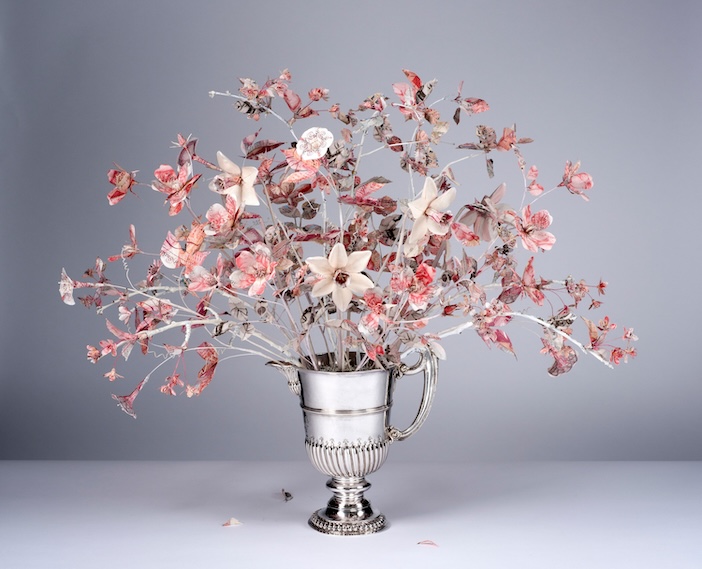
Justine Smith, Specimen Florae Britannicae (2023–24)
Alongside her, photographer Fran Monks honours the often-overlooked individuals working in plant research today, with painterly portraits that capture both likeness and character. Together, these contemporary works bring the exhibition full circle, linking the origins of plant exploration to its present-day global significance.
In Bloom ultimately leaves the visitor with a renewed appreciation for the origins of the plants, trees and flowers that populate Britain today — and for the complex histories, both scientific and cultural, that brought them here.
In Bloom: How Plants Changed Our World runs until 16th August 2026 at The Ashmolean Museum, Beaumont St, Oxford OX1 2PH. For more information, please visit www.ashmolean.org.
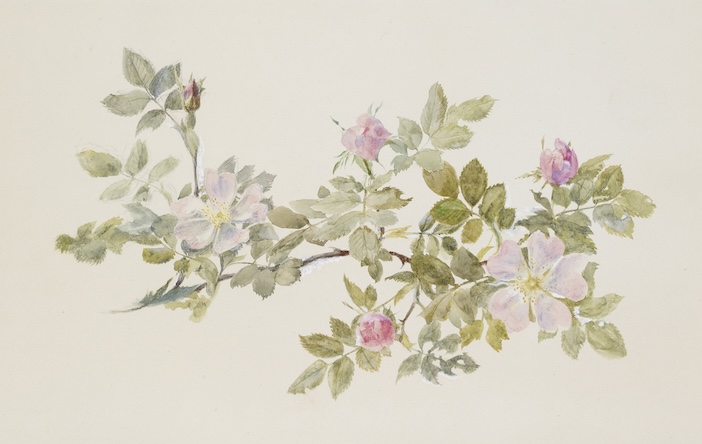
Header image: John Ruskin, Study of Wild Rose (1871), Ashmolean Museum