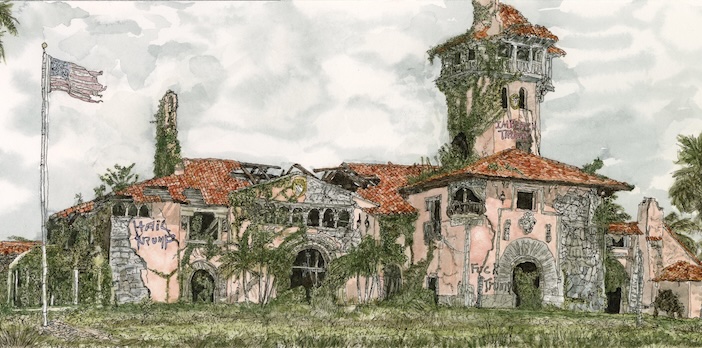
The artist who once destroyed everything he owned now imagines the ruin of London’s landmarks, and a few American ones too. Rosalind Ormiston visits the Soane’s wry, free exhibition…
It was a watercolour at Sir John Soane’s Museum in London, Architectural Ruins: A Vision from 1798 by Joseph Michael Gandy, that inspired the English artist Michael Landy to create a series of watercolour drawings of imagined ‘Future Ruins’. Gandy’s watercolour was commissioned by Soane, architect of the Bank of England, to imagine the Bank in two hundred years’ time, around the year 2000, perhaps questioning what his legacy as an architect would be. It offers a romantic vision of Soane’s Rotunda at the Bank in decay.
For Future Ruins, Landy, artist, sculptor and printmaker, has chosen iconic landmarks and visualised how they might look in two hundred years’ time too. The series includes the Bank of England in the City of London, still flying the English flag over a hollowed-out, decaying façade, in Imaginary view of The Bank of England in ruins after Joseph Michael Gandy. As Landy explains: ‘Many artists have been fascinated with ruins since the Renaissance. I’m one of them. Everything – no matter how important, valuable or cared for now – will eventually fade, crumble, be reclaimed by nature, or disappear…’
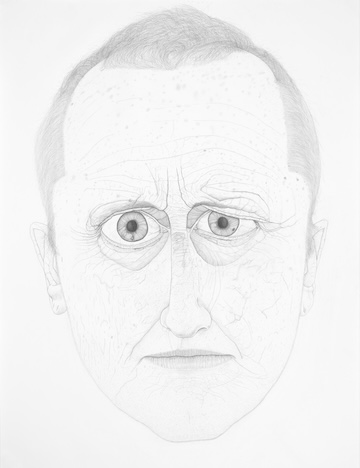
Michael Landy,
Self portrait at the age of 62 (2025)
Some of the works are vast drawings, including Landy’s withering Self-portrait at the Age of 62, emblematic of the artist’s presence in the Soane galleries exhibiting his work. Another large-scale watercolour drawing, this year’s Landy Family Home in Ruins, depicts his parents’ suburban home in Ilford, Essex. It will jog the memories of those who visited Tate Britain in 2004 to see Semi-Detached, the full-scale, brick-by-brick replica of that house recreated in the sizeable Duveen Galleries. It was remarkable. Landy’s name will always be associated, too, with the YBAs (Young British Artists) who emerged in the 1990s, and with Break-Down (2001), for which, from 10 to 24 February, he destroyed 7,227 personal possessions in a glass-fronted showroom on Oxford Street, London, watched by 45,000 people over fifteen days.
Part of the show is Landy’s drawing series Family Ruins, which began during Covid-19, when he spent time in Ireland, his family’s heritage, drawing ruined stone cottages. They are perhaps reminders of the many people long gone who worked the land or local industry. Now the houses and cottages are covered in foliage, missing roofs, walls and windows, left to decay.
Some of Landy’s future ruins have a satirical edge, as in his portrayal of the well-known American landmark Mar-a-Lago, the pastel-pink Florida residence of US President Donald Trump, in slow decay, and The Arc of Trump, which imagines the president’s planned Triumphal Arch commemorating the 250th anniversary of American independence. Is the underlying message that the ego-driven buildings of world leaders may not be respected in the future? Landy’s large-scale drawing Palazzo della Civiltà Italiana in Ruins (2024) looks to the past, depicting the Italian dictator Benito Mussolini’s vast classical Fascist monument, the Palazzo della Civiltà in Rome, completed in 1943. It still stands, a reminder of Mussolini, who was shot and killed and subjected to public mutilation in 1945.
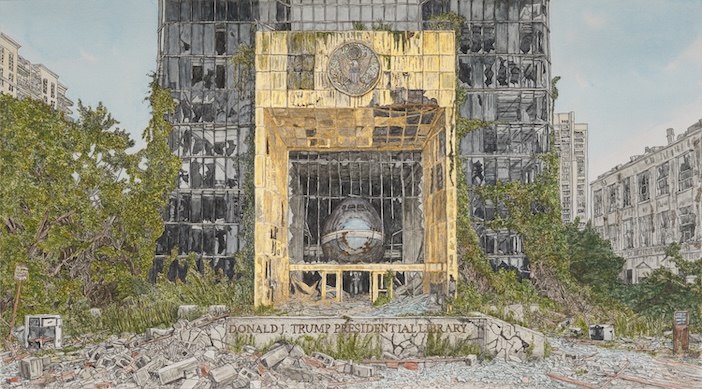
Michael Landy, Donald J. Trump Presidential Library in Ruin, 2026
And what about the architects of buildings? Kanye West’s former Tadao Ando designed Malibu mansion in ruins (2026) imagines how a private residence may look when the architect has left the building. It doesn’t go well. Landy chooses well-known English landmarks too, such as Chatsworth House and Blenheim Palace, grand buildings open to the public and reliant on conservation and funding to keep them viable for future generations. The show makes one think about what should be retained and what should be discarded, and who decides. Among iconic structures, the magnificent 1887 Grade II* listed suspension bridge at Hammersmith in London comes to mind: closed to traffic since 2019 and left in limbo between its local councils and the government, it is steadily deteriorating.
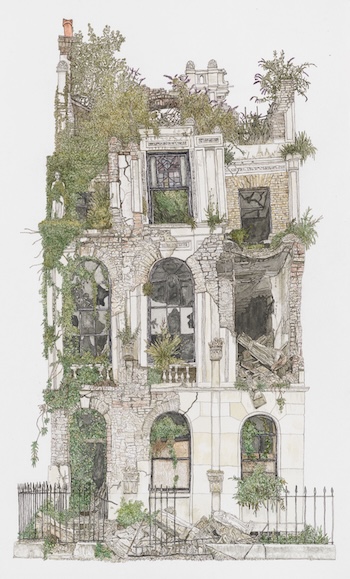
Oh! What a falling off do these ruins present. Sir John Soane’s Museum as a ruin, 2026
Landy’s ruins series echoes architectural history. The English conservationist John Ruskin tried to stop significant buildings in Venice from being destroyed or falling into ruin, and the English designer William Morris set up the Society for the Preservation of Ancient Buildings (SPAB) to stop destructive restorations. They will have known Sir John Soane’s house in Lincoln’s Inn Fields, and Landy has created a wonderful ruined façade for it, sprouting foliage, in Oh! What a falling off do these ruins present. Sir John Soane’s Museum as a ruin.
A favourite for visitors might be Landy’s drawing of a much-loved independent art-supplies shop in Ilford, Essex, where he grew up and bought his own art equipment as a child. Imaginary View of Owen Clark in ruins (2022) is an appreciative remembrance of the shop, now closed. And definitely not to be missed is Landy’s installation on the ground floor. The 12-foot high Broken Column (2026) is built from a column of bins covered in graffiti and advertising stickers, overflowing with discarded items, now washed, found on London’s streets. It is a striking sculpture on consumerism.
Future Ruins is an amazing exhibition, free to visit, and the latest in a series of remarkable shows instigated by Will Gompertz, Director of Sir John Soane’s Museum since 2024. He sums it up as ‘the perfect meeting of two artistic minds’: Michael Landy CBE, RA, and Sir John Soane RA, FSA, FRS, both phenomenal draughtsmen working two hundred years apart.
‘Future Ruins’ rungs until 17th January 2027 at Sir John Soane Museum, 13 Lincoln’s Inn Fields, London WC2A 3B. Open Wednesday to Sunday – free to visit. For more information, please visit www.soane.org.
Header image: Mar-a-Lago in Ruins Study II, 2026