
If the rain has taken up permanent residence and your social life now revolves around the kettle, Philip Cottam’s winter offering is the ideal accomplice: a sharply chosen quartet of reads to distract, provoke and thoroughly entertain — far more rewarding than glaring resentfully at another sodden forecast…
Fly, Wild Swans: My Mother, Myself and China
Jung Chang first burst onto the public consciousness in 1991 with the publication of her deservedly best-selling book Wild Swans. This extraordinary tale, a history of the emergence of modern China, was told through the medium of the lives of her own family and of three women in particular – her grandmother, her mother and herself. Her most recent book Fly Wild Swans: My Mother, Myself and China is a deeply felt memoir looking back over the years at the impact of Wild Swans, her hard-hitting and controversial biography of Mao Zedong published in 2005 and her move to England on her relationship with her country of birth and her family back in China, especially with her mother.
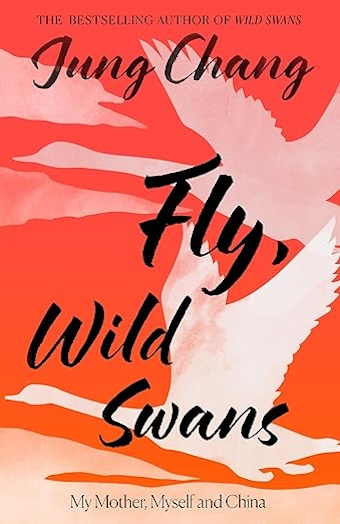 Having survived the chaos and violence that swept through China during the so-called ‘Cultural Revolution’ – which she described so vividly in Wild Swans – Jung Chang came to England in 1978. Sadly, her father never really recovered from his experiences and died quite soon afterwards. Jung Chang completed a PhD at York University, the first Chinese citizen to do so at an English university. This was only possible because of a short period of limited openness in China under Deng Xiaoping. She then stayed on in England to begin a new life as a writer and academic. The searing honesty in Wild Swans about the realities of life in China in the decades of dramatic change that followed the collapse of old imperial regime in 1911 and eventually culminated in the imposition of the Communist dictatorship under Chairman Mao in 1949 changed her relationship with the regime for ever.
Fly, Wild Swans begins where Wild Swans finishes with Jung Chang’s arrival in England. It starts with the huge culture shock she faced. As she says herself it was as if she had just landed on Mars. Having grown up in a one-party state, where economic austerity was the norm and society was dominated by strict conservative customs and rules, to be faced with so much freedom and openness, whether about politics, the clothing one wore, the conduct of personal relationships or attitudes to sex meant it took time for her to adjust to her new circumstances and build a new life.
With the publication of Wild Swans and her biography of Mao, neither of which has ever been published in China, her visits home to China became a matter of interest to Chinese state security. With the rise to power Xi Jinping her annual visits to see her mother were closely monitored and on at least one occasion she was physically manhandled and publicly humiliated. Since 2018 she has been denied the visa she needs to enter China. It comes as no surprise that her attitude towards the China of Xi Jinping is almost as critical as her views of the China of Mao Zedong. Her trenchant judgement is that Xi seeks to build a Marxist state with capitalist features. Fly, Wild Swans is well worth reading both for the personal journey it recounts but also for the insights it provides about the politics and culture of modern China.
‘Fly, Wild Swans: My Mother, Myself and China’ by Jung Chang, is out now published by William Collins.
Pots of Gold
I was never much of a snooker player or cricketer but they both have always had the same magnetic draw for me as a spectator. I would tell myself that I would just watch a handful of frames or overs only to find myself getting sucked in by the developing battles of skill and psychology between two players fighting to outwit each other for domination of the table or the pitch. As for the snooker, anyone who shares the magnetism of the game will find their memories of the great names, great frames and great breaks rekindled by David Hendon’s Pots of Gold: A History of Snooker. 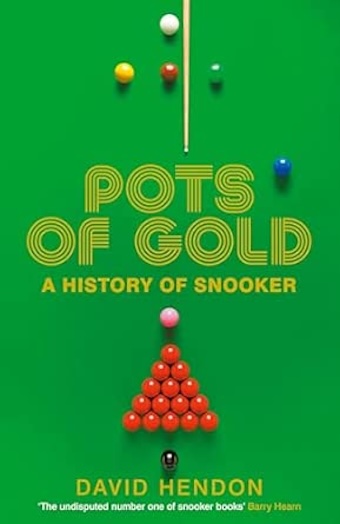 It is a labour of love not only based on an encyclopedic knowledge of the game and its history but also on a series of conversations Hendon held with iconic figures of the game such as Ray Reardon, Steve Davis, Cliff Thorburn, Dennis Taylor and John Virgo. The result is superb history full of insight and colour. Hendon has most certainly succeeded in his openly expressed determination to avoid his book becoming, as he put it, a Wikipedia-like collection of facts and figures.
Hendon begins his history with the invention of the game in India in the 1870s by British soldiers and one in particular – Sir Neville Chamberlain. He then charts the development of snooker right up to the World Championships held earlier this year at the Crucible in Sheffield for the 49th consecutive time. It is a journey that encompasses the first World Championship held in a variety of locations and over an extended period starting on 29th November 1926 and ending on 12th May 1927. Hendon goes on to illustrate and explain the dramatic growth of the public popularity and global reach of the game via the impact of television, most especially with the arrival of colour television. The growth of the sport is well illustrated by the changes in the nationality of the competitors and the size of the prize money. Over twenty nationalities are represented on the professional circuit in 2025 from whom the 32 finalists were drawn whereas in 1927 all the 10 finalists were British. As for the prize money the winner in 1927 received £6.50 compared to £500,000 in 2025. What adds so much to Hendon’s telling is his use of well-chosen anecdotes to illustrate the challenges of the game, the characters of the great players and the magnetic atmosphere that the game creates. This is certainly a book for the snooker enthusiast, but it also makes for an interesting, well written and enjoyable read for the non-player.
Pots of Gold by David Hendon, published by Swift Press.
The Hallmarked Man
After the global success of the Harry Potter series J K Rowling could easily have chosen to rest on her laurels. Instead, writing under the pseudonym Robert Galbraith, she has turned herself into an equally accomplished writer of complex and intricately plotted crime stories. Her most recent, The Hallmarked Man, is her eighth and, just like all its predecessors, involves the same private detective agency and the same two detectives. For those who have not read any of the books yet or seen the BBC series Rowling has created two engaging characters. 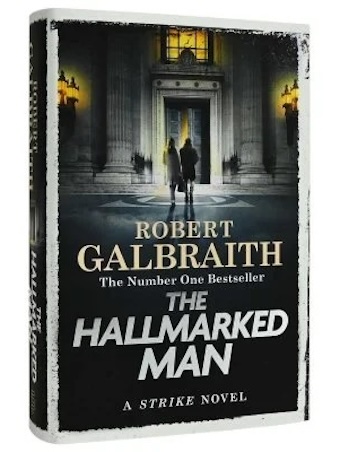 They are Cormorant Strike, an ex-military policeman who lost a leg in an IED incident in Afghanistan and set up the agency, and Robin Ellacott, his charming and clever secretary turned detective whose role has become more important as the series has grown. Indeed, the developing nature of their relationship provides one of the main themes in all the books. It remains so in a The Hallmarked Man, especially as Robin’s relationship with a police officer becomes more serious much to Cormoran’s dismay as he has never told Robin of his real feelings.
The book is another long one – some 900 pages – but it is so well crafted that the reader is carried forward by the compelling nature of the plot and by the range of interesting characters that fill the story. It all starts when Cormoran and Robin are hired, in the middle of a police investigation of a dismembered body found in the cellars of a shop specialising in Masonic silverware, by a woman who believes it is the body of her disappeared boyfriend. As for the police, they think it is the body of a convicted criminal. What seems somewhat straightforward rapidly becomes more complicated and sees the two detectives following a variety of leads, not least into the arcane world of freemasonry. The two detectives are also distracted by the day-to-day routine work of the agency needed to keep its head above water. The biggest distraction of all is managing their own relationship as stories emerge from Cormoran’s past that threaten both his reputation and Robin’s view of him, while she has to handle her developing relationship with a charismatic policeman. It all makes for an enjoyable and compulsive read as Rowling is a master storyteller who combines clever plotting with the ability to create real atmosphere, whether dark or light, physical or psychological. Perhaps her greatest strength is her ability to people the stories with a range of realistic characters that draw the reader in and make the books far more than just an intellectual exercise in complex plotting. Fans of the series will not be disappointed by The Hallmark Man and first-timers will, I hope, be encouraged to engage with the earlier books in the series.
The Hallmarked Man by Robert Galbraith (aka J K Rowling) is out now in hardback, published by Sphere.
The Challenges of Democracy: And the Rule of Law
Anyone looking for some thought-provoking stimulation could do no better than engage with Jonathan Sumption’s The Challenges of Democracy. It is a wide-ranging and incisive collection of lectures given by one of the most distinguished lawyers and historians of his generation, most known for his service on the Supreme Court and for his superb five-volume history of the Hundred Years War. Sumption has put together this set of lectures because of his concern at the declining faith in democracy and the increasing contempt held for politicians; these, at the same time as opinion has become increasingly polarised, hostility to dissent has grown and the sovereignty of Parliament has been challenged by a combination legal activism and debates about the relationship of domestic and international law.
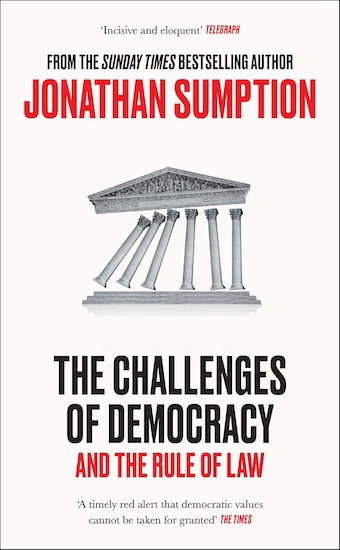 The lectures range from domestic to international law, from the interface between politics and the law to the nature of the social and political culture that underpin the workings of the constitutional and political institutions of democracy. The journey includes an analysis of the challenges to democracy in the UK, a critique of the cross-party lawfare of Trumpian America and behaviour of Trump, an investigation of the conflicts created when interpretations of the rule of law become a contested area in the face of human rights legal activism, the destruction of democracy in Hong Kong, the pros and cons of international tribunals and battles over free speech.
Sumption is a dedicated supporter of representative democracy while fully aware of its weaknesses not least the challenges identified by his 18th and 19th Century forebears who most especially feared what was then sometimes referred to as ‘politics out of doors’, the politics of the street, what we might call populism. It explains why Sumption is so concerned at the increasingly angry, divisive and censorious nature of public discourse. It is not for nothing that his summary of the three greatest threats to democracy includes intolerance as well as economic insecurity and fear. For Sumption the rise of cancel culture has resulted in a narrowing of our intellectual world and the diversity of opinion that, historically, enabled democracies to thrive. It also explains the forensic nature of his essays on free speech and what, as a distinguished historian, he sees as the increasingly frequent and blatant misuse of history for political reasons.
When it comes to political leadership he pulls no punches. Both Trump and Johnson do not escape an incisive critique not least for their mendacity. Some of the most interesting parts of the book focus on the way in which legal activism has intruded on the supposed sovereignty of Parliament. His concern at legal overreach is most clearly set out in an essay entitled ‘Mission Creep’. However, this is certainly not a book influenced by party politics. Sumption sits as a crossbencher in the House of Lords. Although more wide-ranging and political, for clarity, nuance and incisiveness it is nonetheless a worthy companion to the late Lord Bingham’s The Rule of Law. Last, but not least, it is more than just an interesting read; given the global and domestic challenges to democracy it is an important book, especially when one considers nearly three quarters of the world live under authoritarian rule.
The Challenges of Democracy: And the Rule of Law by Jonathan Sumption is out now, published by Profile Books.
Header photo by Annie Spratt, courtesy of Unsplash