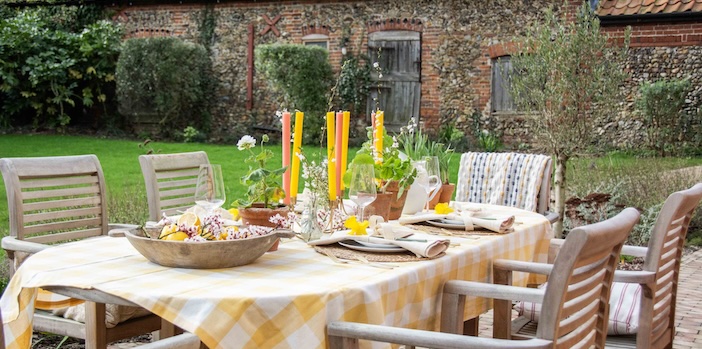
In her latest ‘Home from Home’ column, Jess Baldwin heads back to the Suffolk coast for a windswept adventure, some unexpected history and a seriously stylish barn to come home to…
Long cast as the land that time forgot, East Anglia is a pretty hunk of Blighty where the years pass and — so the myth goes — little changes. Inland, its chocolate-box villages and handsome market towns play along. But on the coast, all vast golden sands and pebbly shores, this is one of Britain’s most dynamic landscapes— a marionette, with Mother Nature calling the shots.
Having grown up in a wind-battered barn on one of Norfolk’s crumbliest cliffs, I’ve watched the North Sea gnaw its way inland, always hungry for more. Roads end in mid-air, houses vanish overnight, and beaches quietly rearrange themselves with every storm. Time and tide are ruthless editors here – their work, it seems, is never done.

The smell of just-baked pastries snaps me out of my reverie. It’s just turned 10am in Orford — one of Suffolk’s most swoon-worthy villages — yet already a queue of camera-clutching tourists snakes out of the village’s petal-pink Pump Street Bakery – presumably eager to discover what a £6 croissant tastes like. Through the window, cherry-cheeked hikers devour their treats, pastry falling from frost-bitten fingers like buttery confetti. Over the road, the oysterage prepares for another busy lunch, locals ready to toast the good life with a glass of Chablis and a dozen Butley oysters.
And it is a good life. Whimsically named red-brick houses, stitched together with garlands of wisteria, tumble down towards glistening mudflats and twinkling marshes. But, as ever, the pocket-sized Orford we see today is only the latest iteration — one glance at its castle tells you as much.
Built for Henry II, Orford Castle was once part of a sprawling complex, but the centuries – and the elements – have edited it down, piece by piece. Almost a thousand years on, only the central keep remains – its new yolk-yellow render giving it a faintly fairytale feel – crowned with a rare polygonal tower. It seems that despite being relentlessly battered by wind and water, this coast has a crafty knack for hanging on to its best bits.
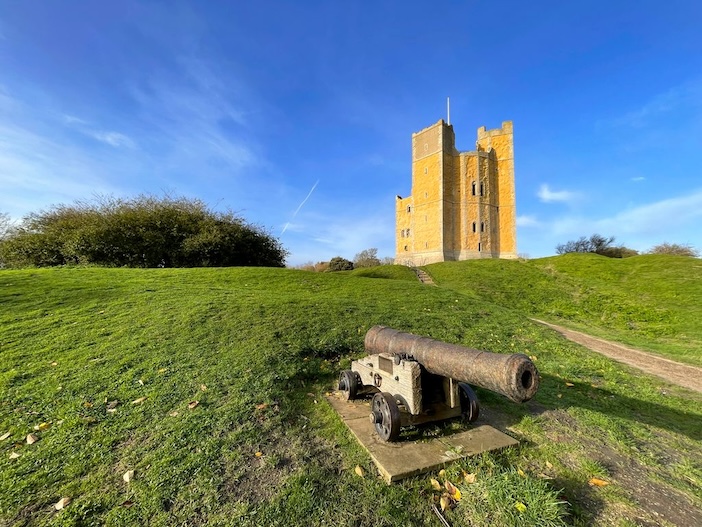
I must have looked puzzled, scuttling around its burly walls, as within minutes of me entering the keep an English Heritage guide materialised at my side, offering to answer any burning questions I had about the salt-smashed stronghold.
“Did he have a tail?” I whispered inquisitively, aware I sounded utterly unhinged.
Yet he knows exactly who I mean: the Wild Man of Orford.
According to local legend, the mysterious figure was hauled from the raging North Sea by fishermen and brought to this very castle, where he was promptly imprisoned and tortured. Tales describe him as a mute, hair-covered coastal curiosity. My mother, however – never one to under-embellish a story – insists that he had a tail. And a spectacular tail at that.
Our guide inhales deeply before delivering his verdict: “He was neurodivergent.”
With those three words, centuries of magnificent merman myth were shattered. Suffolk’s Wild Man transformed from brutish sea creature to bewildered outsider – simply a man washed ashore in an age more fluent in myth than medicine. Presumably without the aforementioned tail. It felt churlish to check.
With this new found knowledge, we made out way up to the wind-pummelled rooftop, its panorama revealing yet another of the village’s secrets: Orford Ness. Europe’s longest vegetated shingle spit was gifted to the village by the sea – fed by collapsing cliffs further north (sorry, Mother) and delivered here stone by stone. In truth, it feels less like a beach and more like a giant fishing net, catching fragments of history as they inevitably drift south.
Once a top-secret nuclear weapons testing site, its eerie concrete blast chambers still loom on the horizon. But the balance of power has shifted. Now a thriving nature reserve, Mother Nature is back in charge.
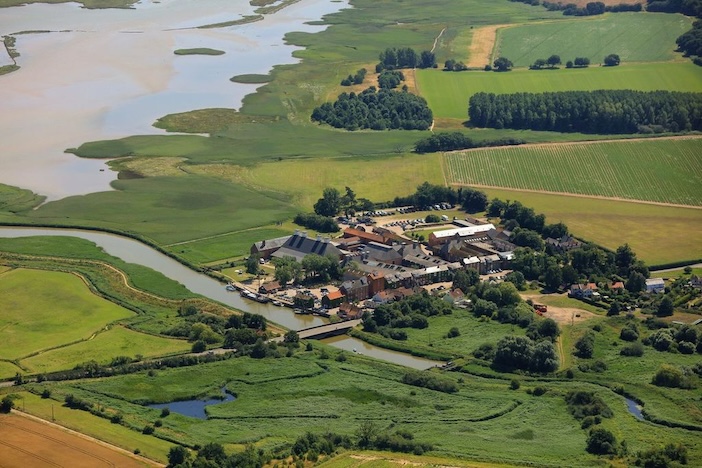
Atomic bomb chambers not currently on your Suffolk bucket list? That is the magic of the estuaries: they reveal the things you never knew you needed to see – landscapes layered with myth, mystery, and quiet wonder. Once mighty trading routes, today these five tidal fingers claw inland through mudflats and marshes, harbouring the haunting remnants of Norman castles, Napoleonic forts and even the occasional Anglo-Saxon burial ship.
As the daughter of sailors, I reluctantly spent much of my childhood drifting along these waters, combing the turmeric-hued shoreline for needle-sharp belemnites, jewel-hued sea glass and the occasional shark’s tooth. The adventure always appealed. The coffin-like berth, chemical toilet and gas-cooker suppers did not.
As a result, I’ve spent much of my adult life searching for the perfect five-star base from which to revisit these enchanting inlets – flushable toilet and all. The search, it seems, is over.
Enter The Barn at Manor Farm: a gloriously remote bucolic bolthole tucked within a peaceful 17th-century farmyard within striking distance of the estuaries. Light-drenched and view-filled, this Grand Designs–style property – from the Curious Retreats portfolio – feels as though it has been meticulously crafted somewhere impossibly chic before being quietly dropped into the Suffolk countryside.
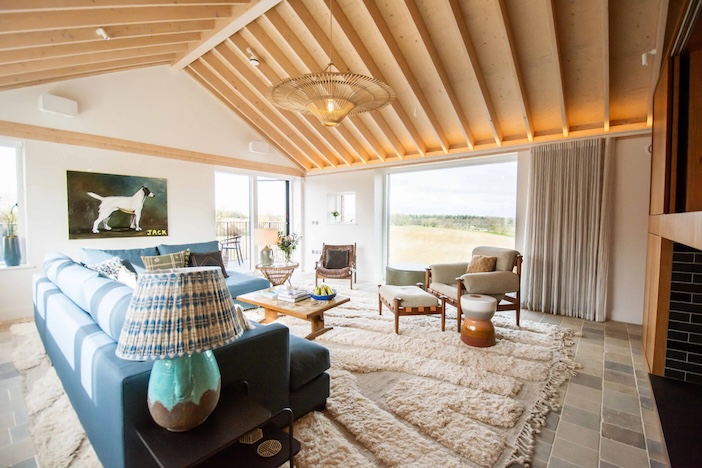
Built on the footprint of an old barn, the award-winning design winks at its past. Double-height ceilings soar overhead, exposed beams criss-cross the space, and a vast corrugated-steel door delivers a jolt of agricultural minimalism — just to remind you that while you sip Champagne and enjoy the Sonos sound system, you’re still very much in a barn. Inside, the four-bedroom house perfects upside-down living, with sunlit spaces spiralling around a central staircase — and a rather flashy lift for good measure.
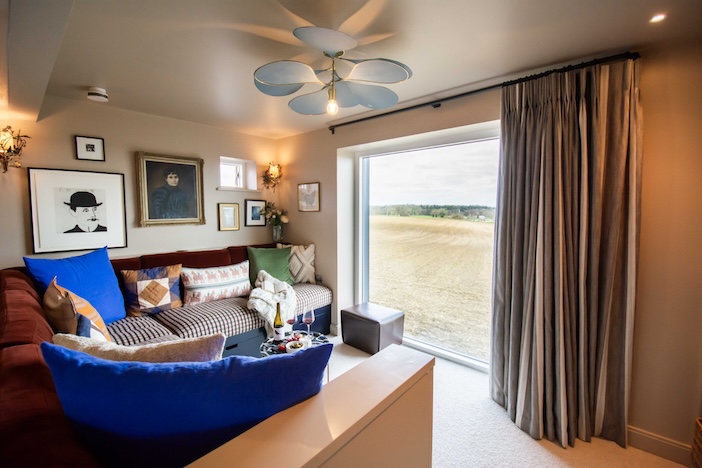
Wherever you settle – the snug, the dining room, the living room – the real star lies beyond the glass. Vast picture windows frame Suffolk’s famously big skies, turning them into living artworks that shift and change by the minute. Despite the grand setting, we kept returning to the smallest room: the snug. This cosy corner bookends busy days perfectly. At sunrise we lounged on its sofas, sipping coffee and watching silently as deer pranced through the fields. At sunset, we would sink into the sofas, laughter rising with the wine as the landscape dissolved into inky darkness, the night sky glittering before us.
And busy days they were. A pebble’s toss from some of the estuaries’ most popular haunts, the barn is the perfect springboard for adventure. Beside history-rich Orford, there’s the well-healed fishing town of Aldeburgh, where fresh-fish shacks line the shore and colourful boats dot the pebbles. Meanwhile, in Woodbridge you’ll find a picturesque waterfront and handsome streets crammed with quirky independent stores, café windows piled high with exquisite sweet treats.
Given my lifelong aversion to all things nautical, it felt faintly ironic that my highlight was the Sailors’ Path, a historic six-mile trail tracing the River Alde from Snape Maltings out to the sea. Once used by seafarers, the path skims miles of head-high reeds, gorse-fringed marshes and pine-scented woodland before spilling out onto Aldeburgh’s pebbly shore.
Blister-covered and utterly ravenous, we headed past the tar-black fishermen’s huts, collapsing next to Maggi Hambling’s controversial scallop sculpture, tucking into a steaming parcel of fish and chips as we silently tracked a lone seal in and out of the waves.
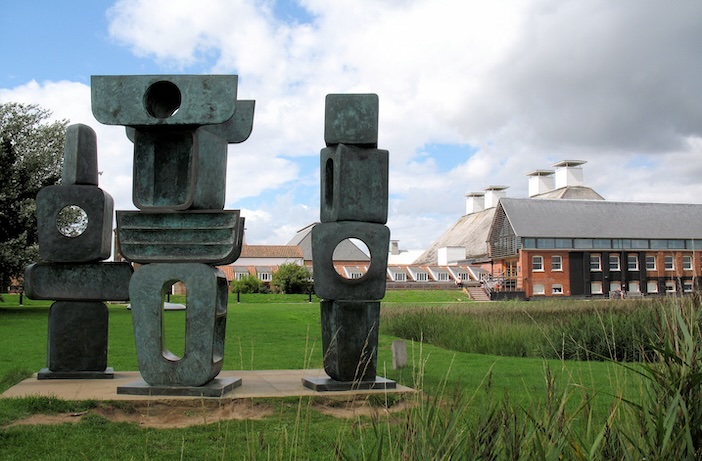
Barbara Hepworth’s ‘The Family of Man’ at Snape Maltings (photo courtesy of WikiCommons)
After 17 miles, Snape Maltings reappeared, an arty beacon rising through the reeds. Exhausted, we collapsed beside Barbara Hepworth’s towering The Family of Man. Three of the nine bronze figures call Snape home. Totem-like, they gaze across the reeds toward the sea, each representing a different stage of life. Once gleaming bronze, they now wear a minty-green patina—a subtle edit courtesy of the sea breeze.
Along this wild and wonderful coastline, the sea is relentlessly clawing at the cliffs, tugging at the shore, dragging shingle, sand and stone steadily south. People, it seems, aren’t so different – curious creatures, lured by the estuaries themselves.
The Barn at Manor Farm is bookable through Curious Retreats, a family-run, independent holiday home agency based in Suffolk. For more information visit www.curiousretreats.co.uk. To discover more about what to see and do on the Suffolk Coast, visit www.thesuffolkcoast.co.uk.