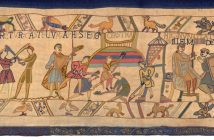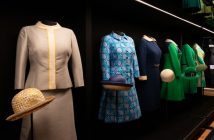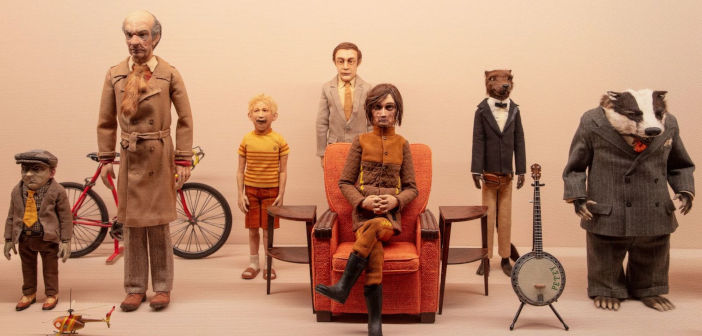
I don’t remember when I was more excited to see an exhibition. Wes Anderson: The Archives at the Design Museum in Kensington is a landmark exhibition celebrating the visionary American film director’s work over three decades; beginning with his first feature film Bottle Rocket, a 90s homage to Scorsese’s Mean Streets and ending with his 2025 espionage film, The Phoenician Scheme, an arc which allows visitors to explore the director’s passion for details, however small, and his love of different techniques. After taking advantage of the replica Grand Hotel Budapest’s reception desk which stands at the exhibition entrance to encourage photo opportunities, visitors enter via a red door, over which reads, ‘NO CRYING’ – and there certainly wasn’t! A director who has given the film-loving portion of humanity the gift of countless invented realities, there is nothing to touch this experience for sheer escapism on a rainy day in London.
Having been granted unprecedented access to Anderson’s personal archives charting his extraordinary evolution from early film experiments in the 1990s to more recent works and collaborations, the Design Museum’s beautifully staged exhibition running until July 2026 offers a unique opportunity for fans of Wes Anderson films including The Royal Tenenbaums, The Darjeeling Express and The Grand Budapest Hotel. Exploring Anderson’s 12 feature films in chronological order, 700 film-related objects illustrate his extraordinary eye for detail and whimsical design that lingers in the memory, joyfully contradicting the director who once claimed that he isn’t “particularly bothered or obsessed with detail.” So says the director who auditioned left-handed children to write a five-word note which was on screen for only seconds in Moonrise Kingdom. So it won’t surprise you that Anderson had final approval over the paint swatches used for this exhibition.
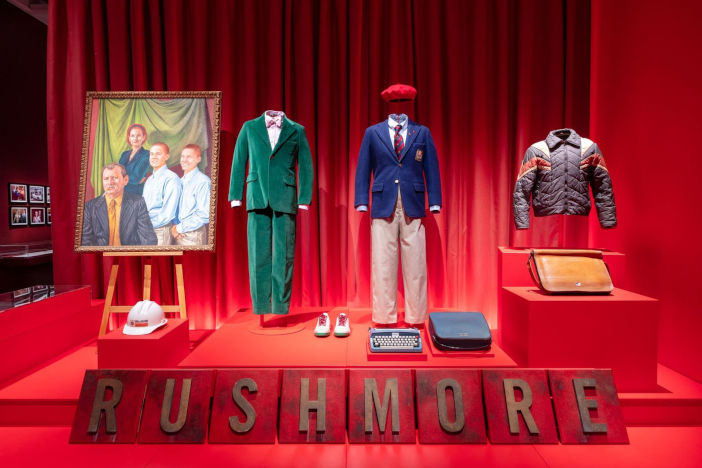
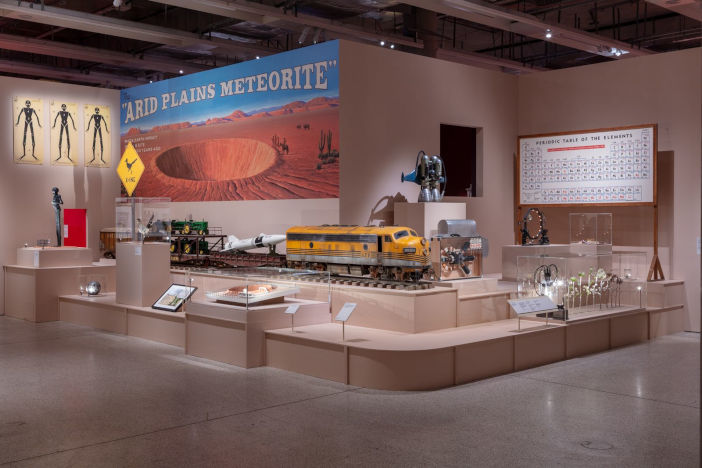
This retrospective, designed by Ab Rogers and curated by Johanna Agerman Ross, Matthieu Orléan and Lucia Savi in collaboration with La Cinémathèque Française, is not only a serious tribute to the most imaginative film-maker on the planet, but succeeds in making visitors fall in love with Wes Anderson films all over again. With something to smile about at every turn, it’s the kind of show that you may well want to visit more than once (admission is free to members), for just like Anderson’s films which have understandably gained a cult following over the years, there is almost too much to notice the first time around. You’ll find everything from props and sets to original storyboards and hand-annotated screenplays, behind-the-scenes polaroid snaps of the production and cast taken on set, besides paintings and sketches, puppets and miniature models. Apart from simply getting the chance to see these objects in real life, it is all the more thrilling given that so many have never been displayed in the UK before now.
The whole experience is that much more atmospheric thanks to the use of soundtrack music piped into the various areas dedicated to an individual film, such as the 1962 Francoise Hardy hit ‘Le Temps De L’amour’ which featured in Moonrise Kingdom (2012) and so perfectly captured Suzy and Sam’s young love affair which eventually compelled the pair to run away – equipped with Suzy’s favourite books and a record player for some slow dancing on the beach. The Scout outfit, worn by the 12-year-old Sam (Jared Gilman) is displayed beside the pink cape coat, knee socks and brogues belonging to Suzy (Kara Hayward), along with the vitally important yellow tent and painted canoe. While Anderson said, “Any romantic feelings for a 12-year-old are like entering into a fantasy world,” he has encouraged all of us to protect or rekindle the more adventurous part of ourselves, open to exploring new ideas and horizons, even if it only involves booking a cinema ticket.
But for me, the most electrifying aspect of the exhibition was seeing the iconic costumes worn by beloved characters close-up, especially those from The Royal Tenenbaums (2001) my favourite Wes Anderson film. In light of Gene Hackman’s recent passing, the double-breasted grey pinstripe suit he sported as the untrustworthy Royal Tenenbaum was especially poignant, an ensemble partnered by the blue dress suit worn by Angelica Houston as his long-suffering ex-wife, Etheline, along with the red Adidas tracksuits worn by Ben Stiller as the safety-conscious Chas Tenenbaum and his on-screen children Ari and Uzi, the cowboy outfit Owen Wilson rocked as Eli Cash and, last but not least, the FENDI fur coat worn by Gwyneth Paltrow as Margot Tenenbaum. (Was the coat protected by a glass case to deter anti-fur protestors I wonder?)
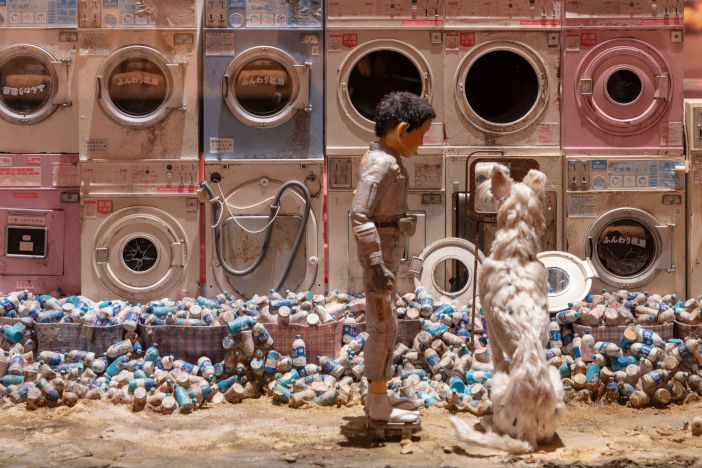
Other exhibition highlights include the set of bespoke Louis Vuitton suitcases, stamped with miniature safari animals, which featured in The Darjeeling Limited (2007), original puppets used to depict sea creatures in The Life Aquatic with Steve Zizou (2004) along with the original casts from Fantastic Mr Fox (2009) lined up in glass cases, with Mr Fox wearing his signature corduroy suit; Anderson’s creative film adaptation of Roald Dahl’s children’s book of the same name which introduced a new generation to both the director and the beauty of handmade film-craft using stop motion animation.
The purple concierge uniform worn by Ralph Fiennes as Monsieur Gustave H. in The Grand Budapest Hotel (2014) is immediately recognisable, showing how integral costume design has always been to how audiences have identified with Anderson’s quirky assortment of characters, besides reinforcing the overall look and feel of each film project. “I feel I get criticized for style over substance,” Anderson once said, “and for details that get in the way of the characters, but every decision I make is how to bring those characters forward.” You won’t be able to miss the large sugar-pink model of the Grand Budapest Hotel which was used for exterior shots. Anderson’s most commercially successful film to date, grossing $172 million worldwide, it was nominated for nine Academy Awards; winning Best Costume Design, Best Makeup and Hairstyling, Best Production Design and Best Original Score, besides receiving eleven BAFTA nominations and scooping those in the same categories as the Academy Awards, along with Best Original Screenplay.
However familiar you happen to be with Anderson’s work, it’s impossible not to be delighted by one of the final displays; a line of retro-looking vending machines in pastel colours which featured in Asteroid City (2023) and offered the characters refrigerated chilled fruit, stockings, cocktails (Martini), coffee, ammunition, candy, snacks, real estate, milk, soup (Campbell’s naturally) and toiletries – perfect for those, like myself, intent on hiding behind one of the larger objects in order to spend the night in Wes Anderson heaven.
Wes Anderson: The Archives at the Design Museum, 224-238 High Street Kensington, London W8 6AG until 26th July 2026. Adult tickets from £19.69, Children aged 6 to 15 from £9.84, Under 6s go free. Concession/Student tickets from £14.77. Members go free. For more information and tickets please visit the website.
Photography by Luke Hayes.