At the Royal Academy of Arts currently, a revelatory exhibition restores the often overlooked 17th c painter Michaelina Wautier to her rightful place – Rosalind Ormiston explores a body of work long obscured by misattribution and neglect…
There is no mistaking the god — naked apart from a strategically placed leopard skin — sprawled in a wooden barrow, pushed by a bearded satyr, half man, half goat. In The Triumph of Bacchus, painted circa 1655-59, we are plunged into a noisy Bacchanalian procession, trumpets sounding as vine leaves, satyrs, a donkey and a goat signal the presence of the Roman god of wine, agriculture and fertility. Reclining supine, head thrown back, he receives juice from freshly squeezed grapes offered by a follower. Around him gather men young and old, alongside Bacchantes — female devotees capable of tearing limbs from animals, or even people. Yet amid the tumult, a semi bare-breasted woman stands calmly at the right, looking directly at us. Is this a portrait historié of the artist herself? Well, yes, it is.
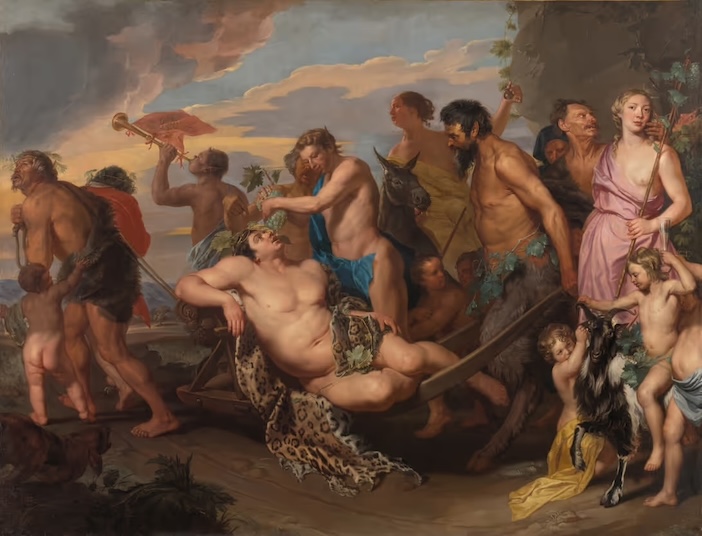
Michaelina Wautier ‘The Triumph of Bacchus’, c. 1655–59 (Kunsthistorisches Museum, Vienna. Photo © KHM-Museumsverband)
The painting introduces the work of Michaelina Wautier, the Mons-born artist of the Spanish Netherlands, a name still unfamiliar to many. A near-contemporary of Artemisia Gentileschi, Wautier, like Gentileschi, learned her craft within a family setting, living and likely working alongside her brother Charles Wautier, a noted portrait painter. Unmarried, she was able in the 1640s to share a home and studio with him in Brussels, close to the Royal Court and its patrons — an arrangement that would have enabled both artistic independence and exchange of ideas.
Her first identifiable work, Portrait of Andrea Cantelmo, is now lost, known only through an engraving. For many years, works by Wautier were misattributed, often to other artists — including Judith Leyster — a pattern that reflects her long neglect. The reconstruction of her oeuvre has revealed a seventeenth-century trailblazer whose achievements were obscured for centuries.
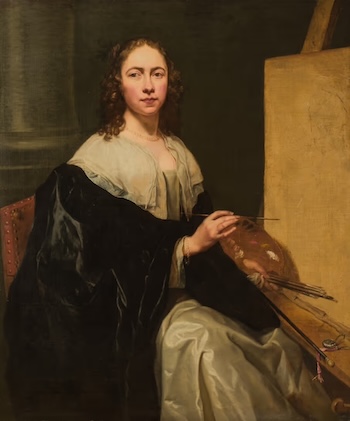
Michaelina Wautier self-portrait c.1650 (Private Collection)
Now, at the Royal Academy of Arts, an exhibition fresh from Vienna (home to The Triumph of Bacchus) brings together her work, offering a compelling reassessment of an artist only rediscovered in recent decades. With few surviving documents — her will was accidentally destroyed during a French bombardment of Brussels — it is through her paintings alone that we piece together her life and career.
The exhibition opens with a striking self-portrait by Wautier, hung alongside a self-portrait by Peter Paul Rubens, inviting comparison between two contemporaries. In her own image, Wautier presents herself elegantly dressed, seated with palette, brushes and mahlstick in hand. A subtle, almost incidental gesture — steadying a silver pocket watch at the edge of her easel — lends the work immediacy. Behind her, a blank canvas awaits: she is poised to paint, asserting her identity as a professional artist.
The breadth of her output is striking. Wautier worked across genres, from still life — as seen in the exquisite Flower Garland with a Butterfly — to religious painting, history scenes and portraiture. Works such as Portrait of Martino Martini demonstrate her skill with adult sitters, while her informal studies of children reveal a remarkable sensitivity to youth and character. Paintings by Charles Wautier are included to highlight the differences in their approaches: Michaelina’s brushwork is looser, her figures more relaxed and naturalistic. In her religious works, saints and sacred figures appear grounded and human, rather than idealised.
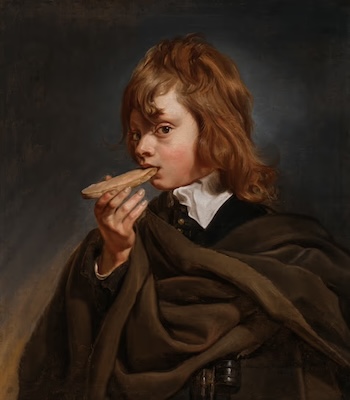
Michaelina Wautier ‘Taste’, c. 1650 (Rose-Marie and Eijk Van Otterloo Collection)
One of the exhibition’s highlights is the Five Senses, a series rediscovered only recently and now shown in Europe for the first time. Five boys represent sight, hearing, smell, taste and touch, set against dark backgrounds and illuminated from the front. Each has a distinct personality — one bites into bread, another recoils at the smell of a rotten egg, while another plays an instrument. These same young models appear elsewhere in her work, suggesting a familiarity that adds to their ease and individuality. It also raises an intriguing question: how did Wautier gain access to so many male models, including for The Triumph of Bacchus, at a time when women artists were rarely permitted to study or depict the male nude?
Her final known work, The Annunciation, presents a surprisingly conversational exchange between the Archangel Gabriel and the Virgin Mary, bringing a sense of immediacy to a traditionally formal subject. Beyond this, little is known of her later life.
What remains, however, is a body of work that confirms Michaelina Wautier as an exceptionally gifted painter. This exhibition firmly restores her to the pantheon of great artists — a ‘new’ Old Master whose time has, at last, come.
Michaelina Wautier runs until 21st June at the Royal Academy of Arts, Piccadilly, London W1J OBD. For more information, please visit www.royalacademy.org.uk.
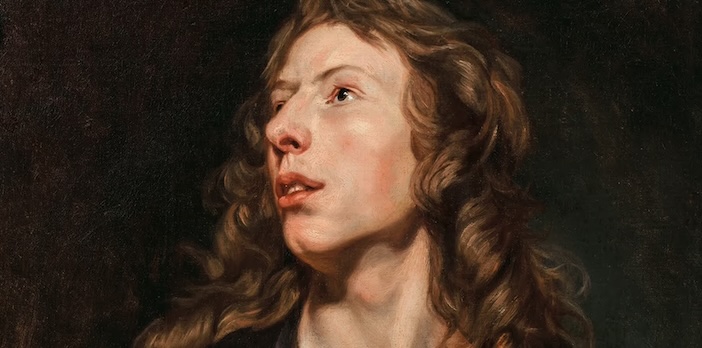
Header image: Detail from Saint John the Evangelist, c. 1656–59 (The Parity Project)