On now at the National Portrait Gallery, ‘Catherine Opie: To Be Seen’ offers a powerful retrospective of identity and portraiture; Rosalind Ormiston looks at how Opie’s deeply personal work reshapes the way we look at ourselves and others…
What does it mean to be seen — and who gets to decide? These questions sit at the heart of portraiture, and few photographers have explored them as compellingly as Catherine Opie. At the National Portrait Gallery, London, Catherine Opie: To Be Seen brings together a remarkable retrospective of her work, spanning three decades and some 80 photographs.
Portraiture has long been Opie’s first love, and she has described the National Portrait Gallery as the ultimate space — a place where painted, photographed and drawn likenesses capture fleeting moments in time, from the anonymous to the famous. It is a fitting setting for this major exhibition, which situates her work within that broader tradition while quietly challenging its conventions.
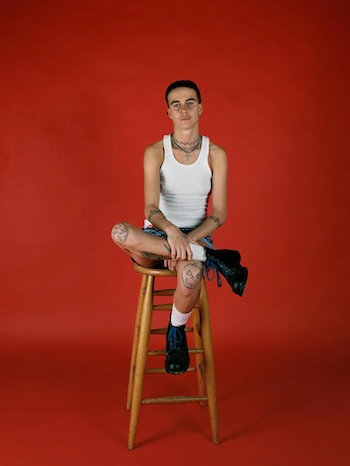
Pig Pen, 1993 © Catherine Opie
Born in 1961 in Sandusky, Ohio, Opie’s fascination with visual culture began early, shaped by magazines such as National Geographic, Life and Look, and a family deeply interested in art. A Kodak Instamatic camera, given to her at the age of nine, set her on a path towards photography. By 29, she was exhibiting in Europe, travelling via the English Channel and arriving first at the cliffs of Dover before heading to London, where she encountered the National Portrait Gallery and began to “grapple” with what portraiture was — and could be.
Now, her vividly coloured works occupy those same gallery spaces, forming what she describes as “a very personal narrative”. The exhibition moves from an early self-portrait at the age of nine through to an expansive body of work that encompasses communities, landscapes, cities and political gatherings. At its core, Opie’s photography is an exploration of identity and humanity — how individuals are seen, and how labels are imposed upon them.
As a lesbian artist, Opie addresses the ways identity can be framed, often negatively, while resisting simplification. Her portraits balance intimacy and confrontation: from the tenderness of breastfeeding her infant son to the unsettling image of her own back marked with deliberate scars. Together, they form a body of work that is both deeply personal and politically resonant.
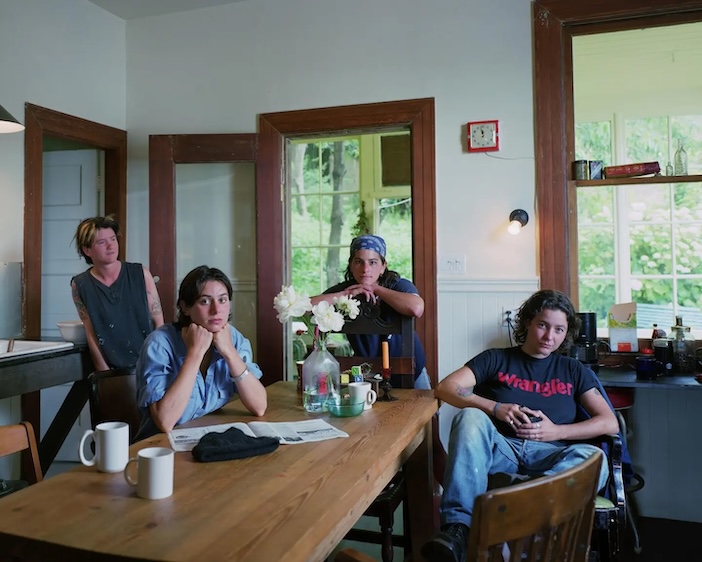
Flipper, Tanya, Chloe, & Harriet, San Francisco (1995)
Opie has remarked that what she values most about the National Portrait Gallery is the sense that “everybody is looking at everybody” — a constant exchange of faces, bodies and ideas. Her installation reflects this dynamic, mirroring both the external appearance and inner life of her subjects. Works such as Bo (1994) and Flipper, Tanya, Chloe & Harriet, San Francisco (1995) create an immediacy that places the viewer almost within the moment of their making.
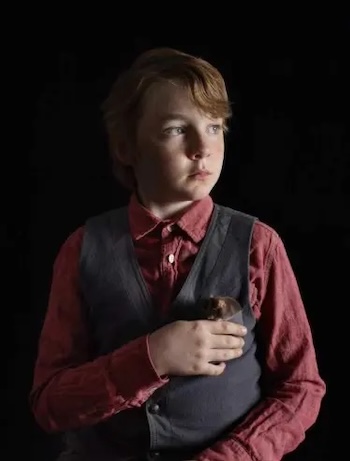
Oliver and Mrs Nibbles (2012)
From the 2010s onwards, Opie introduced a more formal, theatrical style, using dramatic lighting and black velvet backdrops to produce striking, almost painterly portraits. Displayed in the gallery’s ‘red room’, these works subtly reference the Old Masters. In Oliver and Mrs Nibbles (2012), for example, she echoes — without replicating — Lady with an Ermine, drawing a line between Renaissance portraiture and contemporary practice. As Opie herself observes, art is “one long historical dialogue about the times we live in”.
Beyond the main exhibition, several of Opie’s works appear as ‘interventions’ within the Gallery’s permanent collection, inviting dialogue between past and present. Among them is a large-scale family portrait of Elton John and David Furnish with their sons, displayed in the Mary Weston Gallery. These interventions extend the exhibition’s themes, reinforcing Opie’s ongoing inquiry into visibility, representation and belonging.
For those drawn to photography, another compelling exhibition in London is the Deutsche Börse Photography Foundation Prize 2026 at The Photographers’ Gallery. Featuring shortlisted artists Jane Evelyn Atwood, Weronika Gęsicka, Amak Mahmoodian and Rene Matić, the display explores themes ranging from exile and memory to identity, class and the boundaries between photographic fact and fiction. It is a superb and thought-provoking show, and well worth seeing.
Catherine Opie: To Be Seen is on until 31 May, 2026 at the National Portrait Gallery, St Martin’s Place, London, WC2H 0HE. For more information, please visit www.npg.org.uk.
The Deutsche Borse Photography Foundation Prize 2026 is available until 7 June 2026 at The Photographers’ Gallery, 16-18 Ramillies street, London W1F 7LW. Website.
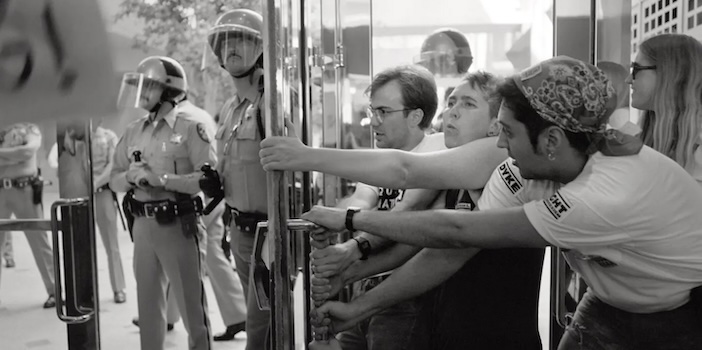
Header image: Detail from AB101 Demonstration (1991)