In Kew Gardens’ vast new Henry Moore exhibition, bronze sculptures, ancient trees and open space combine to create something unexpectedly moving. Sarah Tucker discovers an exhibition that changes not only how we see sculpture, but how we see nature itself…
I recently signed up for a ceramics class in an admirable attempt to reduce my screen time and become the sort of person who says things like, “I’m really enjoying working with clay.”
Instead, I accidentally walked into a life sculpture session featuring a completely naked man standing motionless on a platform. For a moment, I thought west London wellness culture had finally collapsed entirely.
Reader, I stayed.
What followed was unexpectedly transformative. My sculptures looked absolutely nothing like the models. One appeared to have evolved under hostile environmental conditions. Another resembled a philosophical turnip. Yet somehow they still carried emotional weight.
Which is perhaps why Henry Moore remains so compelling.
Born in 1898 and dead by 1986 — but still intellectually healthier than most people currently posting productivity advice online — Moore understood that realism is frequently overrated. His forms are distorted, abstracted, pierced with openings and impossible curves. Yet standing among them at Kew Gardens during the magnificent Henry Moore: Monumental Nature exhibition, they feel more alive than many perfectly realistic statues.
Kew has excelled itself.
This is the largest outdoor exhibition of Moore’s work ever staged, with 30 monumental sculptures installed across the gardens and more than 90 additional works housed inside the Shirley Sherwood Gallery of Botanical Art.
Crucially, the sculptures are not simply placed in the gardens. They converse with them.
Moore always believed sculpture belonged outdoors. He famously described sculpture as “an art of the open air”, and at Kew you finally understand the full seriousness of that conviction. Museums suddenly seem slightly absurd afterwards. Inside white galleries, sculpture behaves politely. At Kew, Moore’s bronzes become elemental.
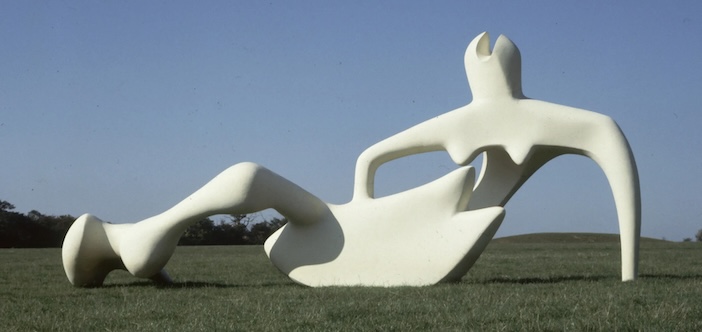
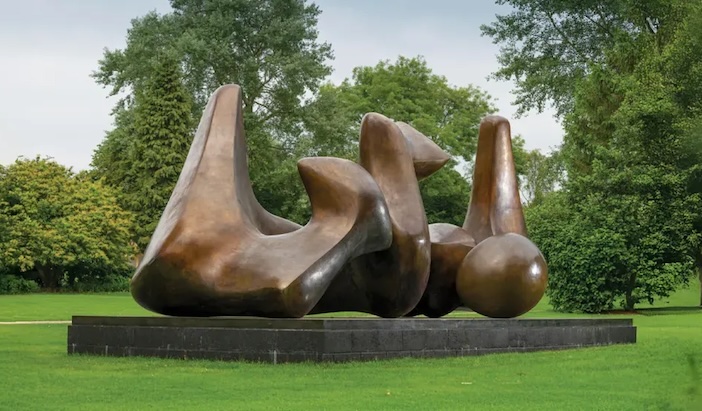
Large Reclining Figure 1983-84 Photo by Errol Jackson
They emerge through trees like prehistoric discoveries. Some appear half-hidden beyond winding pathways. Others sit beside water where reflections distort them further. Light moves continuously across their surfaces, changing the emotional temperature of the work every few minutes.
You cannot simply glance at these sculptures, you must orbit them. And somewhere between one pathway and another, you begin seeing nature differently too.
That is what makes the exhibition unexpectedly profound. Trees stop functioning as background scenery and begin looking strangely anatomical. Branches resemble limbs. Roots become musculature. Trunks suggest torsos.
Or perhaps the opposite happens. Perhaps you realise human bodies have always resembled trees.
The Shirley Sherwood exhibition explores Moore’s lifelong fascination with natural forms — bones, stones, roots, shells and landscapes. I was particularly charmed to learn that while travelling in Italy, Moore found himself missing English trees: thick trunks, dense canopies, proper northern heft rather than elegant Mediterranean verticality. (As an aside, do look at the books not only on Henry Moore, but also on Shirley Sherwood herself. A fascinating woman.)
There is something wonderfully reassuring about a globally celebrated artist essentially becoming homesick for sturdy trees. Frankly, a man who adored both his mother and English woodland sounds emotionally overqualified for modern life.
Motherhood and protection recur constantly throughout Moore’s work. His reclining figures and mother-and-child sculptures are full of sheltering spaces and protective curves. While wandering through the exhibition, I watched two geese escorting an improbable number of goslings across the grass with military precision.
The scene looked so perfectly aligned with Moore’s themes of nurture and protection that it bordered on aggressive curation. And yet that is precisely the genius of situating Moore at Kew. The sculptures stop feeling symbolic because nature keeps quietly demonstrating the same forms nearby.
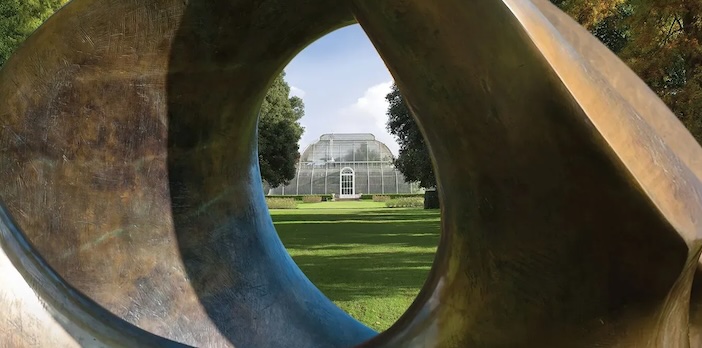
One of the exhibition’s cleverest achievements is its understanding of perspective. Moore was obsessed with internal and external forms — with the relationship between solid objects and empty spaces. At Kew, gaps within the sculptures frame branches, sky and passing visitors. You look through bronze and suddenly notice the landscape differently.
It is difficult not to interpret this psychologically. Modern life encourages relentless closeness. We hover inches from screens all day. Everything feels immediate, urgent and emotionally oversized.
Kew restores distance.
Trees operate on entirely different timescales, and Moore’s sculptures slow you down physically because they demand movement around them. Nothing loads instantly. You have to walk.
The result is oddly calming. More calming, frankly, than many luxury wellness experiences involving fermented beverages and attractive people explaining breathing.
As someone who teaches yoga, I feel qualified to say this.
There is also tremendous pleasure in the sheer scale of it all. Kew’s landscape gives Moore room to breathe. These works were designed for weather, not ceilings. The exhibition guide helpfully maps all 30 sculptures, though many are sufficiently enormous to be identified from space.
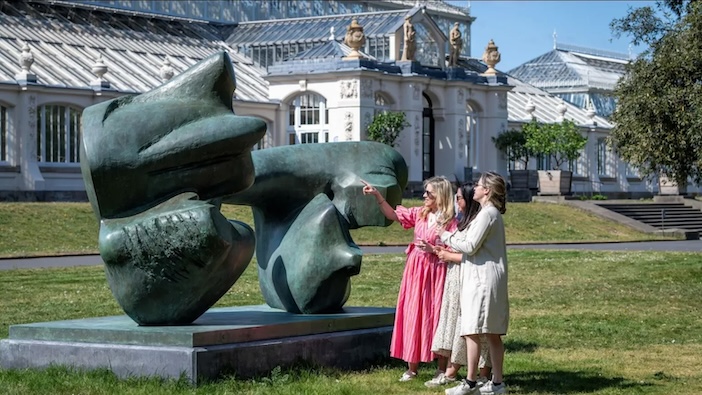
A small note regarding behaviour: please do not climb on the sculptures.
Kew has displayed several signs requesting precisely this, and yet every few minutes one witnesses another adult attempting to mount a Henry Moore bronze as though auditioning unsuccessfully for an arts-based cavalry regiment.
Don’t.
The sculptures are infinitely better viewed from a distance. Besides, public humiliation is exhausting in humid weather.
If you have been considering visiting Kew Gardens, go now. Not eventually. Not “when things calm down”.
They won’t.
This exhibition runs until 31 January and genuinely feels like one of the rare cultural experiences that alters perception rather than merely filling an afternoon.
You leave seeing trees differently. And perhaps yourself as well.
Which is rather a lot to ask from bronze.
Henry Moore: Monumental Nature at Kew Gardens is now open and running until 31st January 2027. For more information, including details of the walking and wine tours, after hours events, and for tickets, please visit www.kew.org.
Photos courtesy of Kew Gardens