Feted as a Royal Academy prodigy, then locked away for stabbing his own father to death, Richard Dadd spent the next four decades painting fairies from inside an asylum cell. Rosalind Ormiston previews ‘Beyond Bedlam’, the RA’s remarkable retrospective of his life and work, which opens today…
Kent-born Richard Dadd, a student at London’s Royal Academy of Arts School from 1837, emerged as a talented painter in the 1840s, his art taking inspiration from Shakespeare’s plays and a sojourn across the Eastern Mediterranean in 1842/43. His career was abruptly halted when, in the summer of 1843, he stabbed his father Robert Dadd to death during a walk in Cobham Park, near Rochester. Fleeing to France, Dadd tried to murder a stranger on a stagecoach journey. He was caught by the French authorities and placed in the Clermont-de-l’Oise asylum, north of Paris, in September that year. From that moment, his career as an artist changed course entirely.
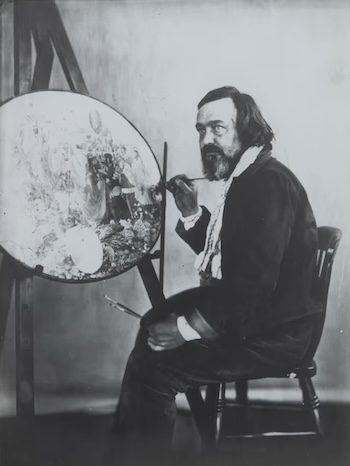
Henry Hering, Portrait of Richard Dadd, c.1857.
Courtesy of Bethlem Museum of the Mind. Alex Fox (Roy Fox Fine Art Photography)
Dadd was transferred from France to England and, at the age of twenty-seven, declared insane before trial for murder. In August 1844 he was sent to Bethlem (Bedlam) Hospital, an asylum in London for the mentally ill, with a separate wing for the criminally insane. His younger brother had been admitted to Bethlem the previous year for insanity, and of the seven children born to Robert Dadd, four would be declared mentally ill. The next forty-two years of Richard Dadd’s life, until his death from tuberculosis in 1886, were spent painting while incarcerated in institutions for the criminally insane. His remarkable trajectory — from art student, to painter, to killer, to posthumously-famed painter of fairy scenes — is the subject of the Royal Academy’s exhibition ‘Richard Dadd: Beyond Bedlam’.
Dadd enrolled at the Royal Academy Schools aged nineteen and, after a probationary term, was given a permanent place. He was a popular student, active as a member of a sketching club known as the Clique, alongside his friends and fellow artists Frith and Egg. It was during his RA years that he created works based on Shakespearean plays, such as Titania Sleeping (1841), drawn from A Midsummer Night’s Dream. Dadd exhibited the painting, an intricate composition, at the Royal Academy Summer Exhibition the same year. Other works, including Puck (1841), established him as a painter of fairies, and his success led to commissions drawing on his gift for interpreting lyric prose. He was a poet, too.
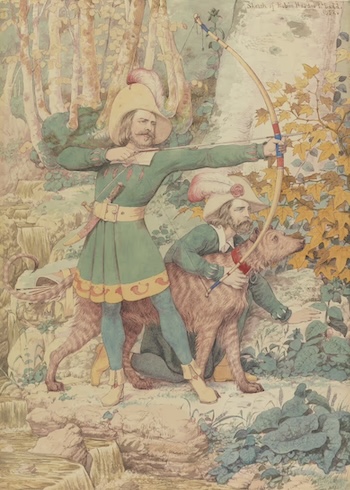
Richard Dadd, ‘Robin Hood’, 1852 (Yale Center for British Art, Paul Mellon Collection)
What led Richard Dadd to murder his father? Robert Dadd was a well-connected man and a friend of the noted painter David Roberts; both were instrumental in Richard being offered a place accompanying the wealthy South Wales solicitor Sir Thomas Phillips on a ten-month tour through the Eastern Mediterranean, taking in Greece, Turkey, Syria and Egypt from May 1842. Dadd travelled as Phillips’s artist-companion, his drawings and paintings serving as payment in lieu of living and travel expenses. However, the fast pace of the “grand tour” that Phillips set left him little time to paint. Dadd later worked from memory of what he had seen, producing works such as the Orientalist oil painting Caravanserai at Mylasa (1845), one of the earliest pieces he created in Bethlem.
The inability to paint on tour may have affected Dadd’s mental health. Toward the end of the trip, Phillips noticed changes in Dadd’s mental state, and after their stay in Egypt he became delusional, becoming convinced that his true father was the Egyptian god Osiris, and that his father Robert was therefore an imposter. This delusion led him to kill his real father, as if to confirm an allegiance to Osiris. After his arrest, police officers searching Dadd’s residence found drawings he had made of three of his friends, each with their throats cut. His mind was disturbed, and the act of patricide led to permanent imprisonment in institutions for the criminally insane.
Dadd created multiple fairy paintings during his incarceration: from August 1844 to 1864 in Bethlem Hospital and for a further twenty-two years, from 1864 to 1886, in the state’s purpose-built Criminal Lunatic Asylum at Broadmoor in Berkshire. With his personal freedom gone, his paintings were built from memory, earlier sketchbooks, and imagination, many of them filled with intense detail. Beyond Bedlam brings together around 100 works, including key paintings Contradiction: Oberon and Titania (1854-58) and Bacchanalian Scene (1862).
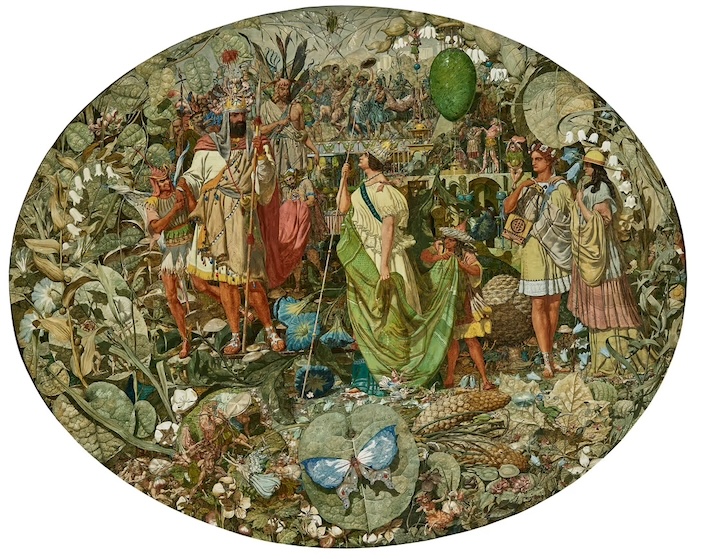
Richard Dadd, ‘Contradiction. Oberon and Titania’, 1854-58 (Private Collection. Photo: David Parmiter)
The exhibition, curated by Nicholas Tromans, author of Richard Dadd: The Artist and the Asylum, and Sylvie Broussine, Associate Curator at the Royal Academy, chronicles Dadd’s life from his early years to his accreditation as an artist, his travels through the Mediterranean, and his years as a prisoner-painter, during which he produced both personal works and pieces for the asylum itself, including wall murals and theatre backdrops.
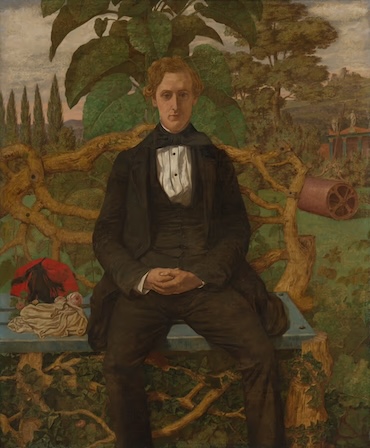
Richard Dadd, ‘Portrait of a Young Man’, 1853 (Tate: Bequeathed by Ian L. Phillips 1984)
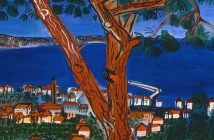
The exhibition includes beautiful watercolour seascapes, possibly reminiscences of Dadd’s upbringing in the maritime town of Chatham, Kent — The Pilot Boat (1858-59) is superb. Other works depict places drawn entirely from imagination, such as Port Stragglin (1861), on the reverse of which Dadd wrote “Not sketched from Nature”. Many were reimagined from his Mediterranean travels, among them Fantaisie Égyptienne (1865) and View of the Ancient City of Tlos in Lycia (1883), both in watercolour. He also portrayed his keepers at Bethlem and Broadmoor: fine examples include Portrait of a Young Man (1853), probably a likeness of Dr Charles Hood, a superintendent at Bethlem; a portrait of Sir Alexander Morison, visiting physician at Bethlem; and Dr William Orange (1875), a medical superintendent at Broadmoor.
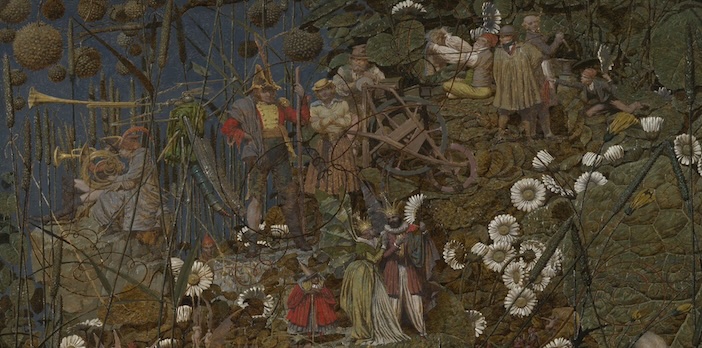
After Dadd’s death in 1886, his works passed mainly into the hands of private collectors, many of them staff at Bethlem and Broadmoor to whom he had given pieces directly. This changed in 1963, nearly eighty years later, when the war poet Siegfried Sassoon — born the year that Dadd died — donated Dadd’s major work The Fairy Feller’s Master-Stroke (1855-64) to the Tate. Sassoon gave it in memory of three of Dadd’s great-nephews, Julian, Edmund and Stephen T. Dadd, brothers who had served as officers in the Royal Welsh Fusiliers alongside Sassoon during the First World War.
Nine years later, in 1974, the Tate staged a major retrospective of Dadd’s work, reviving his memory for a new audience. That same year, the pop group Queen paid tribute with a song written by Freddie Mercury for their second album, Queen II, released in March 1974, its lyrics drawing directly on characters visible in Dadd’s painting. Mercury is said to have taken the band to view the work at the Tate.
Over fifty years on from that revival, the Royal Academy now brings Richard Dadd back to where his career began, in an impressive exploration of his life and work.
Richard Dadd: Beyond Bedlam opens on 25th July and runs until 25th October at the Royal Academy of Arts, Piccadilly, London W1J 0BD. For more information, and for tickets, please visit www.royalacademy.org.