(Editor’s note: We were deeply saddened to learn that Matthew Jukes passed away shortly after this piece was published. We’re leaving it as it stands, as a warm and accurate record of a very good lunch, and our thoughts are with everyone who knew and loved him.)
In which Larry dines with wine legend Matthew Jukes at Tamarind of Mayfair – sommelier, author, outspoken wine writer, and the man behind an eponymous range of drinks built to do everything wine does, minus the wine…
There is a particular thread of confidence that comes from having spent forty years telling other people what to drink, and Matthew Jukes has it in spades. We meet at Tamarind of Mayfair, a restaurant for whose wine list he has, in his own words, “just something I do as a favour, because they’re such lovely people” – and within about ninety seconds of sitting down he has already dismantled the entire premise of what non-alcoholic drinks are supposed to be.
“All sweet, insipid, don’t taste anything like the real thing,” he says, of the alcohol-free wines his Daily Mail editor spent twenty-two years trying to get him to write about. He refused every time. “You’re conning yourself, really,” he says of these non-alcoholic pretenders, “you know you’re holding a fake gin and tonic and you’re trying to enjoy it like it’s a real gin and tonic. Mmm, delish. It doesn’t quite work.”
It’s a bracing opener for a lunch built around the alternative he eventually invented instead – but then Jukes has never been much of a fence-sitter. Twenty-six years writing the wine list at Bibendum in the old Michelin building, a Times #1 bestseller, a BBC radio show, fourteen books, a twenty-year Money Week column he still files every Friday: this is a man who has spent a career with a very firm point of view. And it was an Indian restaurant group, not a wine connection, that gave him his most unlikely credential. Consulting for Amaya, Veeraswamy and Chutney Mary, he became – by his account, and it checks out – the first person to take Indian food and wine pairing seriously. Amaya got a Michelin star on the back of it. Which is roughly why we are here today, working through a tasting menu at Tamarind designed not to showcase wine at all, but the range of vinegar-based drinks that now carries his name.
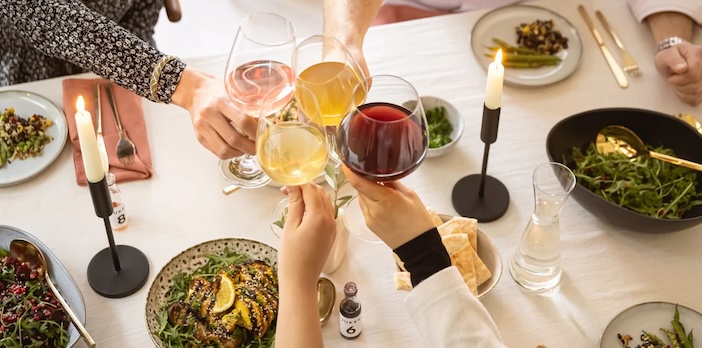
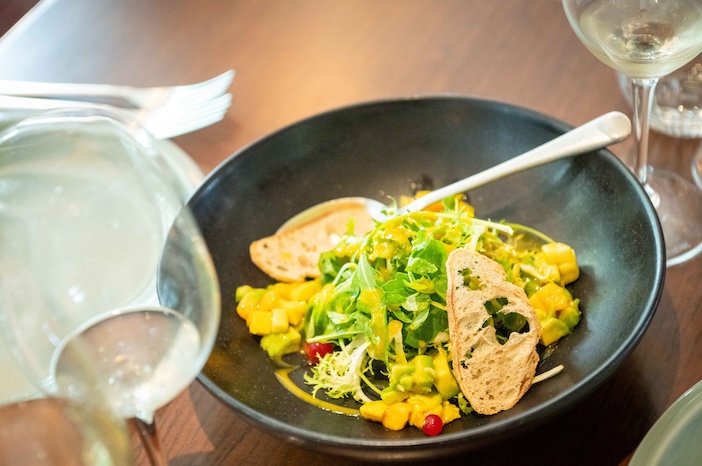
The menu arrives in waves – mango and avocado salad first, “help yourself, dive in, snatch or starve” – each dish paired with a different Jukes cordial, poured from those elegant little bottles designed, it transpires, by two of the most significant designers in Britain you’ve likely never heard of. More on that shortly. First, the important bit: what’s actually in the glass, and why.
The story starts, unpromisingly, with a New York dinner nine years ago. Jukes was in the city on behalf of Sacha Lichine – the man behind Whispering Angel – telling sommeliers that rosé could be aged. Seated next to Sally Singer, then editor of Vogue.com, on a Tuesday night, he watched her order wine and describe it as an act of minor rebellion. “New York is now basically wine-free during the week,” he recalls her telling him. “If one of your rivals from another bank spots you having a glass of wine at lunch, they’ll phone your boss.” He came home convinced the same shift – abstemious weeknights, booze-free lunches – was heading for London. He just had to work out what to put in the glass.
He didn’t know what that might be, so he did what he always does when he’s stuck: he looked backwards. “Every newsflash you hear this morning,” he says, settling into the anecdote, “you go, ‘seen that before, that’s happened before’, we know how to solve it. History teaches us.” The answer he landed on, then, was pleasingly old-fashioned: a haymaker’s punch, the drink eighteenth-century farm labourers made from whatever was left over on the kitchen table – bruised fruit, peel, stalks, pips – steeped in apple cider vinegar and sweetened into a rough cordial.
He tried it, rebuilding the recipe from proper ingredients, stripped out the sugar, and spent two years – first in his own kitchen in Clapham, later in a borrowed commercial kitchen in Battersea that is still Jukes’ home – making single-note macerations of different fruits, vegetables, herbs and spices, then blending them the way a winemaker blends a cuvée. Over two hundred attempts, by his reckoning.
“Two hundred?!” I ask, if a little too incredulously, “so, was there a moment it clicked?”
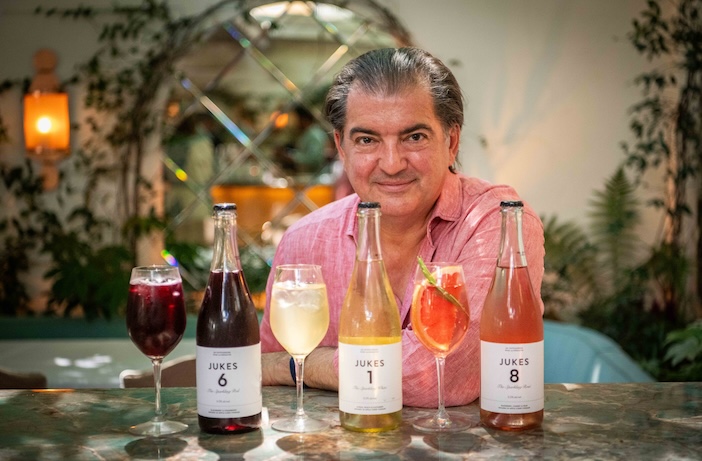
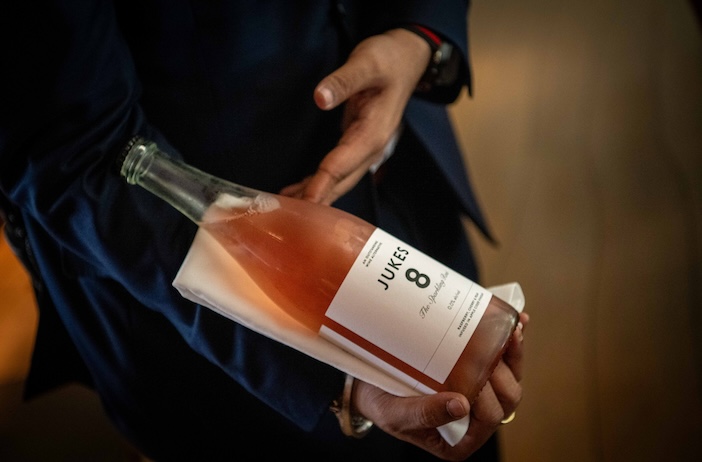
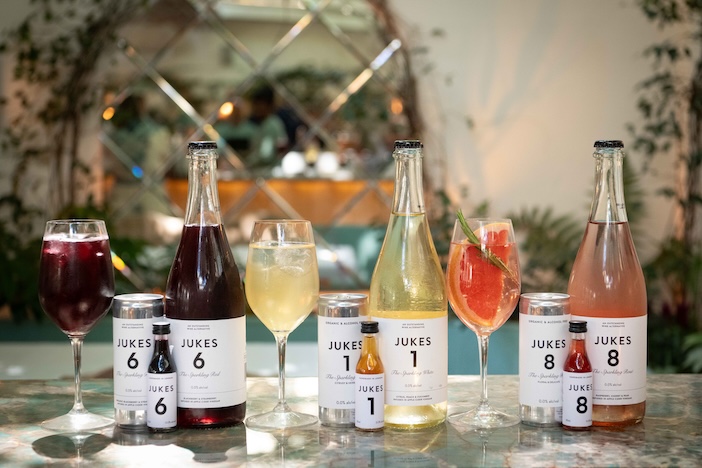
“Absolutely,” he tells me, holding up Jukes 6. “This. If you can make a dark red anything, you’ve nailed it. It’s much easier to make a rosé.” The beetroot-anchored red, by his own account the one that took a full year to balance, was the breakthrough.
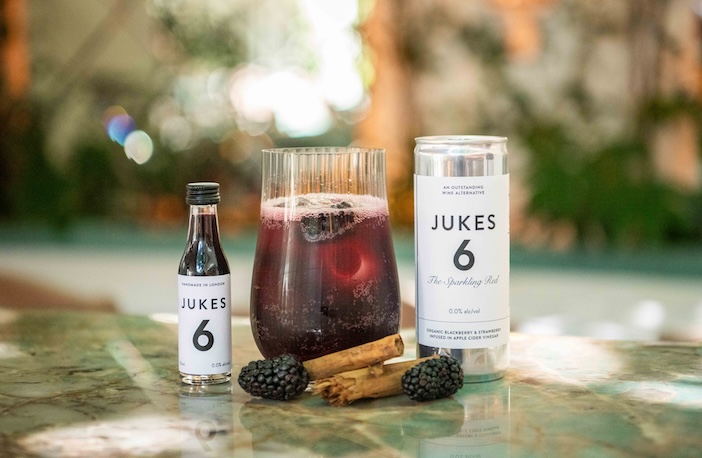
What lands on the table over lunch, then, isn’t a de-alcoholised anything, and Jukes is prickly, in the nicest possible way, about the distinction. Every drink is built on real macerated fruit – a “fruit camp” balanced against an “anti-fruit camp” of vegetables, herbs and spice, “otherwise you’d end up with a fruity, sweet kids’ drink” – steeped for around a week in an organic apple cider vinegar sourced from Milan, itself the product of its own small odyssey to find the right one. From there it’s pressed, blended, lightly sweetened “to clip the tail off the vinegar,” and pasteurised. The vinegar, he explains, does something alcohol does structurally, if not chemically; “it gives the drink grip, a little kick at the back of the palate…something for the fruit flavours to hang off — like a washing line.”
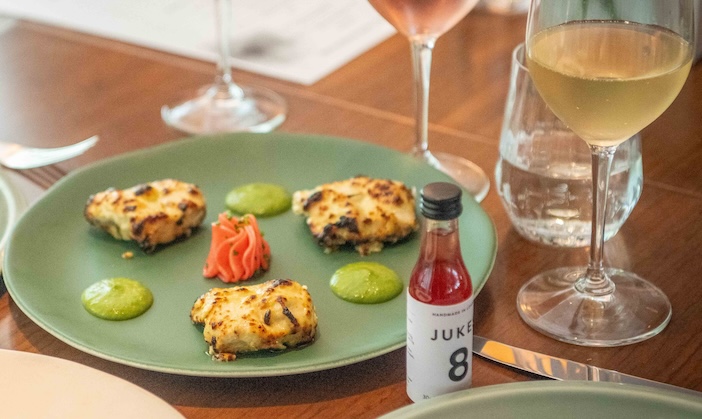
There’s a showman’s satisfaction in watching him talk through the range against the food – Jukes 1, the white, alongside the mango and avocado; the deeper, spicier Jukes 6 as the curries arrive, a tandoori chicken tikka and astounding crispy lobster – and it’s here the Tamarind pairing earns its keep. Indian food, with its layered spices, turns out to be an unusually generous partner for a drink built on vinegar and maceration; the same qualities that make it notoriously tricky to pair with wine make it a natural match for something designed, from the outset, to behave like one.
The cleverest bit of staging, though, came from the trade itself. When 67 Pall Mall – “the snootiest wine club in London,” by Jukes’s own account – took the drinks on, they refused to put the bottles on the table at all. Instead, they bought a stack of French brasserie-style carafes, decanted the cordial into those, and set them down next to the wine glasses. Indistinguishable from wine, its members’ dignity duly upheld, they were a huge success. It’s since become the unofficial industry playbook, copied everywhere from a boutique hotel on the Isle of Wight to superyachts moored off the Med.
The design story, when it surfaces mid-meal, is a proper diversion. It traces back to a coffee table Jukes commissioned in the mid-90s for a wine bar he owned on the Fulham Road, designed by two Royal College of Art students he simply calls ‘the boys’ – Jay Osgerby and Edward Barber, who went on to design the London 2012 Olympic Torch and the interiors of the Elizabeth Line, and whose rejected coffee table (too low, Jukes told them at the time, send it back) now sits in MoMA, the V&A and the Design Museum.
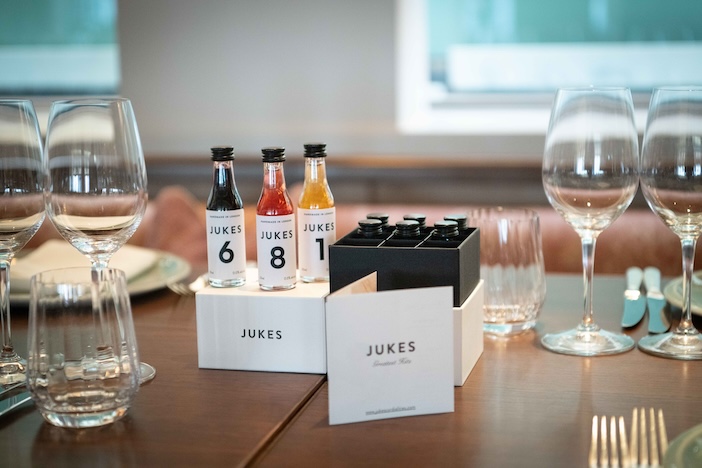
Decades on, the same two designed the Jukes labels and the box the bottles arrive in – a perfect, near-featureless white cube, almost devoid of text, that would sit very happily on a plinth beside their table a floor away. Each bottle, in fact, is a miniature: precisely two servings, a line etched into the label marking where to stop pouring, small enough to travel in a handbag and appear, with a flourish, somewhere over Berkshire, say. The same instinct for portability shows up in carbonated form too, in a line of ready-to-drink cans built for the train, the beach bag, the picnic rug – everything the bottles were designed for, just without the glass.
Since the tenacity of that kitchen table beginning, the business has grown into something rather more than a clever bottle, mind: four consecutive years topping the World Alcohol-Free Awards, organic and halal certification, listings from Fortnum & Mason to three-Michelin-starred Arpège in Paris and Alinea in Chicago, cans landing in Waitrose and, from September, Marks & Spencer. America, run by his business partner, now outsells the UK.
What stays with you, though, isn’t the growth chart – it’s the argument underneath it, delivered somewhere between the second and third course with the unshakeable confidence of a man who has spent his whole career telling people what to drink and rarely being wrong. You shouldn’t have to justify not drinking, and you shouldn’t have to settle for something that tastes like an apology either. Lunch with Matthew Jukes doesn’t feel like either. It feels, gratifyingly, like lunch.
The full Jukes range, including bottles, cans and gift boxes – as well as ideas for mixers and cocktails – is available at www.jukescordialities.com, and stockists including Waitrose and Selfridges, alongside Believe, the new lower-priced ‘pret-a-porter’ line recently launched into Tesco.
Tamarind of Mayfair, 20 Queen Street, London W1J 5PR. For more information, visit www.tamarindrestaurant.com.