The Oxford Collection has spent four decades building hotels and restaurants which could belong nowhere else. Douglas Blyde checks into 36 St. Giles and dines at the newly reworked Gees Market…
Hospitality increasingly resembles forestry by spreadsheet. Old businesses are felled, parcelled into portfolios and replanted beneath whichever investment house won the auction. Restaurants become ‘concepts’, hotels ‘assets’, guests ‘occupancy figures’. In Oxford, Jeremy Mogford has spent more than four decades doing the reverse: building a close-knit group of hotels, restaurants and residences which share his eye without surrendering their individual characters.
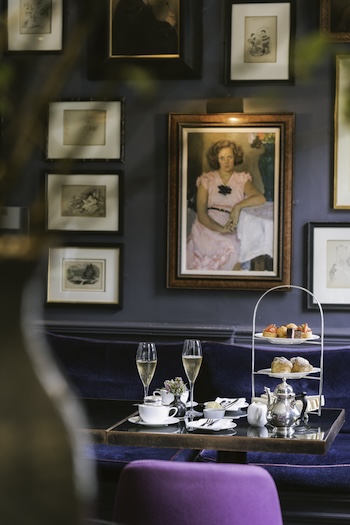 Old Bank became Oxford’s assured front room, with Quod as its bustling civic brasserie; Old Parsonage its bookish retreat, with Parsonage Grill as its clubby dining room; and Gees Market the democratic glasshouse where professors, publishers, politicians, parents and students eat beneath the same panes. The newest arrival, 36 St. Giles, turns the same instinct towards longer stays. Together, they answer a question troubling British hospitality: how does a business grow without becoming generic?
Staying put
Mogford understood how readily a restaurant idea could travel long before replication became the industry’s obsession. With John Mayhew, he opened the first Browns in Brighton in 1973, expanded it to seven restaurants, largely in university cities, and sold the group to Bass in 1996. Time has sharpened the contrast. The original Duke Street Browns closed in May 2025 after 52 years when negotiations for a new lease failed; Kingston’s Riverside Walk branch followed this year, after earlier departures from Reading and Mayfair.
Oxford supplies the more interesting scene. Browns still trades on Woodstock Road, near the fork with Banbury Road. Walk from Old Parsonage towards 36 St. Giles and the national brand Mogford sold sits almost indecently between the addresses he continued to develop.
This is not a simple tale of wicked chains and saintly independents. Oxford Browns survives because the original idea still has force. The sharper point lies in what followed: one business was reproduced across Britain; the other accumulated art, courtyards, fountains, long-serving staff and architectural complications within one city.
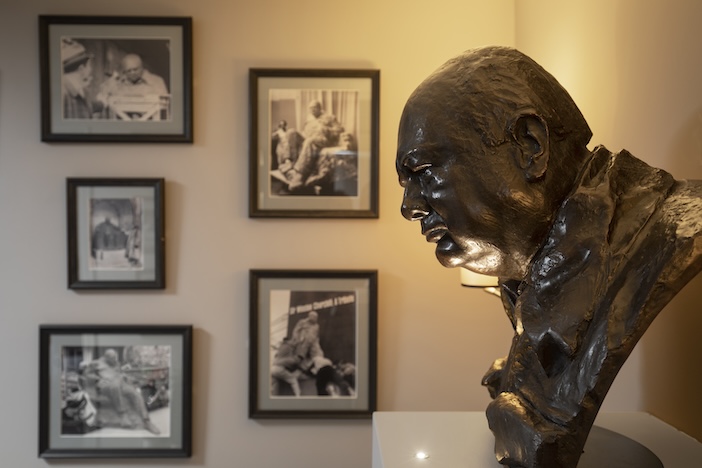
Independence guarantees nothing. Proprietors may be erratic, vain or slow to change, while a board can sometimes stop an owner confusing whim with vision. Yet private ownership can look beyond the next reporting period. A dining room may be rebuilt because it must serve another generation; a chef may be backed without becoming the prototype for a nationwide rollout; a painting may be bought because somebody responds to it, not because it behaves beside the curtains.
The human continuity is equally persuasive. Rebecca Mofford, now managing director, began as a trainee manager at Gees, later ran Quod, and returned to senior roles across Old Parsonage and Gees before taking charge of the wider business. Her route through the company says more about its culture than any corridor of corporate values.
A market under glass
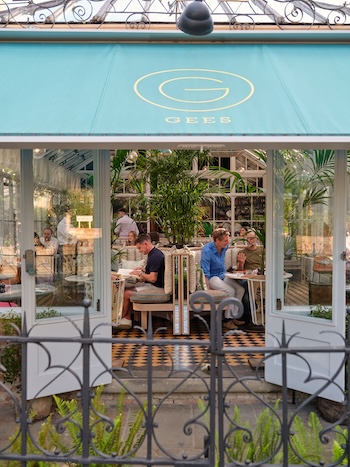 Gees is now Gees Market, a modest alteration with unusually credible roots. Outside, wooden produce crates stamped ‘Gees’ recall the building’s first trade before one reaches the door. The Victorian glasshouse was built in 1897 for the Gee family’s nursery, florist and greengrocery business. The connection remains personal: during my research, a fellow writer replied, ‘Where my parents’ wedding flowers came from!’
Mogford acquired the lease from the family and the freehold from Oxford University in 1982. From 1985 to 1989, it housed Raymond Blanc’s first Petit Blanc, with John Burton Race and Christine Burton Race recruited as chef and manager. Gees followed in 1989. The address has passed from nursery to French restaurant to neighbourhood institution without treating any chapter as final.
The family connection continues beyond the lettering. Medley Manor Farm in Binsey, acquired by the Gees in 1958 and now run by Charlie and Rachel Gee, grows asparagus, strawberries, raspberries and other crops within the city of Oxford. A restaurant occupying the former Gee nursery is still supplied by a Gee: one need not shake the family tree very hard before the fruit lands in the kitchen. In an industry ruled by central purchasing and ingredients which may travel farther than the diners, the route from Binsey to Banbury Road is remarkably concise.
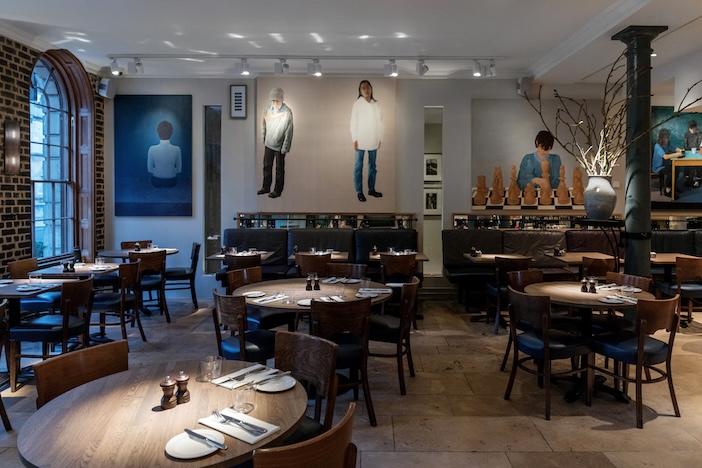
The latest reworking handles the glasshouse with similar intelligence. Cushioned booths, richer fabrics and sheltered corners bring intimacy to a room which once exposed every table to every other. Pale fabric ‘sails’ run around the windows, softening fierce summer light without concealing the ironwork, while palms occupy the height without pretending the conservatory remains a working nursery.
Most usefully, air conditioning delivered a delicious refrigerated rush on a hot July afternoon. Conservatories often photograph better than they lunch; Gees Market gave us brightness without broiling us.
Smoke, shade and water
Architecture and provenance cannot rescue an indifferent meal. Happily, new head chef Nick Galer brings appetite as well as biography. His career includes The Crown at Bray, eight years at The Miller of Mansfield and, most recently, The Pot Kiln. He is joined by new restaurant manager Tom Bunnell-Pyper. At Gees Market, British produce, Mediterranean ease and Asian spice meet without making the menu resemble a stack of boarding passes.
Oysters are a Mogford obsession, appearing at every restaurant in the Collection. Smoked eel with beetroot and creamed horseradish was rich, deeply savoury and sharpened by sweetness and heat. Gazpacho was juicy and vivid, while squid carried the grill without losing tenderness. Tandoori quail arrived butterflied, evenly cooked and steeped in spice.
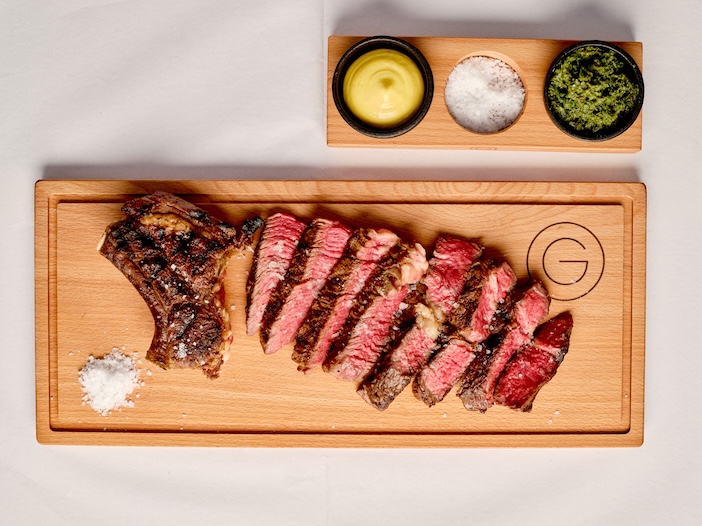
The strongest dish was monkfish tail served on the bone, its muscular flesh pearly, subtly smoky and cooked with exactitude. Monkfish readily becomes fibrous; this one had been handled, then wisely left alone. Crab linguine, an established Gees favourite retained through the reworking, strayed a little beyond al dente, although such generosity with sweet crab made sustained objection feel mean.
A lemon tart ended dinner beneath a glassy, crème-brûlée-like top, the spoon breaking through caramel into emphatic citrus, with bramble sorbet supplying darker fruit and acidity. Galer’s menu roams widely, yet smoke, generosity and appetite provide the route home. His task is not to overthrow Gees Market, but to put its previous lives to use.
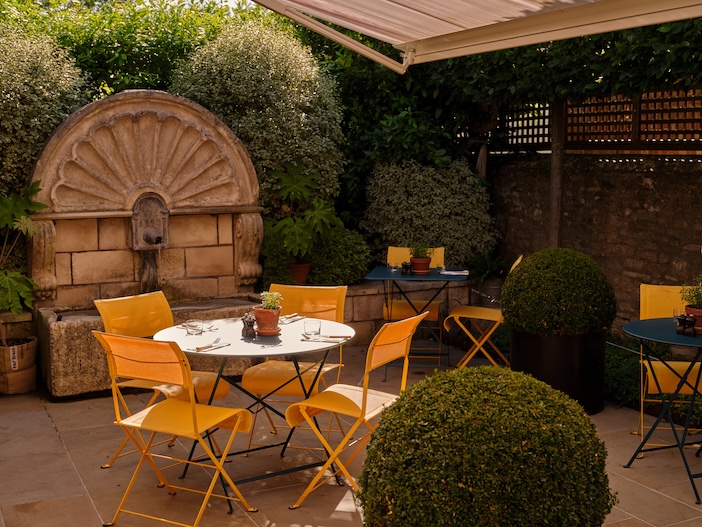
Beyond the glasshouse, a canopy reaches across the Secret Garden beside a fountain, while the adjoining Gees Gallery offers an art-filled private dining room and bar for 36 seated guests.
Quod hides a shaded Italian courtyard and running water behind the High Street; Old Parsonage has another enclosed terrace arranged around stone, foliage and its own fountain. Three outdoor rooms, three variations on the same Oxford trick: turn away from traffic, add leaves, water, oysters, and martinis, and let lunch forget the buses.
Fire, art and bells
The same hand is visible at 36 St. Giles, although the mood becomes domestic. Its two self-contained residences are serviced by the Old Parsonage team and equipped for stays extending well beyond a weekend, with expansive living areas, kitchenettes, workspaces and Carrara-marble bathrooms.
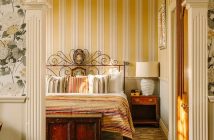
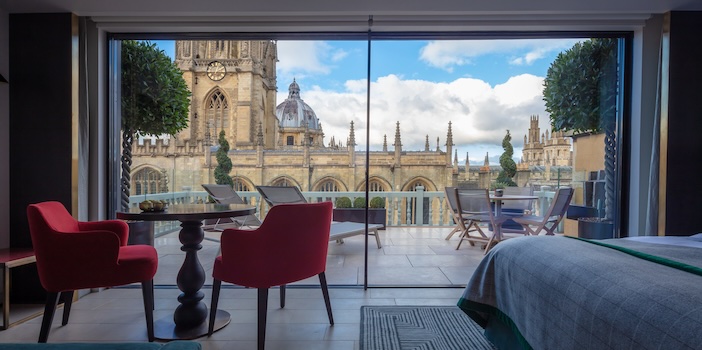
We stayed in No. 1, where high ceilings and intricate cornicing give the room amplitude, while bright modern canvases from Mogford’s personal holdings keep the pale interior alert.
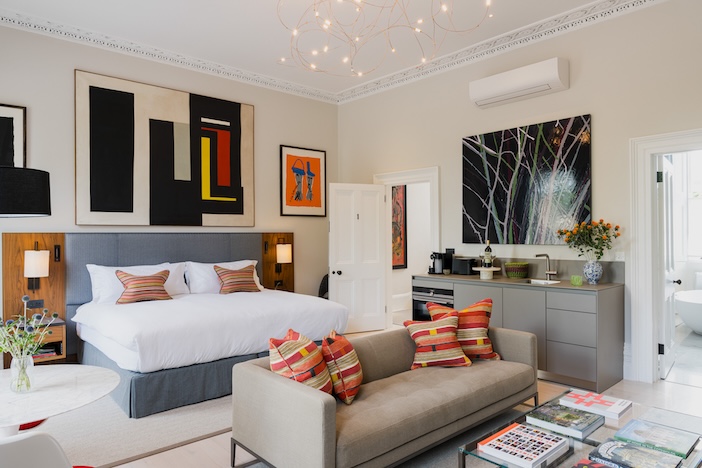
A gas fire anchors the main room; another burns beside the bath in the vast bathroom, an extravagance both improbable and deeply enjoyable. The apartment allowed three people to read, work and withdraw from one another without the negotiations imposed by a conventional hotel bedroom. It felt less like accommodation organised around nightly turnover than a temporary Oxford home for guests with lives to continue.
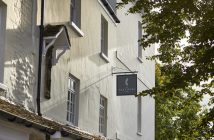
Outside the vast sash windows, with their original shutters, bells travelled across St. Giles. A blue plaque on the adjoining house commemorates Annie Rogers, the classicist and ‘ceaseless campaigner’ for women’s full membership of Oxford University, finally achieved in 1920. She lived at 35 St. Giles from 1891 to 1899 and possessed a horticultural streak, reportedly concealing unauthorised cuttings from college gardens inside her umbrella.
Built to belong
Rogers’s botanical contraband became an unexpectedly apt preface to ‘In Bloom: How Plants Changed Our World’, which we saw at the Ashmolean during our stay. Through more than 100 artworks and objects, the exhibition traced the role of plants in exploration, trade, knowledge and obsession – a larger history unexpectedly foreshadowed by one woman’s cuttings.
Oxford kept returning the motif: a former nursery still supplied by the family which once traded beneath its glass; fruit travelling barely two miles from Binsey to Banbury Road; fountains running beneath leaves behind three Mogford dining rooms. Here, history is not held at arm’s length. It is put back to work.
This matters beyond lunch or a night’s accommodation. British towns and cities are losing the businesses which once made individual streets recognisable, while hospitality groups increasingly favour ideas which can be copied, measured and sold. The Oxford Collection proposes another method: growth achieved by deepening a relationship with one city rather than escaping it.
At the head of St. Giles, Browns records the route Mogford once took; farther up Banbury Road, Gees Market records the one he pursued afterwards. One travelled. The other put down roots.
In an industry increasingly designed to work everywhere, The Oxford Collection succeeds because it could belong nowhere else.
For more information about Gees, as well as other properties in the portfolio, please visit www.theoxfordcollection.co.uk.