Looking beyond ski slopes and summer hiking trails, Estella Shardlow discovers why the Swiss shoulder-season deserves the spotlight – from flower-bedecked cattle and cool-weather cheesemaking to glacier gazing…
There’s something a little indecent about Vacherin Mont d’Or – a cheese so oozing, unctuous and pungent, usually spooned from its round wooden box onto a chunk of bread or sometimes – no judgement please – straight into my open mouth. In our house, it’s a much-anticipated fixture of the festive table. I’d always assumed its association with Christmas was just due to its decadence, but in fact the production of this particular fromage is hyper-seasonal, taking place strictly during autumn and winter in the Vallée de Joux, which straddles the Swiss-French border. And so began my off-season odyssey across Switzerland.
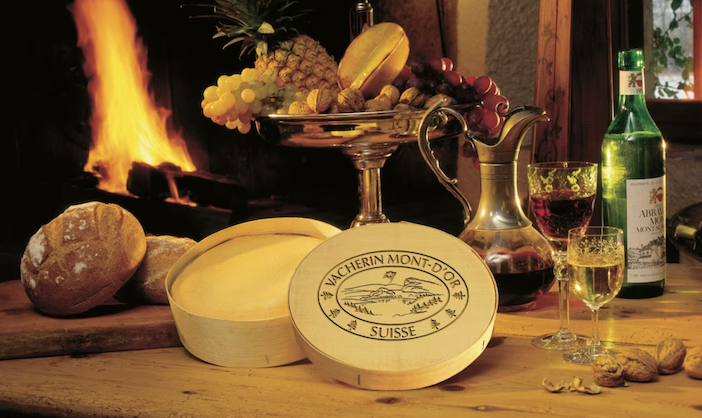
Cheese, undeniably, is a fine motivation for travel. Buffalo mozzarella in Puglia, Camembert in Normandy, Gouda in the Netherlands… there are a fair few fromage-fuelled stamps in my passport. But while seek out the origin story of Vacherin Mont-d’Or was my initial incentive for heading to Switzerland in October – that low-season limbo when alpine resorts catch their breath between the hiking brigade departing and the powder hounds descending – the plot soon thickened. It turns out there’s a lot more to the Swiss autumn than meets the eye.
Bovine Beauty Queens
The clang of cowbells ricochets between the timber chalets of Lenk im Simmental. If the name rings a bell, it’s because an editor of this fair journal previously wrote about his ski sojourn in this lesser-known resort, deep in the Bernese Oberland. When I emerge from the railway station, however, only the lightest dusting of snow has settled on the peaks so far, while the meadows rising steeply around the village are fringed with tawny-coloured trees. October usually sees these streets at their sleepiest, but instead, for one day only, the pavements are packed with visitors, raclette stalls, beer tents and yodelling choirs. And it’s all in honour of cattle.
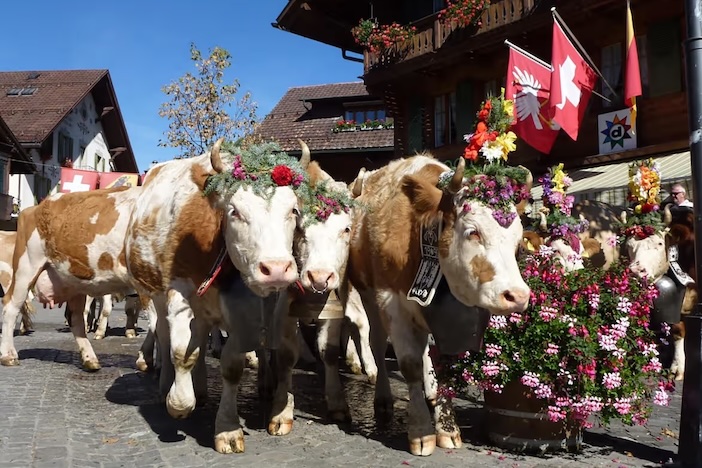
Having spent the whole summer grazing in high-altitude pastures, the cows are coming home to the valley in considerable style, festooned with elaborate floral headdresses and ornamental bells. Every hour, another local family leads its herd up the high street. Scenes like these play out across Swiss mountain communities during early autumn, continuing an age-old migration ritual known as the Züglete or désalpe, depending on which side of the country’s linguistic divide you find yourself. Lenk’s Älplerfest has become one of the largest modern incarnations, as well as one of the latest in the season.
Farmer Lukas Zeller tells me it’s the culmination of months of hard work. “We spend ten weeks up in the mountains, milking and tending to the animals, so this is a really nice moment to celebrate a successful season and be proud.”
He urges me to cast my vote for Miss Lenk. Twenty leggy contestants are lined up in the village square, awaiting the public’s verdict. Now, I’m not terribly well versed in bovine beauty standards – are we judging the silkiest hide, the curviest horns or the longest eyelashes? – but I take a shine to Marlis’s demure, unflappable temperament, which stands out from some of her moodily mooing neighbours. Alas, my taste isn’t shared by the masses, and the crown goes to Sophia.
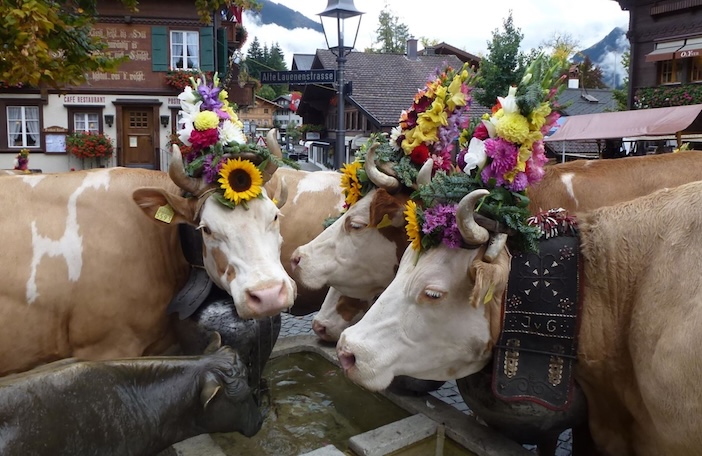
The Züglete also heralds a change in cheesemaking. Summertime grazing on a varied diet of fresh grass, herbs and wildflowers lends alpine cheeses their characteristic golden colour and herbaceous, nutty flavours. Come winter, the hay-fed herds produce creamier, richer and paler milk. Around Lenk, this sees production of Berner Alpkäse AOP – which has to be made in copper vats heated over wood fires at an altitude of at least 3280ft – cease in favour of Simmentaler Bergkäse and melting varieties for raclette. Over in the Vallée de Joux, Gruyère gives way to Vacherin Mont d’Or.
Of cheesemongers and watchmakers
Stepping inside Fromagerie Hauser on a chilly October morning, I’m immediately enveloped by a thick cloud of steam and tropical warmth. Employees clad in starched whites and hairnets are absorbed in their tasks: stirring warm milk in a vast stainless-steel vat; ladelling the pale, wobbling curds into circular moulds as streams of whey drain onto the tiled floors; gently turning and stacking the rounds onto trolleys. Overseen by father-and-son duo Patrick and Charles Hauser, the team crafts around 90 metric tonnes of Swiss Vacherin Mont d’Or each year – one of only nine official AOP dairies that are permitted to make it.
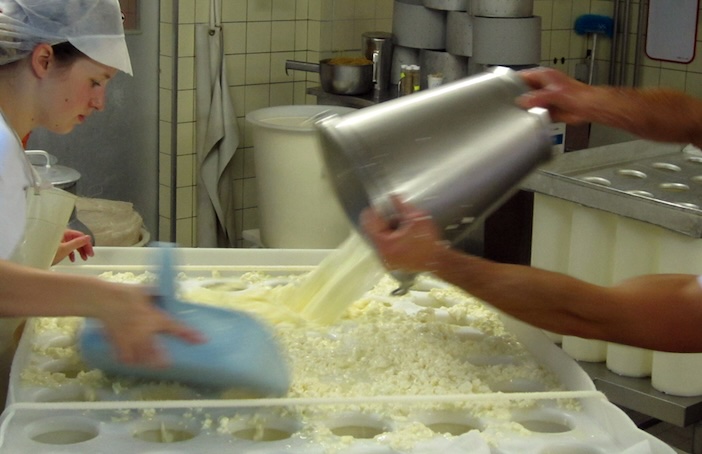
Photo: Fromagerie Hauser
My cross-country journey from Lenk to Hauser’s dairy in Le Lieu involved a four-hour, multi-leg train journey. Of course, that’s no hardship on Swiss Rail. Only one of my trains failed to depart on the dot, and that mere four-minute delay came with profuse apologies. Station names switched from German to French as I watched the plunging, emerald-bright valleys and intricately carved chalets of the Bernese Oberland give way to gentler, rolling farmland and golden forests as the route carved north-west, eventually sidling along the shores of Lac de Joux.
Cédric Baudois, managing director of the Interprofession du Vacherin Mont-d’Or – essentially, the region’s guardians of traditional cheesemaking – leads me from the sweltering kitchens into a series of cool, dark cellars. There’s row upon row of young cheese laid out on spruce boards, resting for a minimum of 17 days (Hauser favours 25) until their rinds turn a deep amber, the earthy, savoury flavour intensifies, and the surface yields to the touch of a finger.
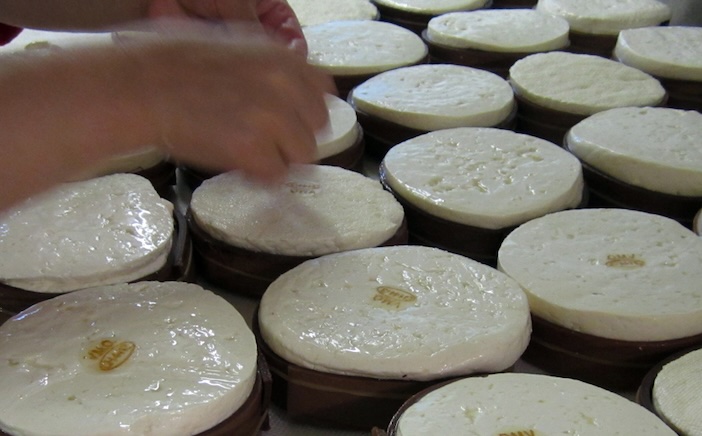
Photo: Fromagerie Hauser
Our last stop is the packing room, where dozens of suitably squidgy, mature cheeses are being eased into round wooden bands. Per the exacting Swiss AOP rules, these must be made from spruce bark gathered from surrounding forests, Cedric tells me, and each cheese must be packed into its box by hand – no mean feat when you’re dealing with a product the consistency of just-set custard.
From Cowsheds to Complications
Historically, cheesemaking wasn’t the only seasonal work pivot practised by Vallee de Joux farming families. The evidence is all over these lakeside villages: for every field of grazing cattle and tumbledown farmhouse, there’s also a sleek, sprawling, modern building with a corporate air, their steel and glass facades emblazoned with such hallowed horological names as Jaeger-LeCoultre, Patek Philippe and Vacheron Constantin. Yes, Vallée de Joux is a global epicentre for precision watchmaking. And for much the same reason as the region’s fromage prowess – indoor piecework proved a fruitful side-hustle for agricultural communities during long, harsh winters from the 17th century onwards. Rich iron ore deposits in the surrounding countryside provided a key resource, too.
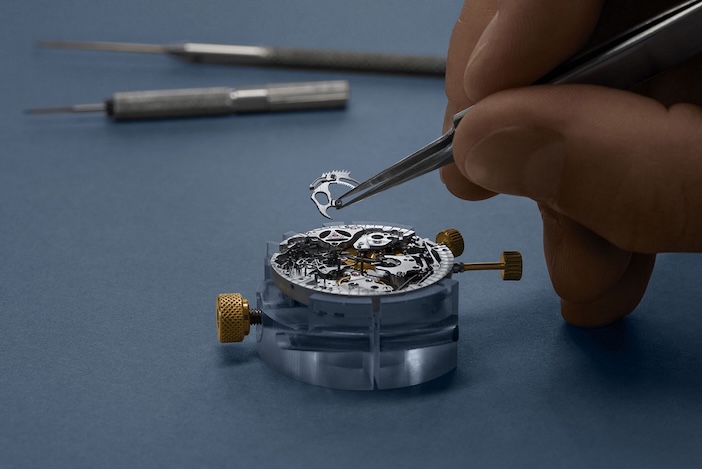
Photo: Audemars Piguet
While a handful independent masters like David Candaux continue to operate from old-school farmhouses, most of the big names have decamped to those aforementioned state-of-the-art factories. Connoisseurs can tour Audemars Piguet’s atelier-turned-museum, its spiralling form inspired by a watch spring (be warned: spots typically sell out three months in advance), bed down in minimalist-chic retreat Hôtel des Horlogers (which applies its watchmaking theme with an elegantly light touch) and shell out four figures on intensive workshops where they learn to assemble their very own movement.
A more accessible – and underrated – option comes in the shape of public museum Espace Horloger in Le Sentier. Glinting and ticking away in its glass cabinets, each exhibit is a miniature cosmos of tiny cogs, jewels and dials, from a split-seconds chronograph for timing two events simultaneously to mechanisms tracking the phases of the moon. You can even catch free demos from apprentice watchmakers if you, ahem, time your visit right.
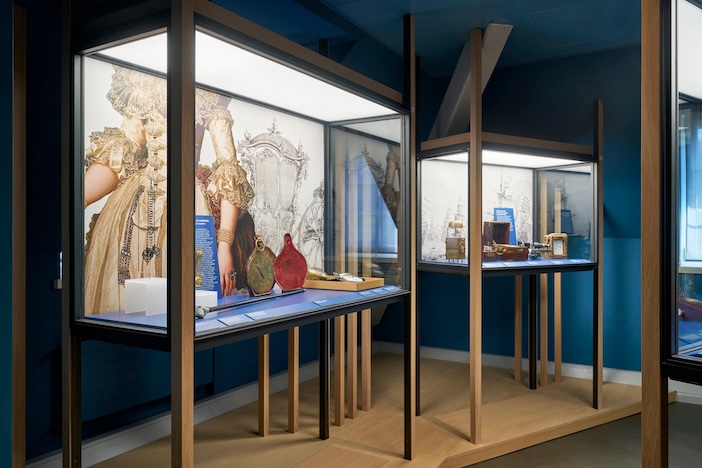
Photo: Espace Horloger
Deep time on fast forward
While the denizens of Le Sentiers deal in milliseconds, the final part of my Swiss off-season odyssey dealt in an altogether different chronological scale: deep time. I had a date with Europe’s longest glacier.
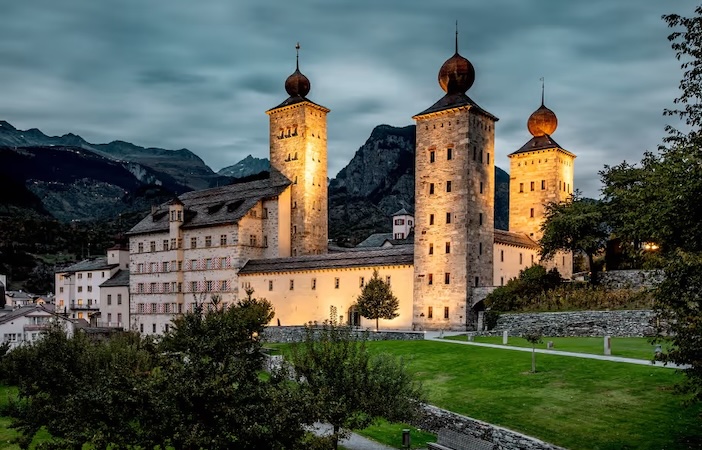
I break my journey in Brig. As a stop on the Glacier Express and a general transport hub, many travellers only see its railway station. Instead, I linger for a pleasant, sunny afternoon wandering its cobbled heart with a gelato in hand – Italy is tantalisingly close – and craning up at its onion-domed Baroque palace. The latter is the legacy of 17th-century merchant Kaspar Stockalper, whose fortune came from trade across the nearby Simplon Pass. The route would later become an important crossing for Grand Tourists bound for Italy, including a young William Wordsworth.
A footbridge over the Rhône takes me to sister-town, Naters, where the World Nature Forum provides a useful primer on glaciology and alpine heritage alike. High-tech gadgets – like a hulking spectrometer, used for measuring greenhouse gasses, recently retired from the Sphinx research station – brush up against the simple wooden dairy tools that sustained generations of high-altitude livelihoods.
Another short train journey and a gondola ride later, I spend a peaceful night in the car-free village of Riederalp before teaming up with guide Patrizio Perino Fontana. My timing is spot-on: a bluebird sky, the wind barely a whisper. According to Pat, early October is something of a sweet spot for a crowd-free visit. Delay until the end of the month or November, though, and he warns that many local hotels, restaurants and lifts will have closed for pre-winter maintenance and staff holidays.
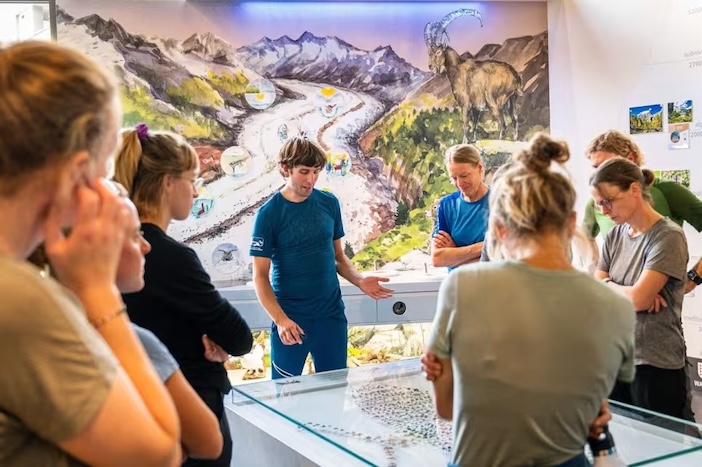
October is also a crucial point in the calendar for glaciologists, who take their annual measurements at the end of the summer melt, before fresh snow begins accumulating. The latest figures make sobering reading: Switzerland’s glaciers lost 5.5% of their remaining ice volume in 2026 alone, marking the second-worst melting year on record after 2022.
Whisking us up the last mile or so to the Moosfluh viewpoint is a cable car created with climate resilience in mind. Pat points down to the lift’s foundations as we glide along, explaining how the hydraulic system can move the entire structure up to 36 feet – something it’ll probably need to do with increasing frequency as glacial retreat destabilises the surrounding slopes.
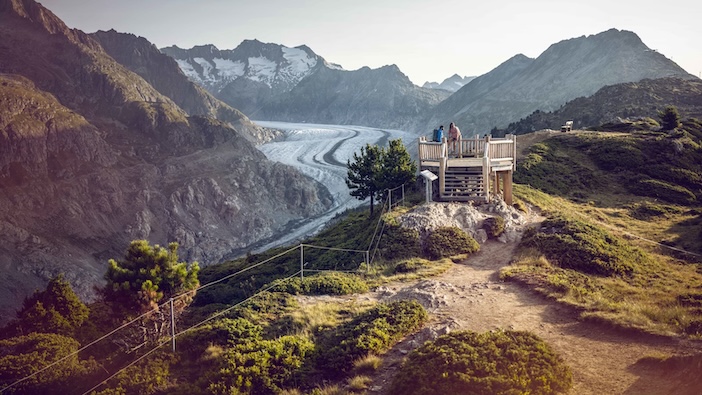
Cable car pass to Moosfluh, Aletsch Arena (Photo © Valais Wallis Promotion – Pascal Gertschen)
Just as I’m remarking how clever human engineering can be, the words are whipped away by a sight that reminds our design feats still aren’t a patch on nature. The Great Aletsch Glacier snakes through the valley below us, a 12-mile highway of ice banded with darker rocky debris.
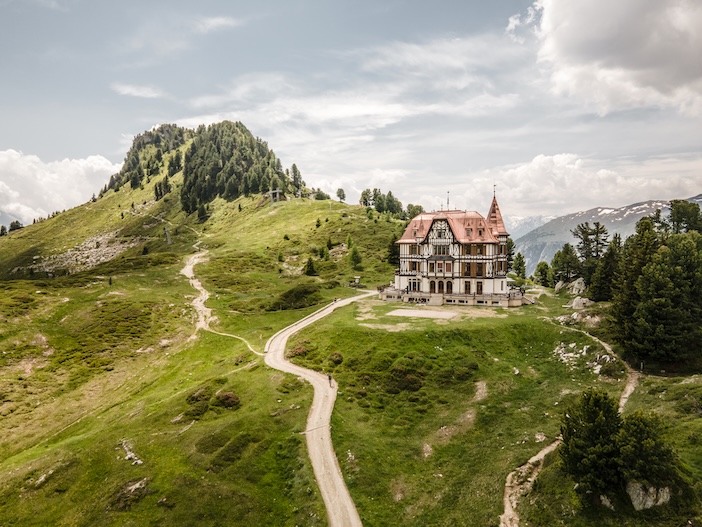
We hike along the ridgeline, the trail threading between wild blueberry bushes, their crimson-tinged leaves contrasting photogenically with the white-tipped peaks. Pat points out the Matterhorn’s distinctive hooked summit and a chamois grazing on the slopes a few feet below us. Villa Cassel lies ahead, a half-timbered, turreted pile framed by the pines like a fairytale scene.
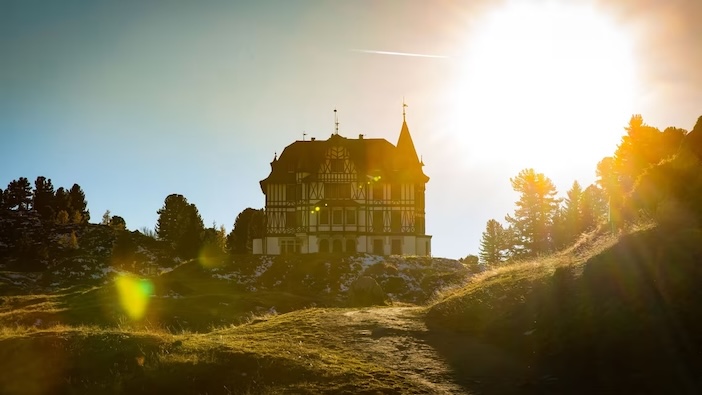
Now a nature conservation centre, the summer house was built by a British banker on the advice of his physician after suffering what we’d call burnout. Pat promises that a refreshing glass of apricot juice awaits us there, followed by a hearty post-hike lunch of potato rosti topped with a fried egg on the panoramic terrace of neighbouring Restaurant Riederfurk.
There’s something magnetic about the glacier’s blue-grey heft, though, making me glance back over my shoulder every few paces, to imprint one last lingering look in my memory, before our path curves away. I think of the words written by another traveller in this landscape: “The impressions of three hours of our walk among the Alps will never be effaced.” This was William Wordsworth, penning a letter to a friend in 1790. More than 200 years later, I feel exactly the same way.
Swiss International Air Lines (SWISS) connects Switzerland with the world, offering more than 160 weekly flights from London Heathrow, London City, Manchester, Birmingham and Edinburgh to Zurich or Geneva. One-way fares start from £76 to Zurich and from £54 to Geneva, and include all taxes, fees and surcharges, one piece of checked luggage weighing up to 23kg and one piece of hand luggage. SWISS are also happy to transport your first set of ski or snowboard equipment and boots free of charge in addition to your standard free baggage allowance subject to availability (excluding hand-luggage-only fares). For more information, visit www.swiss.com.
Travel Switzerland’s Swiss Travel Pass offers international visitors to Switzerland unlimited travel on consecutive days across the rail, bus and boat network, plus scenic routes (seat reservation fees apply) and local trams and buses in around 90 towns and cities. It also includes the Swiss Museum Pass, which grants free entry to 500 museums and exhibitions. Prices start from £254 for a three-day second-class ticket. For more information, visit www.swisstravelpass.com.
For more information on Switzerland, visit www.myswitzerland.com.
Photos courtesy of MySwitzerland (unless otherwise credited)