Three interconnected palazzi, a swimming pool in a city of water and a bartender who won’t lecture you about juniper: Douglas Blyde on the first act of Danieli’s Four Seasons transformation…
Christian Zandonella is discussing trees. This is an unexpected starting point for a conversation with the general manager of Danieli, Venezia, A Four Seasons Hotel, until he explains that timber from the Dolomites, where his family has its roots, was once floated towards Venice and driven into the lagoon bed to support its palaces. The Venetian Republic drew upon the same forests for ships and fuel, while in some mountain communities village elders collectively determined how the woodland could be used. Venice, so celebrated for its marble, owes rather a lot to wood.
Born in South Tyrol and raised in Munich, Zandonella learnt hospitality behind the counter of his parents’ ice-cream shop. At 16, he progressed to a Michelin-starred restaurant, followed by the Ritz-Carlton in Vienna, Berlin’s Hotel Adlon and the opening of W Rome. All useful preparation, although Venice insists upon adding the lagoon to management’s list of interested parties.
We are seated in Bar Dandolo, a pianist providing agreeable accompaniment, while Zandonella explains the unusual responsibility of caring for a hotel whose foundations are older than most countries. Those ancestral timbers seem a fitting preoccupation for somebody charged with modernising what stands upon them.
But what should one expect from a hotel whose principal building once belonged to a family which produced four doges? A museum with minibars, or somewhere one might actually enjoy living?
 A palace on piles
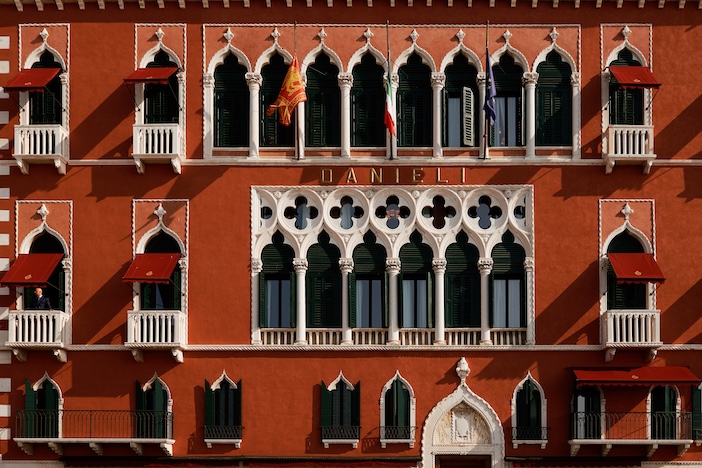
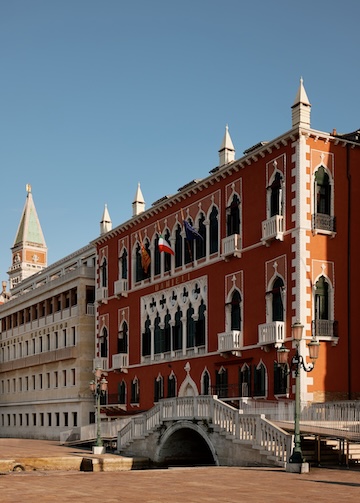
Palazzo Dandolo, dating from the late 14th century, was home to a family which supplied Venice with four doges. The Doge’s Palace itself stands just along the waterfront. Evidently, proximity to power was no disadvantage. Since 1822, when Giuseppe Dal Niel began welcoming paying guests, the former aristocratic residence has entertained a clientele considerably more varied than the Venetian nobility.
Today the hotel comprises three interconnected buildings: Gothic Palazzo Dandolo, 19th-century Palazzo Casa Nuova, once home to the Republic’s treasury, and Palazzo Danieli Excelsior, inaugurated in 1950. They resemble an architectural family whose members have agreed to share an address despite possessing very different personalities.
The latest transformation, formally unveiled on 30 July 2026, has brought Danieli into the Four Seasons portfolio. The owner, Giuseppe Statuto, whose Gruppo Statuto also possesses the Four Seasons properties in Milan and Taormina, has entrusted the interiors to French designer Pierre-Yves Rochon. Zandonella, appointed in January 2025, has meanwhile had to reconcile a restoration of considerable complexity with the expectations of guests who regard Danieli almost as a hereditary entitlement.
Renovation began while the hotel was still operating. Guests moved between buildings as work progressed, with public areas remaining accessible until the final seven months of complete closure. In Venice, where replacing a kitchen appliance can resemble a naval operation, renovating three interconnected palazzi demands considerable ingenuity.
A swimming pool has proved particularly challenging. Zandonella becomes surprisingly animated on the subject of chlorine, describing the measures required to prevent treated water from penetrating historic masonry. Double walls, substantial protective engineering and an emergency system capable of emptying the pool within minutes have been incorporated. Given Venice’s long and occasionally disastrous relationship with water, inviting a chlorinated quantity indoors seems almost wilfully provocative.
Work continues. A spa with three treatment rooms, sauna and hammam, together with the swimming pool, is scheduled to open later this year. Meanwhile, the restoration of Palazzo Danieli Excelsior should increase the number of rooms and suites from 120 to 168 in 2027.
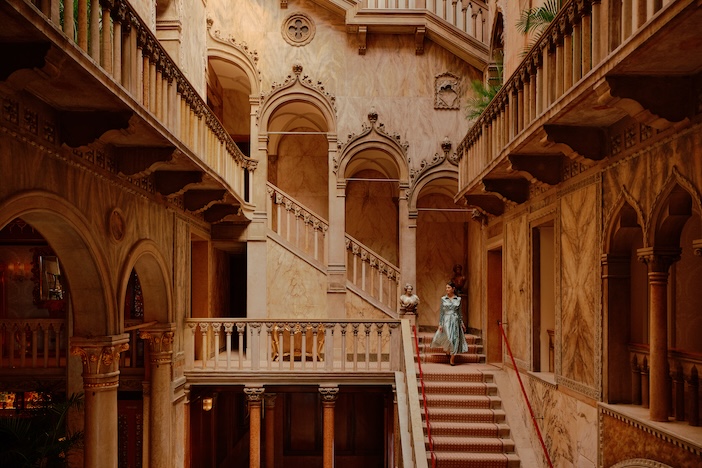
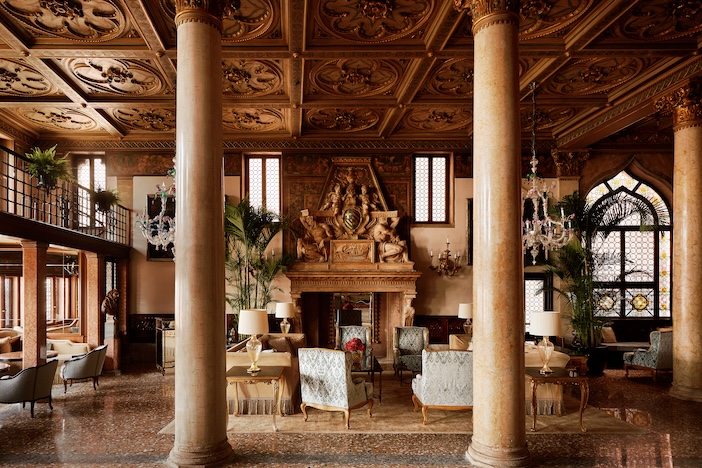
What has been completed looks splendid. Palazzo Dandolo’s four-storey atrium, with its pink marble columns, carved arches and monumental staircase, rises towards a stained-glass skylight. Elsewhere, a restored ceiling displays hand-painted gilded quatrefoils against brilliant azure blue. Murano chandeliers, Venetian mirrors and Rubelli textiles lend further richness to interiors which were hardly short of ornament in the first place.
Rochon has borrowed his palette from the city: celadon, powder pink, terracotta, ochre and pale blue. Thankfully, nobody appears to have proposed stripping the building to bare plaster in pursuit of fashionable austerity. Venice has been perfecting the art of decorative excess for centuries. It would be rude to contradict her.
The flowers are especially extravagant. Grand arrangements greet guests and enliven the public and private rooms, their abundance challenging even the floral displays of the Four Seasons in Florence, a hotel which occupies a particularly affectionate corner of my memory.
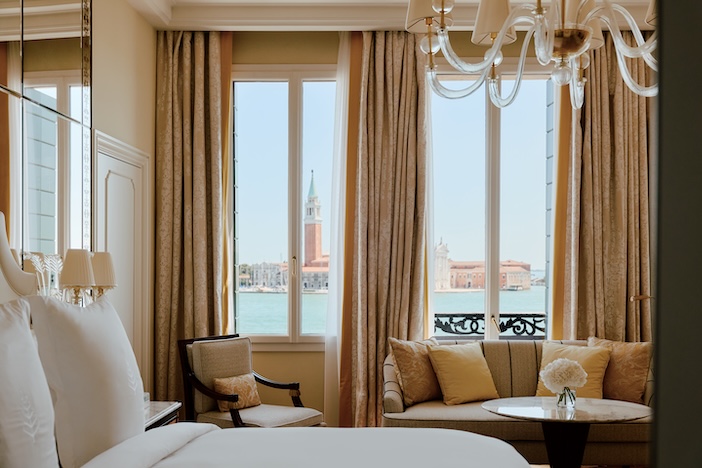
Bedrooms combine generous proportions with technology which has learnt its proper place. Curtains operate automatically, lighting responds to the occasion and televisions are absorbed into arrangements of artwork and objects. One can admire the craftsmanship of an ancient palazzo without being obliged to live according to the technological limitations of the Renaissance.
A bar, not a classroom
When I last visited Danieli, approximately 15 years ago, a Bellini seemed the obvious order. This time, Stefano Ruocco, the director of bars, has other ideas. Ruocco’s career has taken him from the Amalfi Coast to Dubai and Guangzhou, furnishing him with an admirable understanding of what guests actually want. He is particularly sceptical of the contemporary bartender’s compulsion to educate.
‘You have to look after people,’ he says. For some, a detailed account of obscure ingredients is part of the pleasure. Others would prefer an excellent drink, a comfortable chair and the freedom to enjoy the pianist without being subjected to a dissertation on juniper.
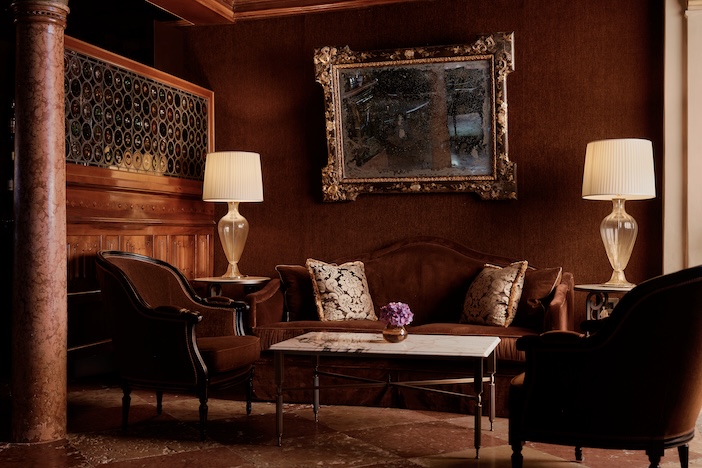
He envisages Bar Dandolo as a Venetian drawing room, somewhere residents and visitors might enjoy coffee, lunch, an aperitivo or a nightcap. Importantly, he is resisting the temptation to make prices as exalted as the surroundings. With spritzes on Piazza San Marco capable of commanding €40, Ruocco considers reasonable pricing part of being welcoming.
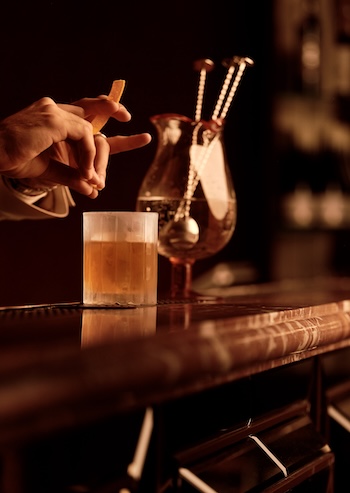 For Venice Cocktail Week, he devised drinks which drew upon both his international experience and the Veneto. T&Tonic introduced tea and fragrant citrus to local gin. Casanova combined walnut-infused rye, amaro and maple, while a New York Sour incorporating Valpolicella gives Manhattan a Venetian hinterland. The drinks have sufficient intellectual content to occupy the curious, but Ruocco would prefer people to concentrate on enjoying them.
Our daughter, whose enthusiasm for assertive flavours extends considerably beyond most children’s menus, requests a Virgin Mary, specifying that it should be spicy. It is treated with the same seriousness as the adults’ cocktails. Ruocco takes an interest in her verdict, too. Hospitality, after all, should not depend upon whether the customer is old enough to drink gin.
That is the bar dealt with. A hotel’s character, however, is best judged over dinner, and a table on the terrace was waiting…
Douglas’s dive into the Danieli continues tomorrow.
Danieli, Venezia, A Four Seasons Hotel – Riva degli Schiavoni 4196, Castello, 30122 Venice. For more information, please visit www.fourseasons.com.