The Rise and Fall of the City of Mahagonny is the lesser known Weill and Brecht collaboration – the more famous, of course, being The Threepenny Opera. Mahagonny nevertheless has some truly gorgeous Kurt Weill numbers (notably The Alabama Song reprised by everyone from Bowie to The Doors) set against Bertolt Brecht’s inevitably abrasive political backdrop.
Even though it is a smidgen short of 100 years old, there’s a lot here that seems remarkably current. It’s a tale of greed and hypocrisy, a town run by a corrupt power and filled with vicious drunks and vacuous influencer-prostitutes, who know the price of everything and value of nothing. The message is then – was it ever anything else with Brecht? – far from uplifting. The production, though, is another matter.

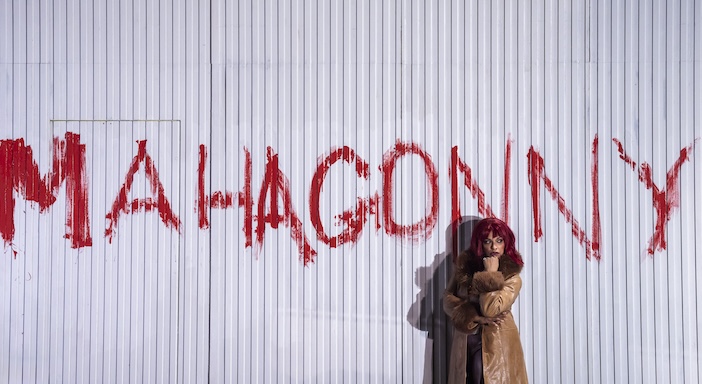
In some ways, the bare-ish stage, pared back to its industrial bones, is testament to the ENO’s ever-vanishing budget. In others, Jamie Manton’s production lays bare a surreal rawness that is at the very heart of the show from the butcher’s where Jack (a compelling Elgan Llyr Thomas) eats himself to death or the tap dancer who pirouettes his way across the terrified crowd as the incoming typhoon, the chorus down to their baggy white underpants queuing up for sex or the populace lying on sunloungers waiting for their “wellness wheesky”. We’re given as coruscating a diatribe against capitalism as Brecht could have dreamt of, its scenes tumble chaotically, led on by music that embraces every genre from the spoken word to jazz, from cabaret and ragtime to the operatic – quite an ask from the singers.
ENO certainly has that covered and the commitment here is palpable, particularly when you consider the speed with which this production was put together. The three principals are all quite magnificent. As Widow Begbick, Rosie Aldridge rules Mahagonny, her city of empty pleasure, with an iron fist. Whether she’s in a boiler suit as the city’s founder (alongside the excellent Mark le Brocq and Kenneth Kellogg) or delivering pantomime justice in an orange Barbie-style wig, there’s never any doubt she’s in charge.
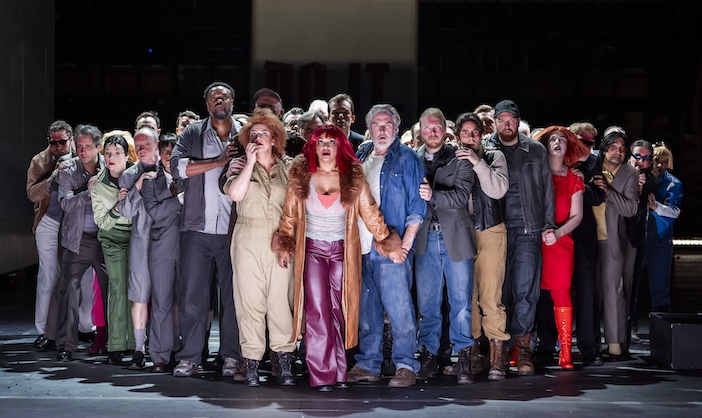
Speaking of red wigs, as Jenny, Danielle de Niese is the sultry tart in plastic leather trousers, who defies convention by turning out not to have a heart, though with a convincing capacity to engage everyone else’s. Her Alabama Song is simply beautiful and her stage presence is dynamite – you can’t take your eyes off her. Jimmy is the only really sympathetic character, come to town with his newfound wealth -– he’s been a lumberjack in Alaska for seven years alongside Jack and Billy, the friend who betrays him at the last (beautifully sung by Alex Otterburn). Simon O’Neill sings Jimmy with visceral power and passion, the one man who is not completely taken in by meretricious Mahagonny because he always knows something is wrong and who dies, remarkably, without bitterness.
The orchestra, along with Justin Quinn offering such on-stage extras as banjo and Hawaiian guitar, play with real commitment under André de Ridder who grew up with Kurt Weill’s music in his native Berlin. As their Music Director Designate, he has a reputation already as something of a pioneer and one wonders if this production is a sign of things to come at ENO. He says it’s not just about doing the war horses of the opera stage but, “exciting music, exciting stage concepts pared with great pieces, some of which may have not yet been written.”
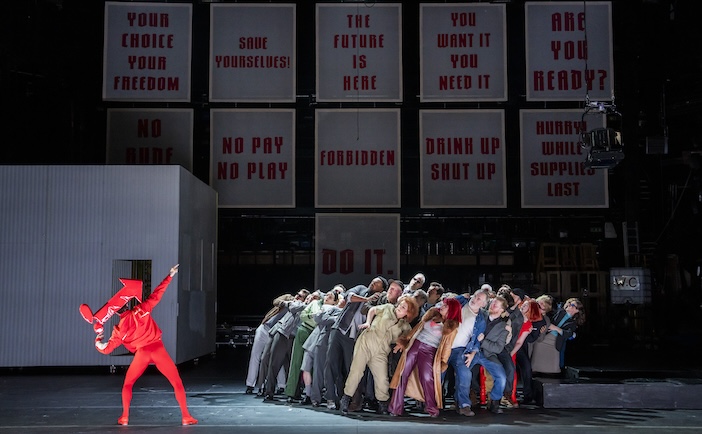
As for Mahagonny, it has an interesting pedigree and was banned by the Nazis (Brecht and Weill both fled). Brecht was never seeking so much to entertain as to confront – and you do feel exposed here in the audience – sometimes quite literally with blinding lights and sometimes with the accusatory fingers pointed from the royal box by two of the blood-stained deceased characters. Are we complicit? We’re certainly accused.
This season is coming to a close – there are just two more performances of Mahagonny – and I, for one, can’t wait for the new season in the autumn. Always risk takers and full of surprises, ENO is surely our most dynamic opera company.
The Rise and Fall of the City of Mahogany continues at the ENO on 18th & 20th February. For more information, and for tickets, please visit www.eno.org.
Photos by Tristram Kenton