
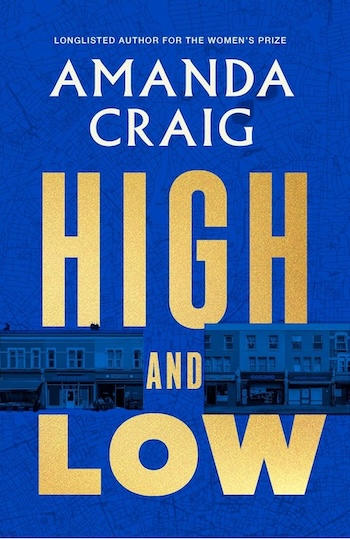
Amanda Craig has long been one of the sharpest observers of modern London: its fault lines, its hypocrisies, and the uneasy proximity of wealth and struggle. In her new novel High and Low, she turns her eye to a single North London neighbourhood where elegant Victorian squares and neglected council blocks stand face to face, divided by class, history and a growing sense of grievance. Here’s the opening of a novel that promises to be as gripping as it is painfully recognisable…
Even at the best of times, Cross Street did not look like anywhere special.
Less than one week into the New Year, and it had been raining for months. One gale after another then buffeted Britain, bringing down trees, flooding streets and closing airports. Those who had spent Christmas away were reluctant to return, and a couple of shops did not bother to open at all. People would never guess that this had once been a gentle country lane, lined with cherry and ash, hawthorn and lime, or that its pub stood beside a former meadow where farmers would stop to allow their herds to drink in the ponds before descending into the slaughterhouses of the city below.
 Those lost fields and their river were buried under tar and rubble several feet thick. Just one tree survived, an old, seamed trunk whose butchered branches, raised to the sky like impotent fists, sprouted spears in March only to be lopped back again in August. Yet beneath the surface, Cross Street was a place of continual change. Inexorable forces were at work, twisting and kneading the bricks and mortar above so that everything was being fractionally pushed up or sunk down. For North London is all hills and inconveniences, springs and subsidence, and there is hardly a street in this locality which does not suffer from a continual friction between differences. A pothole that begins as a crack will widen and fill up into a pool because water, like murder, will always come to light.
The shopkeepers and residents of Prospect Park were all too familiar with the consequences of geological instability.
‘What can you expect?’ their insurers would say. ‘These buildings are over two hundred years old, and were never meant to last this long.’
If cracks appeared in Cross Street itself, the insurers blamed vibrations caused by heavy traffic, given that this was one of the minor, yet major, routes into the city centre; if it was on the Cross Estate they would take no notice; but if it was in the residential area radiating off Prospect Square, the insurers demanded that certain vegetation be excised, whether these were trees or ornamental creepers trained up the front of a house. For the first thing any aspirational Briton does when moving into a run-down area is to plant wisteria. This creeper wreathes the dullest brickwork with poetry, and its feathery leaves, twining stems and cascades of violet flowers give delight for a few weeks every spring before requiring extensive and expensive pruning twice a year. Only the west-side houses had wisteria, however. Those on the east had none.
Originally, the housing on both east and west sides of Cross Street had been identical, being constructed by the same speculative developer at the start of Queen Victoria’s reign. Augustus Evenlode had built on some twenty acres of unproductive farmland outside the City and transformed it into a pleasant suburb. Renamed Prospect Park, it was intended for Londoners of modest means and rising respectability. For himself, Evenlode had built the largest house of all in Prospect Square, a detached, double-fronted villa now owned by Ivo Sponge, former editor of the Chronicle, and his American wife, Ellen. The other houses in Prospect Square were all semi-detached, with only one wall between each house and its neighbour, something that their inhabitants congratulated themselves on, because semi-detachment to a Briton is always the next best thing to splendid isolation. The rest, radiating up and down from the square, were mostly smaller, narrower terraces, with a single row of bricks between them and their neighbours on either side, so that every domestic altercation was clearly audible to next door. However, what they lacked in privacy and quiet they made up for in a degree of shared warmth.
These were not imposing dwellings, and the pair in Angler’s Lane at the bottom were little more than cottages. Their painted stucco only reached to the bottom of the first floor before petering out into yellow brick. They had no porticos over the front door, no handsome wrought-iron balconies, and though the largest windows in Prospect Square were arched, like supercilious eyebrows, they had half-basements into which passers-by could have a clear view of the kitchen (formerly the coal hole). Each had a front garden, too small for off-street parking, and a long, thin rectangular one at the back where privies and bomb shelters had once been built. Inside, the fireplaces on each floor had plain grey marble surroundings. The mouldings around the ceilings in the drawing-room were covered with so many layers of white emulsion paint that they looked like a string of sausages, and the bedrooms above had no room for a maid. In short, this was housing intended for the lower levels of the professional classes: people such as printers, teachers, journalists, engineers and clerks, rather than the bankers, doctors, publishers and lawyers who congregated in loftier locations like Hampstead, Highgate and Highbury.
By the 1930s, Prospect Park became a place where only the poorest lived or lodged. Most houses had by this time been crudely subdivided into rooms for immigrants, mostly Irish and Jewish, and their faded wallpaper housed only slightly more bedbugs than people. Burglary and crime were commonplace, and Prospect Park acquired the reputation of being a place to avoid. But the housing itself remained sound, and its west side escaped bombing during the Blitz. It was still shabby, with buddleia sprouting in walls, but retained a pleasant air and many plane trees. By the 1990s, homes around Prospect Square began to be bought from the Evenlode Trust by those who could not afford Islington, Kentish Town and Camden. Re-roofed, repointed, repainted, replumbed, modernised and restored, they had become desirable to doctors, academics, journalists, accountants, actors and authors. Prospect Park was now advertised by estate agents as an up-and-coming area, albeit one served only by buses.
The inhabitants on the east side of Cross Street had not been so fortunate. First bombed, then knocked down to make way for council flats in the Brutalist style, the Cross Estate was a different world. It consisted of five blocks named Chaucer, Milton, Wordsworth, Tennyson and Blake, set in a small, wooded area. For a while, these flats were seen as more desirable than the Victorian housing they had replaced. They had indoor plumbing, balconies and windows that did not rattle or leak. There were lifts, and communal central heating, and the land between the blocks retained one of its ancient oaks and was planted with birch and grass. Every block had a large, raised planter for shrubs and flowers set before its entrance, which it was hoped residents would enjoy.
As time passed, however, the estate declined. It was no longer maintained by the council. The walls inside and out were fanged with grime, black mould speckled the ceilings, and the grassy areas, mown twice a year, were dotted with dog faeces, rubbish and used syringes. The people of Prospect Park visited it just once every five years, when a general election was called and the polling station opened in the community centre, leaving as soon as they had pencilled in their X. Yet plumbers, cleaners, hairdressers, decorators, locksmiths, window-cleaners, postmen, nurses, drivers, refuse collectors, shopkeepers and electricians all had their homes on the Cross Estate. Some had more than one job, though despite this, many were also on benefits because they could not earn enough.
Recently, however, a very different kind of work had come to dominate the existence of those who lived on ‘the Cross’. How many were aware of this was questionable, for every human being is a mystery to another, even if living almost as close as bees in a hive. Those who did know were afraid to speak about it, and those who did not were still full of foreboding and anger. A feeling had been growing among them that they were being pushed out to the edge of society by forces they did not recognise, but resented with a growing ferocity.
High and Low is out now in hardback, published by Abacus.
 Amanda Craig is a British novelist, short-story writer and critic.For ten years, she was the children’s books critic for The Times and a features writer for The Sunday Times and is widely credited as being one of the first to spot the Harry Potter books and Philip Pullman’s His Dark Materials series.
Her seventh novel, Hearts And Minds, was long-listed for the Bailey’s Prize for Women’s Fiction, and her eighth, The Lie of the Land, was a Radio 4 Book At Bedtime, and picked by six national newspapers as a Book of the Year in 2018. Her novels can be read separately but feature an interconnected contemporary cast of characters, in which minor protagonists become major. High and Low is her 10th novel.
Header photo by Christin Hume, courtesy of Unsplash