“Frida Kahlo was a genius, she is in many ways a unique artist. Her work transcends time. She is iconic. You feel like you know her.”
That’s how the specialists describe Frida Kahlo in the opening of Exhibition on Screen’s eponymous biographical film.
Originally released in 2020, ‘Frida Kahlo’, directed by Ali Ray and produced by Phil Grabsky, brings our attention to Kahlo as an artist, combining detailed explorations of her art, interviews with world experts and dramatised portrayals of the painter to bring her and her world to life.
Kahlo is one of the world’s most famous and influential artists. Even now, over 70 years after her death, she is more renowned than ever: a cultural phenomenon, a symbol of activism for everything from feminism to worker’s rights, and a revolutionary artist.
While she is often seen as a figure in and of herself, often her work as an artist is actually overlooked.
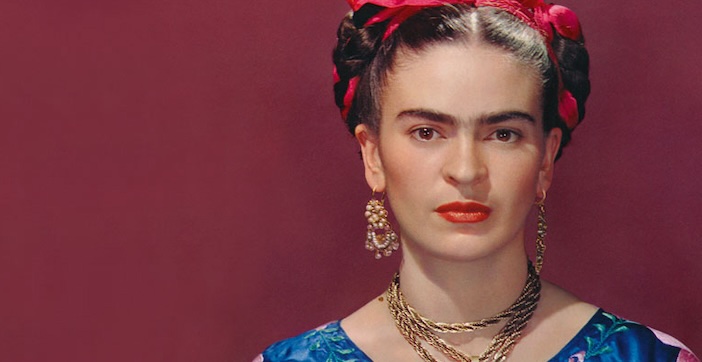
In this 90 minute film, the focus is brought back to her art, not what she represents as a figure, and on the woman behind the trademark eyebrows, floral crowns and bright colours.
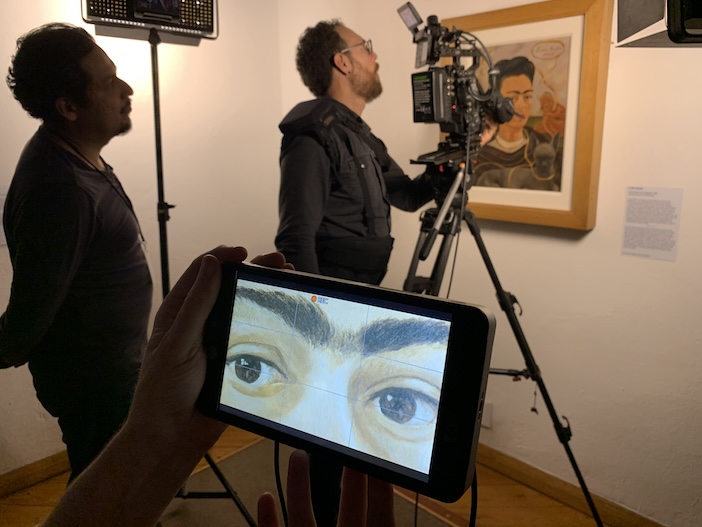
The film is now being re-released in conjunction with a transatlantic exhibition from Tate Modern and Museum of Fine Arts Houston, ‘Frida: The Making of an Icon’ with an additional ten minutes of footage from the curators of the exhibition, that focuses on her legacy both as an artist and a global icon.
While Ray was initially apprehensive about returning to her first feature-length film, six years on, in the end, she says, the new exhibition “reignited my relationship with her”.
She talks of Kahlo like a person she knows intimately — not something she does with other artists she’s made films of, she says — and that comes across in the film.
“I spent nine months reading her diaries, reading her letters, trying to work out what story I wanted to tell about her,” she says. “And I suppose, most importantly, to get to know her art.”
Ray feels she has an extra, secret relationship with Kahlo because of the time she has spent with her art, and that’s something she lets us into through the film.
Kahlo’s life is told chronologically, from her birth in Coyoacán, Mexico, in 1907 and her upbringing in the vibrant cobalt blue building La Casa Azul (The Blue House), all the way through her marriage to fellow artist Diego Rivera and her death in 1954.
The film is anchored by a series of paintings created through the course of her life, each providing an entrance to different key elements of her life, whether that was her political views, the importance of her Mexican heritage, her relationship with her body or her refusal to be categorised as any one thing, whether that be a surrealist or a political icon.
These are mostly self-portraits, in part because her work was largely autobiographical. She produced around 150 paintings over the course of her life, around one third of which (55) were self-portraits.
“I paint self-portraits because I am so often alone, because I am the person I know best,” Kahlo once said. Struck by a bus at the age of 18, Kahlo spent much of her life in physical agony, bedridden and alone.
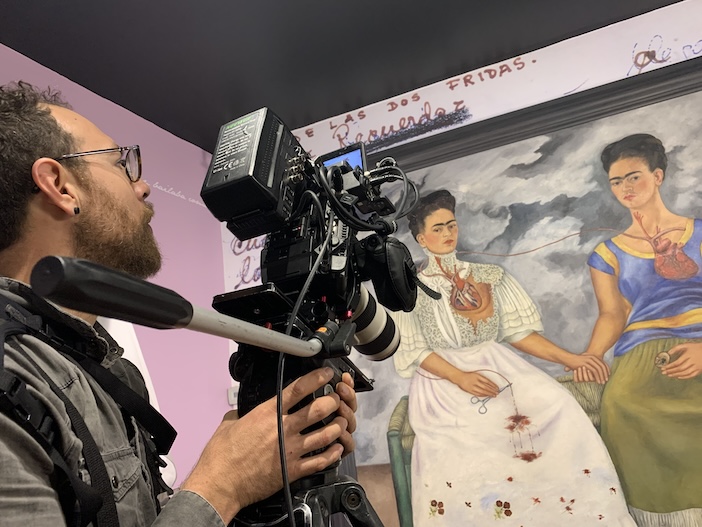
The film begins with her first painting, ‘Self-Portrait in a Velvet Dress’, which she created while recovering from the accident, originally as a gift for her ex-boyfriend, Alejandro Gómez Arias.
He later wrote of Kahlo, “Who was Frida Kahlo? It is not possible to find an exact answer. So contradictory and multiple was the personality of this woman that it may be said that many Fridas existed. Perhaps none of them was the one she wanted to be.”
But she explored this question through her many self-portraits, including ‘El Sueño (La cama)’, which also features in the film and sold for $54.7m in November 2025, breaking the record for the most expensive artwork by a woman artist at auction. The painting shows Kahlo, asleep in a bed that seems to float among the clouds, a papier-mâché skeleton covered in dynamite lying above her.
Although the painting is frequently seen as Surrealist, Kahlo resisted the label, saying, “I never painted dreams. I painted my own reality”
There were paintings that would’ve been included in the film that weren’t possible due to licensing restrictions — the Mexican government sees Kahlo and her artwork as a very valuable asset, and so not everything is available on film — but some of those, including ‘My Dress Hangs There’, will feature in the Tate Modern exhibition which opens next month.
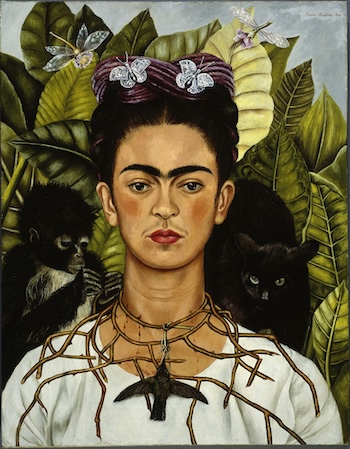
Self-Portrait with Thorn Necklace and Hummingbird, 1940 oil on canvas (Harry Ransom Center, University of Texas, Austin, USA)
The exhibition, ‘Frida: The Making of an Icon’ takes on a slightly different stance to that of the film’s, focusing on the life and legacy of Kahlo, showcasing 30 of her works alongside her garments, jewellery, photographs and memorabilia, as well as more than 200 works by artists and activists inspired by her and her legacy.
The exhibition is transferring from Houston, where the curator Marie Carmen Ramirez, an expert in Latin American art, had purposely never done a Kahlo exhibition before simply because so much other art gets dismissed because it is not Kahlo.
The exhibition, and the film, ends by exploring what it calls ‘Fridamania’: Kahlo’s transformation from an artist into a global brand, her face printed on tote bags and keychains, a symbol for more than she could have possibly intended.
This is something explored in the film’s additional ten minute short, jumping from Kahlo’s life to how she is viewed and known now, with all that is projected onto her as a figurehead.
Ray thinks Kahlo would be “utterly fascinated and silently pleased” with how her legacy has transformed her image.
While the hope is that people will watch the film and come away with an understanding of her as an extremely talented artist often overshadowed, literally and figuratively, by her husband Rivera and by her political leanings, something that both the film and the exhibition speak to is how much Kahlo truly was an individual.
“She didn’t subscribe to any sort of style. She absolutely was her own person,” Ray says, adding, “I think she’ll be pleased that so many different people have been inspired by her, and she would probably sit back and think it was fine that I never actually landed on one particular persona. It’s okay just to explore and swing back and forth between emotions and identities.”
‘Frida Kahlo’ is released on 19th May 2026 on Exhibition on Screen in association with Seventh Art Productions. For more information, check your local cinema or visit www.seventh-art.com.
The exhibition ‘Frida: The Making of an Icon’ is on at Tate Modern from 25 June 2026 – 3 January 2027. For more information, please visit www.tate.org.uk.
Header image: Frida in Blue Dress (c) Nickolas Murray Photo Archives