Few people have remained almost as famous in death as they were in life, but Marilyn Monroe is one of them. Just like the lyric in Elton John’s ‘Candle in the Wind’ song, written in tribute to Marilyn Monroe before being adapted for Princess Diana’s funeral service, “Your candle burned out long before, your legend ever did.” And so far the legend is still going strong.
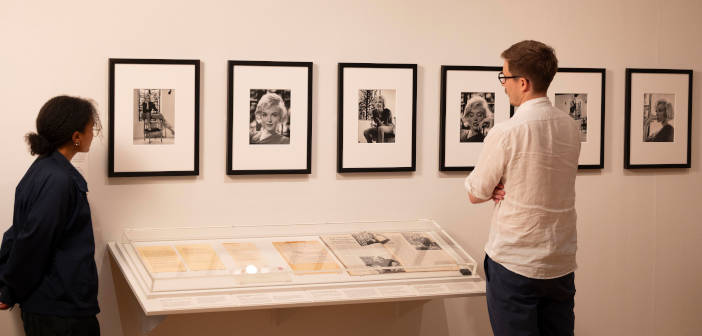
Coinciding with the 100th anniversary of the Hollywood star’s birth in 1926 and exploring the striking images which contributed to making her one of the most popular actresses of all time and an enduring cultural icon, the National Portrait Gallery’s Marilyn Monroe: A Portrait exhibition, in association with the Marilyn Monroe Estate, is a fascinating retrospective of her legacy through works by some of the most renowned photographers and artists of modern times.
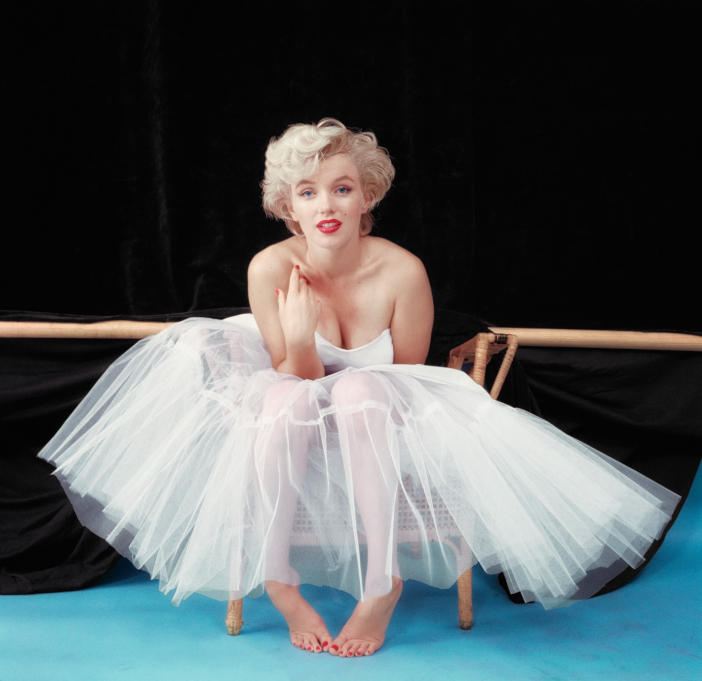
Marilyn Monroe ‘Ballerina’ sitting, 1954 by Milton H. Greene
Exhibition curator Rosie Broadley explained, “Marilyn Monroe is one of the most photographed people of the 20th century and her genius for image-making has been a constant inspiration in curating this exhibition…We have focused on the portraits of Monroe that came out of professional relationships she developed with some of the leading photographers of the era…portraits [which offer]fresh insight into her development as one of the most unforgettable performers of all time.”
From Cecil Beaton, Milton Greene and Sam Shaw to Andy Warhol and Eve Arnold who said that she “never knew anyone who came even close to Marilyn in natural ability to use both photographer and still camera,” this curation of works encourages visitors to consider the woman behind the myth. Sam Shaw once remarked, “Everybody knows about her insecurities but not everybody knows what fun she was, that she never complained about the ordinary things of life, that she never had a bad word to say about anyone, and that she had a wonderful, spontaneous sense of humour.”
Including rarely seen images of Monroe – I especially loved the ‘snaps’ taken by a group of teenage fans known as the ‘Marilyn Six’ – personal artefacts and artworks created after her tragically early death in 1962, the National Portrait Gallery are presenting their own ‘portrait’ of the woman behind the bleach blonde hair and red lipstick; a woman who started out more comfortable in front of the camera than she was away it: “I knew I belonged to the public and to the world, not because I was talented or even beautiful, but because I had never belonged to anything or anyone else.”
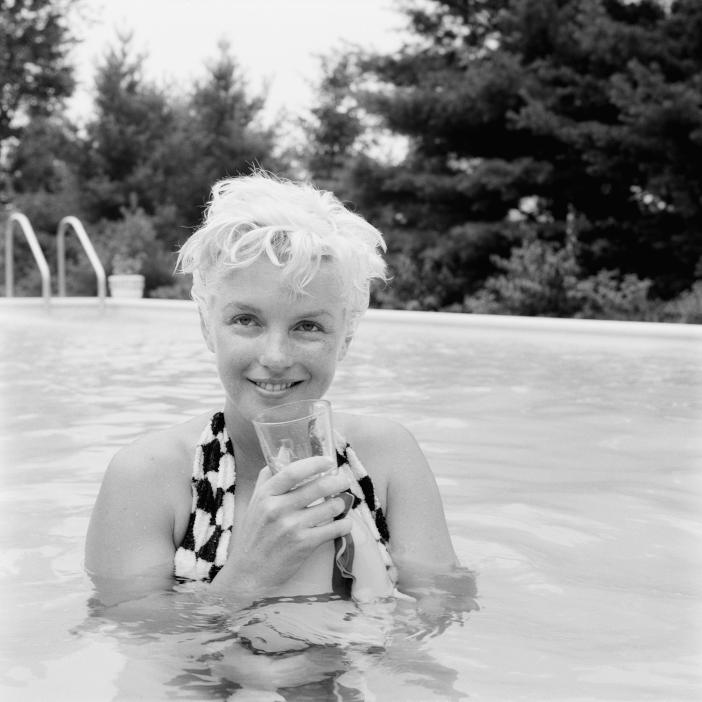
Marilyn Monroe,1955 by Milton H.Greene
Aged only 20 in 1946, and already married when she signed her first studio contract with 20th Century Fox, it’s understandable that she didn’t possess the life experience to take a balanced view of what must have seemed like an opportunity akin to winning the jackpot. Regarding a contract with 20th Century as a chance of real fame and fortune which the two-bit modelling jobs she’d taken previously would never offer – fame which would eventually enable her to dictate her own terms – she dedicated herself to months of dance and vocal coaching.
‘Marilyn’ was a creation just like all the other roles we now look back on fondly and she worked extremely hard to hone her performance. Determined to put her unhappy childhood behind her, ambitious for love and adoration far more than wealth, the studio bosses could hardly have had a more willing or talented young starlet. Norma Jeane was dead and buried (as was her first marriage), her hair lightened to fit the bombshell stereotype the studio were intent on pushing, when ‘Marilyn’, by then aged 21, was given her first film role in the somewhat presciently named ‘Dangerous Years’.
Norma Jeane Baker, as she was before the studio insisted on changing her name, never considered just how famous she would become (no one could have guessed that) or how tiring it would be to live the role of ‘Marilyn Monroe’ every time she stepped outside. This was a role she took with her when the set closed down for the day and within just a few years, it’s hard to say where Norma Jeane ended and Marilym Monroe began. She later summed up the tedium of stardom perfectly, “Fame is like caviar, you know – it’s good to have caviar but not when you have it at every meal.”
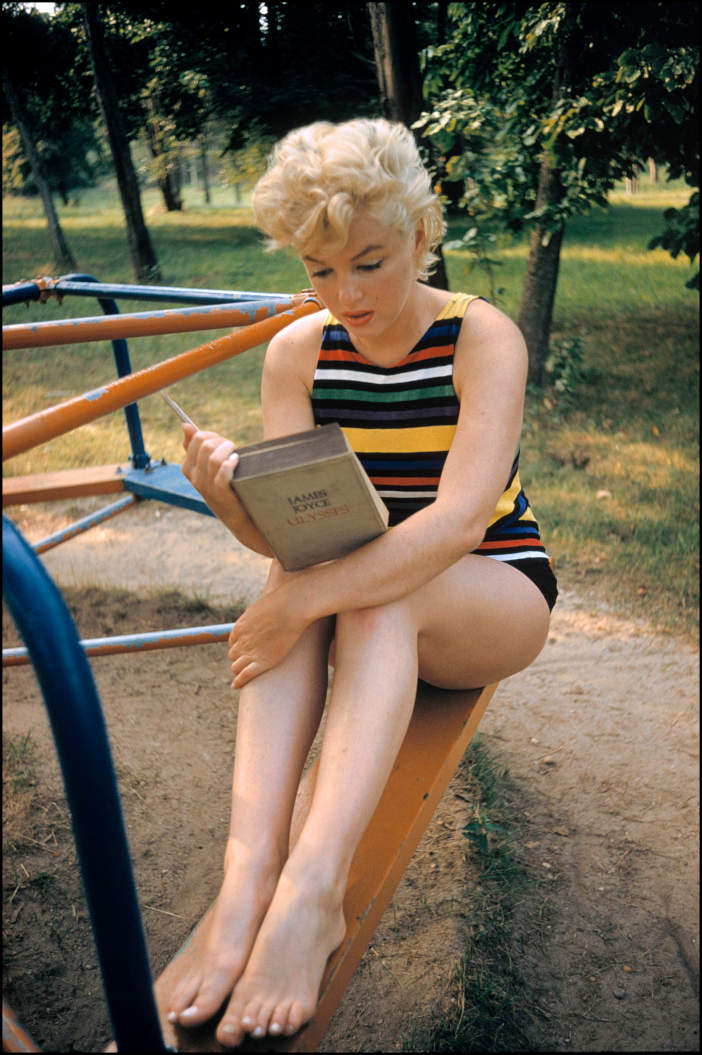
Marilyn Monroe, Mount Sinai, Long Island, 1955 by Eve Arnold
Marilyn’s film career was stratospheric so she had little time to adjust to the curiosity of the press and fans; every aspect of her personal existence pored over and every film appearance the subject of fascination for tens upon tens of millions, not just in the US but every town on the planet boasting a cinema. Life was never the same again; a life which turned out to be much shorter than her vivacious personality would have led anyone to guess.
This exhibition draws attention to how many of the photographers with whom she worked weren’t only impressed by Marilyn’s work ethic and her collaborative approach, but how they had never seen anyone more comfortable in her own skin and at ease before a camera. “She was an untutored artist,” Sam Shaw explained, “She had a hunger for knowledge, a talent for absorbing what artists and teachers shared with her, and she gave it back authentically.”
There is something enchanting about Eve Arnold’s documentary photograph of Marilyn reading Ulysses by James Joyce, a shot taken candidly in Long Island in 1955. Many will be surprised to see Marilyn poring over such a lengthy and intellectual title, and to learn that she was an avid reader of classic literature and poetry and was often seen with her nose in a book on set; albeit this wasn’t the kind of image the studio were keen to publicise of one of their most bankable sex symbols. Aside from the immersive quality of prose, she was intelligent enough to know that she had some serious gaps in her education and perhaps a part of her, conscious or otherwise, felt naive when mixing with Hollywood’s resident writers, directors and artists with whom she wanted to hold her own.
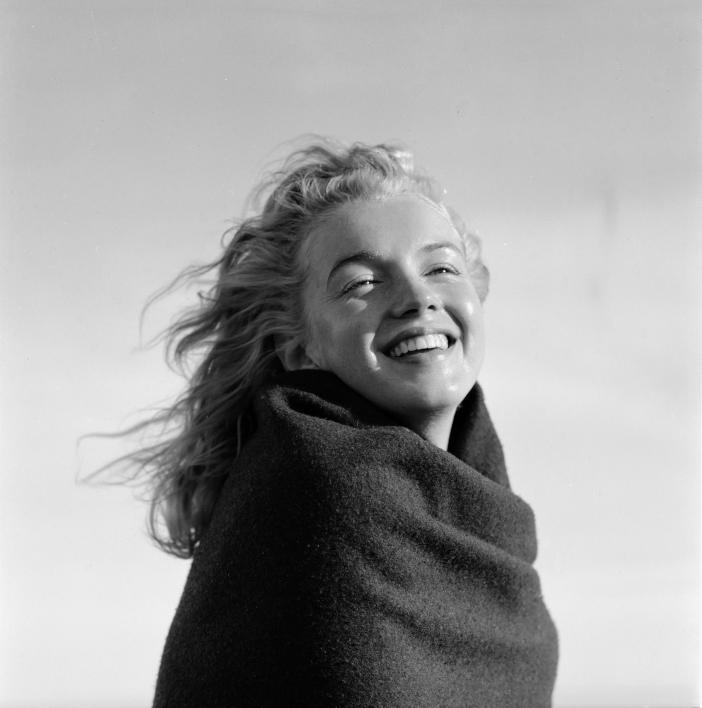
Marilyn Monroe, 1946 by André De Dienes
If you read Marilyn Monroe’s incredibly witty quotes or watch her first and last films, ‘Don’t Bother to Knock’ (1953) and ‘The Misfits’ (1961) you’ll notice how her acting ability profoundly matured over the years and that she should not have been confined to the one-dimensional characters the studio continued to offer years after ‘introducing’ Marilyn as Rose Loomis in ‘Niagra’ (1953), a role which cemented her superstar status and displayed her natural femme fatale quality. Relocating to New York in 1955 to study under the legendary Lee Strasberg, when it came to renegotiating her contract just a short time before her death, Marilyn fought against what she considered the deep injustice to her acting abilities and, insisting that the studio offer her serious roles, announced her intention to steer clear of scripts in which she would be typecast as a gold digger or a showgirl.
Examining the choreographed images that were commissioned by Marilyn’s studio, I am all the more intrigued and captivated by those ‘off duty’ shots of which there are considerably fewer; Marilyn on the beach with tousled hair and no make-up, reading whilst curled up at home, or riding a bike in the English countryside with her third husband, the playwright Arthur Miller, during the filming of the Sir Laurence Olivier-directed ‘The Prince and the Showgirl’ (1957). In fact, although the couple look natural, the Daily Mail had presented them with the bikes in the hope of staging some pictures – another example of how Marilyn was rarely off-duty.
Her months in England, living in a rented house in Surrey with Miller for the duration of filming, were far from the days of newly-wedded bliss she’d probably imagined, and despite her joy on learning that she was pregnant with what would have been her first child had she not miscarried in September of that year. The on-set tension between herself and Olivier, along with Marilyn having had endometriosis, is thought to have contributed to the miscarriage, while many believe that she was heartbreak on reading her husband’s diary in which he confessed to being ‘disappointed’ and often embarrassed by her when in company.
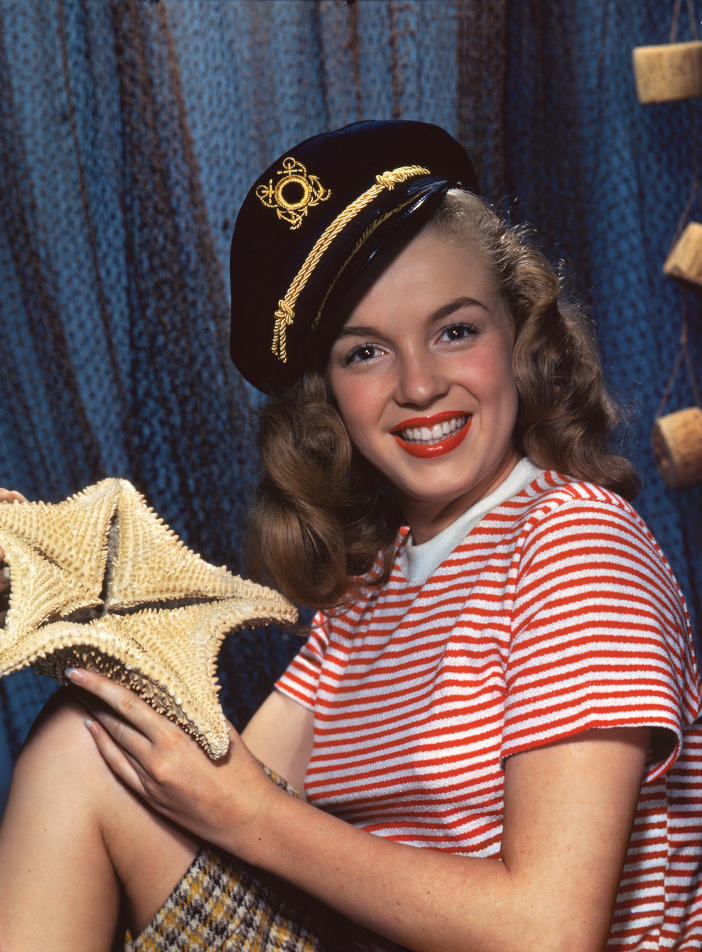
Norma Jeane,1946 by Bruno Bernard
A floor-length period dress worn by Marilyn in ‘The Prince and the Showgirl’ is one of only two costume exhibits, displayed in a glass case and accompanied by a photograph taken during the fitting. This is not an exhibition for those hoping to see a wide array of Marilyn’s garments. The only other item of her wardrobe is a pair of Salvatore Ferragamo heels which immediately brings to mind her strut down the station platform in ‘Some Like it Hot’ (1959) and another of her quotations: “I don’t know who invented high heels, but all women owe him a lot.”
There was a queue for the exhibition last Friday afternoon, something I’ve never witnessed at the National Portrait Gallery before, while inside, people were just as captivated by Marilyn Monroe’s image as they were during her lifetime. Many admirers weren’t even born when Marilyn was at the peak of her fame, proving not only the power of her captivating beauty, but her joyful exuberance and ability to connect with all people and generations. On reaching one of the last rooms in which a projection shows a montage of clips taken from Marilyn’s most iconic film roles, you too will struggle to take your eyes away from the screen. I must have watched it three times on a loop, smiling whenever, as Lorelei Lee, Marilyn sings about the dazzling appeal of Tiffany, Harry Winston and Cartier ‘rocks’ in ‘Diamonds Are a Girl’s Best Friend’, the flamboyant centrepiece of the 1953 musical ‘Gentlemen Prefer Blondes’, or when she illustrates the art of posing for the camera as The Girl in ‘The Seven Year Itch’ (1955). Marilyn had the kind of magnetism that’s impossible to adequately decipher. Let’s not even try.
All the images on display at this exhibition have one thing in common – they give you an overwhelming feeling of sadness when you know that Marilyn was raised in an orphanage and a series of foster homes due to her mother’s mental health issues, and that, just a few months after causing a stir by singing ‘Happy Birthday Mr President’ to JFK and a crowd of 15,000 at Madison Square Garden in May 1962, she was found dead aged 36. Marilyn’s tragic ending has changed the context of every image, making them ethereal and almost other-worldly. Finding yourself in a room with so many captures of Marilyn frozen in time, forever young, looking you straight in the eye and granting you her biggest smile speaks to you more than any performance she ever gave. She wouldn’t want us to grieve that her life ended before she’d found creative satisfaction, or her elusive soul mate; she did many things of which she was proud, ever grateful to the fans whom she insisted had made her a star; “No studio, no person – the people did it.”
Marilyn Monroe: A Portrait at the National Portrait Gallery, London until 6th September 2026. Tickets from £25 off-peak – concessions available. For more information and tickets please visit the website.