In which Douglas Blyde, fresh from his guest appearance at a recent Consorzio Lugana DOC tasting in London, reports back from 48 hours on the southern shores of Lake Garda — and finds a denomination hiding in plain sight…
A fortnight ago, I thought I knew what Lugana was. A pleasant white wine from a beautiful lake. Refreshing. Reliable. The sort of bottle one drinks happily on holiday, orders again, then forgets to take seriously.
Then I spent 48 hours there. And for 48 hours, Lugana kept refusing to behave as expected.
The first surprise was scale. From just 394 hectares in 1988, Lugana has expanded to around 2,560 hectares today, and it continues. Growth on that scale doesn’t happen by accident. It suggests a denomination still writing its own story.
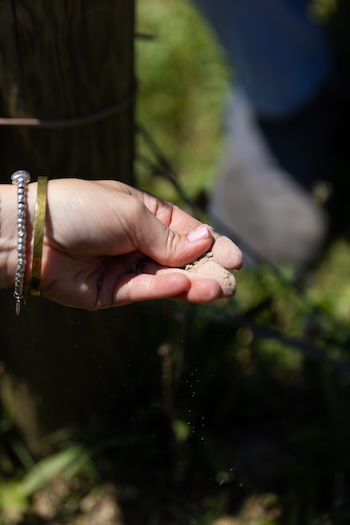 The second surprise was where that story begins. Not with producers. Not with wineries. Not even, really, with wine. It begins with glaciers.
The defining feature of Lugana is the white clay left behind by retreating ice. Producers spoke about it almost tenderly, which is generous, given how badly it behaves. In summer it hardens almost to concrete. After rain it becomes dense, adhesive and difficult to work. Yet it stores water, drives roots deep into the subsoil, and increasingly appears to help Turbiana retain freshness as growing seasons become warmer.
Then there are the winds. The Pelèr from the north. The Ora from the south. They move across Lake Garda with remarkable regularity, cooling the vineyards, moderating extremes, and turning the southern shore into what producers describe as a climatic cradle. After visiting, I find that phrase difficult to resist.
Topographically, this is not dramatic mountain viticulture, but something subtler: a low, glacial amphitheatre at the lake’s southern edge, where water, clay and wind do most of the work.
And then there is Turbiana. Legally, Lugana may appear as the classic DOC, as Superiore after at least one year’s ageing, as Riserva after at least two, and also in late-harvest and sparkling forms — but what matters most is not the category on the label, but the surprise in the glass.
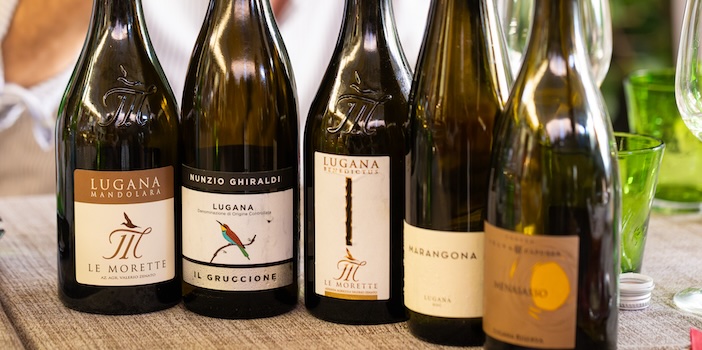
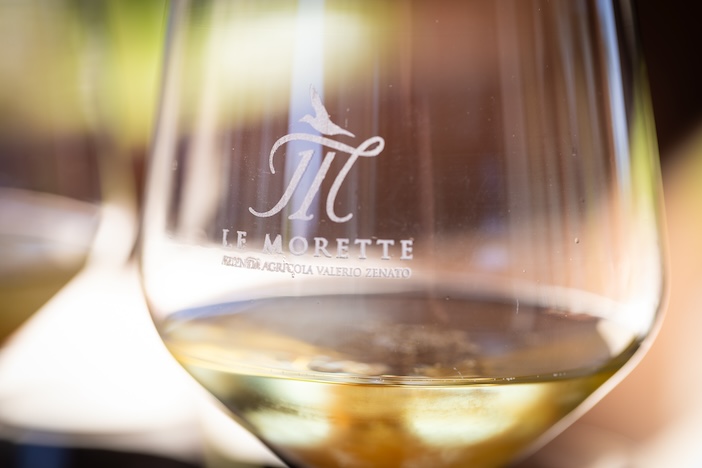
Over two days I kept hearing the same words. Salinity. Freshness. Longevity. This was slightly awkward, because I had arrived thinking of Lugana as a youthful wine. Then Le Morette poured a 2017 Riserva which seemed nowhere near finished with itself. Then Tenuta Roveglia poured Vigne di Catullo from 1997. And suddenly the conversation changed. Because when a white wine remains compelling after nearly three decades, we need to stop talking about it simply as a holiday wine and begin treating it as one of Italy’s serious ageworthy, fine whites.
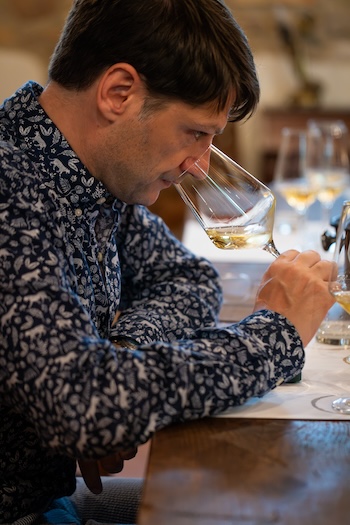 At Roveglia we also tasted the same 2011 under cork and screwcap. Two bottles. Two closures. Two different futures. The screwcapped bottle remained taut, youthful and tightly drawn. Its cork-sealed counterpart had broadened, softened and acquired another layer of complexity. Ageing here is not a theory.
At Cascina Maddalena, Clay 2018 may have been the most eloquent wine of the trip. Not because it was the loudest. Quite the opposite. It felt as though somebody had translated the denomination’s defining soil directly into liquid form.
At Montonale, Orestilla 2016 was mature yet vivid, broad yet precise. Roberto Girelli also told me the family is preparing wines for release only after three years in ceramic vessels and another seven years in bottle. Ten years before release. That requires confidence. Or madness. Perhaps both.
Yet perhaps the greatest surprise was not the ageability. It was the breadth. Traditional-method sparkling Lugana. Skin-contact Lugana. Earthenware-raised Lugana. Late-harvest Lugana. Extraordinary grappa.
This is where comparisons with Burgundy need care. Chardonnay is rightly celebrated for its versatility. But Turbiana has a different story to tell. Its strength is not that it imitates Chardonnay. It is that it does not need to. It carries freshness naturally. It speaks through clay. And it appears remarkably well equipped to retain balance as climates become warmer. In the decades ahead, that may prove one of its greatest strengths.
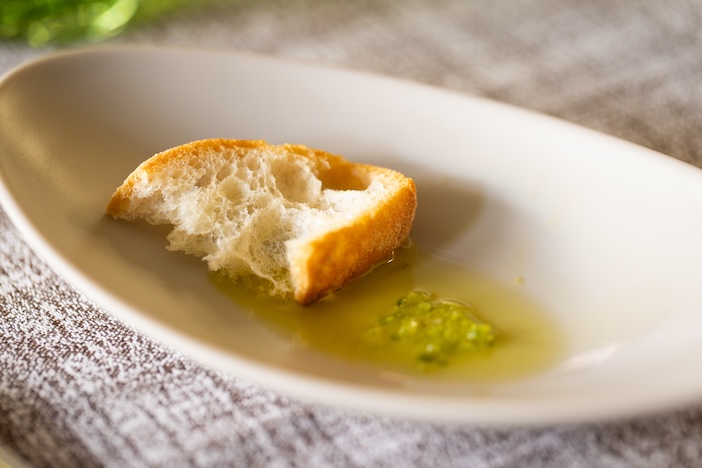
And Lugana’s story is not only one of wine. It is also saffron from Pozzolengo. Grana Padano. Extra virgin olive oil from Garda. Capers from nearby Gargnano. Lake fish. Vineyards bordered by orchards and olive groves.
And it is wonderfully easy to navigate. This is not a wine region which demands heroics from the visitor. You can move between lake, village, vineyard and cellar by car, of course, but also by bike or e-bike, following gentle routes through the Lugana vineyards around Sirmione and Peschiera. There are lakeside hotels, family estates, restaurants, historic sites, and wine resorts such as Cobue, where visitors can sleep among the vines rather than simply taste and leave.
At Villa Cortine Palace I walked through kitchen gardens, beneath umbrella pines and Roman ruins before dinner overlooking a lake broad enough to resemble a sea. That evening, chef Mattia Bartoli paired Ottella’s skin-contact ‘Back to Silence’ with ravioli del plin filled with formaggella from Tremosine, saffron from Pozzolengo and capers from Gargnano. The wine no longer felt like an isolated glass. It had become part of its landscape.
One afternoon I climbed the tower at San Martino della Battaglia. Below me stretched vineyards across land once occupied by armies. Nearby, an ossuary preserves the remains of those who died there, while the origins of the Red Cross are closely intertwined with these same landscapes. The view was beautiful. It was also corrective. Lugana is not simply a holiday destination. It is geology. History. Agriculture. Food. Climate. And generations of patient work, all distilled into a glass.
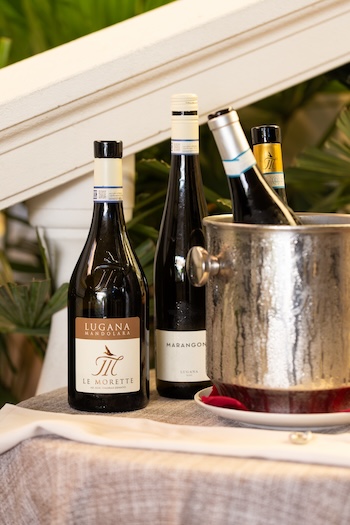 Which brings me to a slightly provocative observation. I do not believe Lugana’s challenge is quality. The wines are already good enough. The challenge is visibility. Many of the most exciting bottles I encountered remain little known outside specialist circles. Some of the most interesting stories remain untold. Some of the most adventurous wines remain hidden behind the classics.
So, consider this an invitation to look past the bottle you already know. Ask your wine merchant what else Lugana makes. Because there is more to find than the crisp, easy-drinking classic that made its reputation.
Ask to taste the sparkling wines. Ask for the skin-contact wines. Ask for the wines raised in earthenware. Ask for the late-harvest wines. Track down the grappas, the experiments, the adventurous edges of the denomination. Those expressions do not dilute Lugana’s identity. They deepen it. They demonstrate belief in the denomination. And belief is precisely what Lugana has earned.
After two days on the southern shores of Lake Garda, I left with a very different impression from the one I arrived with. I thought I was visiting a pleasant white wine region. I left wondering whether one of Italy’s most compelling wine stories has been hiding in plain sight.
As the Italians say, “Chi ben comincia è a metà dell’opera” — well begun is half done. I hope the UK will help bring Lugana into the public’s consciousness — one sentence, one glass, one sip at a time.
To learn more about Lugana wines, including where to purchase them in the UK, please visit www.consorziolugana.it.