A meticulously researched biography cuts through decades of controversy to ask what Gauguin’s paintings actually show us about the Polynesia he lived in — and the people he lived among…
Gauguin more than almost any other artist provides a battleground on which modern sensibilities collide with the enduring popularity of the artist’s work. Despite his controversial reputation, Gauguin’s work still achieves eye-watering prices at auction. Exhibitions of his work sell out fast and there is also no doubting his influence on the development of modern representational art. Yet the list of his personal and professional sins is extensive: arrogant, narcissistic, unreliable, socially inept, sexual predator, colonial exploiter and cultural appropriator. Central to the debates surrounding Gauguin and his art is explaining his relationship with and representation of Polynesia, its people and their culture. This is not as straightforward as it might seem given the depth of controversy that surrounds it and the fact that much of Gauguin’s writing about his life and art is so contradictory.
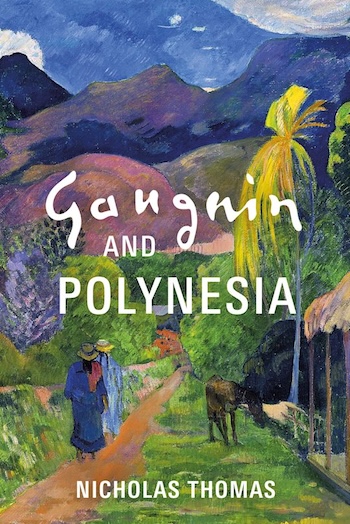 There is no better guide to be found through these various controversies than Gauguin and Polynesia by Nicholas Thomas, a superb biographical study of the controversial French artist. It is not only a deeply researched examination of Gauguin’s life and works but also one founded on Thomas’s own decades of living and working across Polynesia.
Thomas’s response to the fashionable truism that Gauguin painted a Polynesia of his own invention is that it misses the extent to which he just painted what was in front of him — indeed, Thomas remarks that it is often difficult to look at a painting by Gauguin without feeling one is being told how to react. However, while making this case, Thomas takes care to acknowledge and identify the way in which Gauguin often mixed local myth and spirituality with elements taken from other cultures in his paintings. Thomas also makes clear the difficulties in deciphering Gauguin’s artistic intentions given what he wrote was so often contradictory, both in his letters and in the book, Noa Noa, that he wrote about his Polynesian experiences. As Thomas points out, one needs to remember the very different audiences Gauguin’s writings were directed at – a Parisian art market, and his own family and friends whose support he still needed.
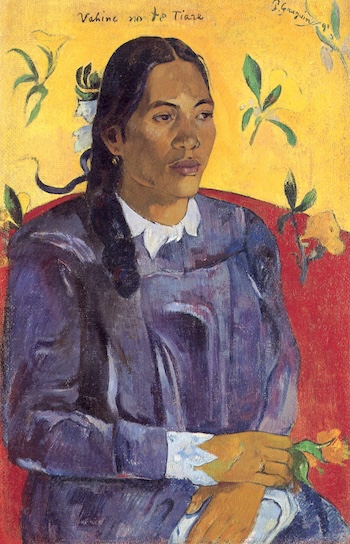
Tahitian Woman with a Flower (Vahine no te tiare), 1891, by Paul Gauguin (Ny Carlsberg Glyptotek, Copenhagen).
Thomas’s deep personal experience also enables him to point out when misreadings of Polynesian culture and history result in a false lack of agency and lack of empowerment attributed to the subjects of his paintings. The powerful unnamed portrait of a Tahitian woman Vahine No Te Tiare/Woman with a Flower is a case in point on two counts. The first, is that when Gauguin asked to paint her, she refused and went home. When she returned, she was dressed as she had chosen to be – she had decided not only that she would be painted, but how.
The second, relates to the European influence evident in the style of dress she chose to wear, which was not unusual and can be seen in photographs taken at the time. This custom has been regarded, especially by some art scholars, as a mark of disempowerment and colonial oppression. What Thomas points out is that this is based on a mis-reading of Polynesian culture and history and, in particular, the value placed on cloth, before and during colonisation, both as a sign of status as well as of sacredness. Wearing cross-cultural dress was not so much a sign of colonial oppression as one of adaptation and improvisation — and you’ll still see Polynesian women dressed much the same way today.
The most controversial aspect of Gauguin’s reputation for modern eyes comes from his relationships with young girls symbolised by paintings of them naked such as in Mana’o Tupapa’u’/Spirit of the Dead Watching. The girl in question was Teha’amana, the first of the three young girls he had live with him at various stages during his time in Polynesia. However disreputable his behaviour was, it was not illegal. The age of consent in France, at that time, was thirteen and the age for marriage was fifteen. In Tahiti, thirteen was even considered a marriageable age but any marriage had to have the agreement of the family.
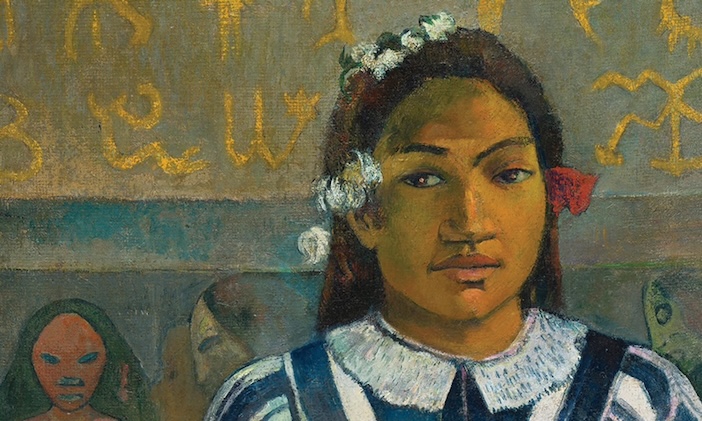
Detail from ‘The Ancestors of Tehamana’, 1893, by Paul Gauguin (currently in the Art Institute of Chicago).
In the case of Teha’amana the family insisted she could come home after eight days if she was not happy. This she did but then returned a few days later to live with him for two years. His relationships were most certainly exploitative but his vahine (woman or wife), as they were called, despite their age, all exhibited degrees of independence. Thomas, while putting the relationships into their Polynesian context, including explaining how Teha’amana had two so-called mothers – even today motherhood comes early and it is not unusual for a first child to be informally adopted and brought up by a surprisingly young grandmother – is nonetheless unsparing in his assessments of Gauguin’s behaviour.
Gauguin’s disreputable reputation has always been made worse by the implication that he was knowingly syphilitic. Thomas treats these implications with care as the evidence has never been conclusive. However, very recent research, that appeared too late for this book, has up-ended the accusation that Gauguin was a syphilitic lecher. Analysis of some of his teeth has found no traces of the medicines commonly used to treat syphilis during his lifetime. A lecher he remains but that he was syphilitic as well is now far less likely. It will be interesting to see how this affects future judgements of Gauguin, including Thomas’s own.
One of the many strengths of this fascinating book is the care lavished on its presentation. Nicholas Thomas deserves congratulation for writing a book that enables one to see more of Gauguin the painter, a Gauguin whose work so often gets buried beneath the controversies and contradictions that inevitably seem to accompany him. At the same time, Thomas has opened a door to the enduring beauty of Polynesia and the complexity of its culture. Above all, his book is just such a pleasure to read.
Gauguin and Polynesia by Nicholas Thomas is out now in hardback and ebook, published by Head of Zeus, and available in all good stockists. The paperback is due for release in April 2027, and is available for pre-order. For more information, please visit www.bloomsbury.com.
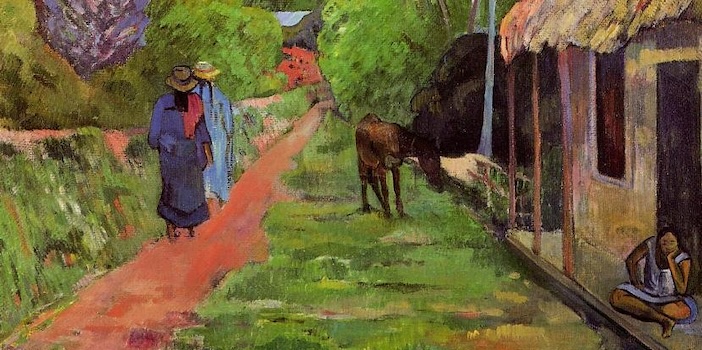
Header image: Detail from ‘Street in Tahiti’, 1891 (Toledo Museum of Art, Ohio)