The lagoon at dusk, a scampi risotto finished at the table and veteran waiters whose individuality no corporate handbook could hope to contain: Douglas Blyde concludes his stay at Venice’s new Four Seasons…
At Danieli, Ruocco’s approach turns out to be the house style. This attitude extends to the hotel’s personnel. Zandonella has assembled a team of polished international professionals alongside exuberant Venetians whose years of service predate the Four Seasons takeover, some by decades.
Among the newcomers is Gianvito Sasso, now assistant director of food and beverage, whom I recognise from London’s Dorchester. His move to Venice followed a scooter-related accident. The prospect of working in a city whose historic arteries are entirely free of such vehicles subsequently acquired considerable appeal. Venice has many advantages, but freedom from the London traffic system is seldom listed in the luxury-hotel brochures.
Sasso brings worldly experience to a building already rich in institutional memory. The balance is important. Too much corporate polish and one risks replacing character with compliance. Too little discipline and the guest may find that a hotel’s long history is being used to excuse its contemporary shortcomings.
Zandonella seems alert to both possibilities. His team numbers around 300, predominantly Venetian, and some of the longer-serving employees know the building with a familiarity which no induction programme could replicate. Returning guests have their own memories, preferences and favourite members of staff. They expect recognition, and not merely from a computer.
A view worth competing with
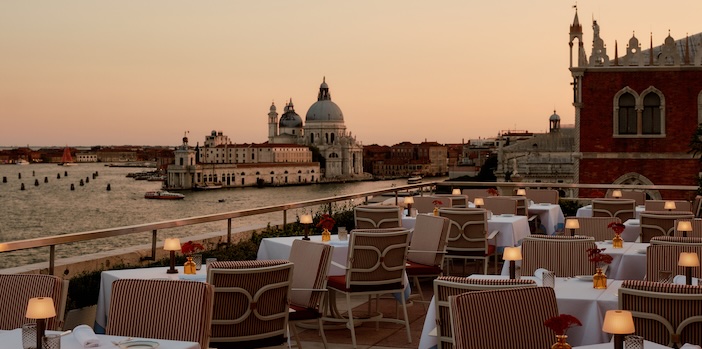
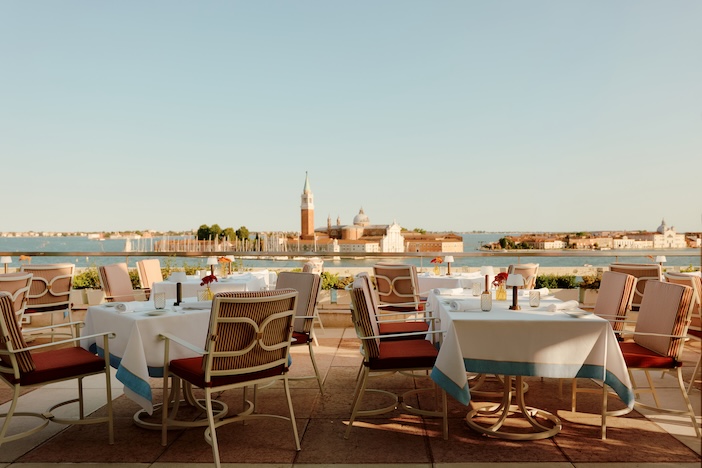
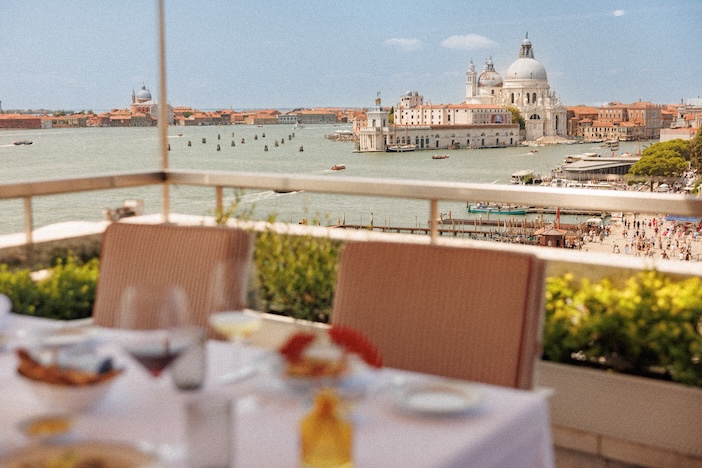
Terrazza Danieli occupies one of the most enviable restaurant positions in Europe. From its rooftop terrace, the lagoon unfolds towards San Giorgio Maggiore, while boats negotiate the water beneath a horizon whose architecture makes conventional city skylines seem terribly unimaginative.
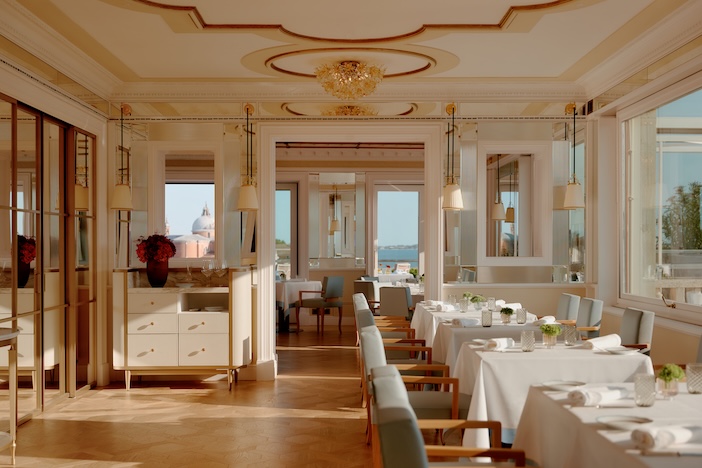
The dining room has been refreshed with paler colours, azure accents and vast mirrors. It is a handsome setting, although any interior designer attempting to compete with the view would be better advised to seek alternative employment. Fortunately, the cooking has no such insecurity.
Small lagoon oysters are served without the numbing chill of ice, allowing their delicate character to emerge. Local spider crab with avocado and potato offers a particularly pleasing interplay of textures. Raw Puglian prawns with mint possess magnificent sweetness, while Sicilian red prawns meet broccoli and greens. Danieli carpaccio is finished with black truffle shaved at the table.
Sous-chef Michele Da Broi appears repeatedly to explain the dishes, plainly enjoying the pleasure they give. Executive chef Adriano Rausa is absent that evening, though thoughtfully sends a personal note expressing his regret. It is a small courtesy, although small courtesies tend to distinguish genuinely good hotels from ones which simply employ very expensive architects.
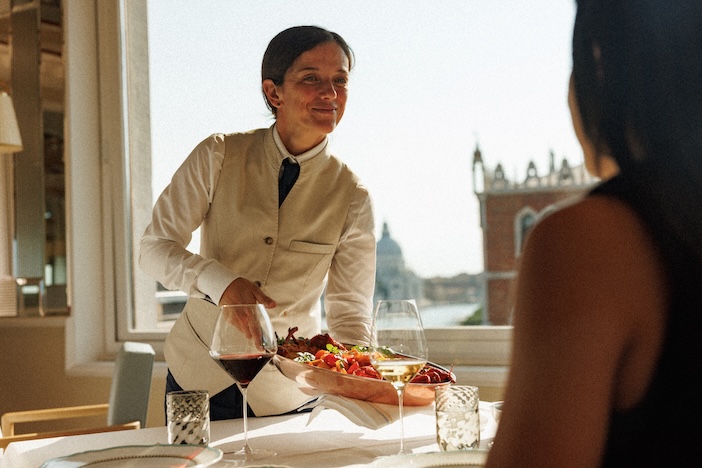
A scampi risotto is particularly accomplished. Finished tableside, with lightly blowtorched shellfish resting on beautifully al dente rice, it derives its depth from a stock of considerable intensity. The dish respects its principal ingredient rather than treating the scampi as an excuse to introduce half the contents of a luxury delicatessen.
Head sommelier Gianluca Lorusso has an unusual professional pedigree. Before moving into fine wine, he spent 18 months dealing cards in a casino. Reading people, maintaining composure and handling substantial stakes were essential skills. At Danieli, the clientele may be similarly demanding, although the odds of leaving with a good bottle are rather more favourable.
His wine list takes inspiration from the historic trading routes of the Serenissima, offering discoveries beyond the predictable procession of expensive labels. Cantina Terlan’s Quarz Sauvignon Blanc brings precision and structure to the opening seafood, while Edi Kante’s Vitovska 2016, with its developed, savoury character, accompanies the scampi risotto.
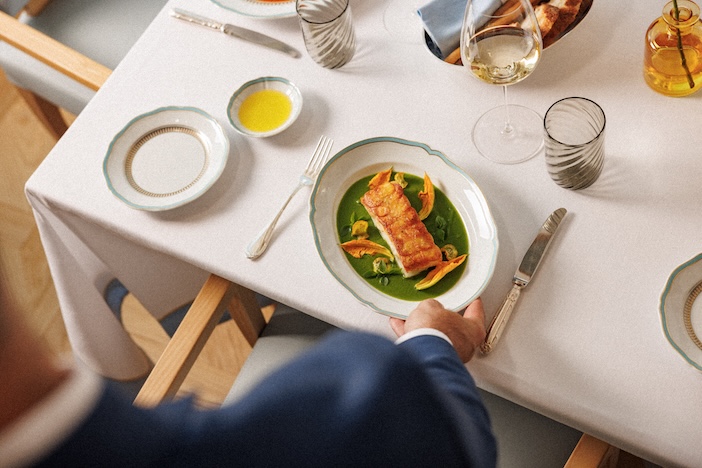
The main course, wonderfully succulent bluefin tuna belly with Venetian onions and a rich jus, inspires two contrasting pairings. Ronco Calino’s P.R. 2013, a mature Pinot Noir-led Franciacorta, has the breadth and acidity to confront the richness. Ceretto’s Asili Barbaresco 2020, poured through Coravin, takes the argument further. Its aromatic complexity, acidity and fine tannins suggest that this magnificent fish is almost better approached as red meat. Lorusso’s former occupation evidently taught him when to play an unexpected card.
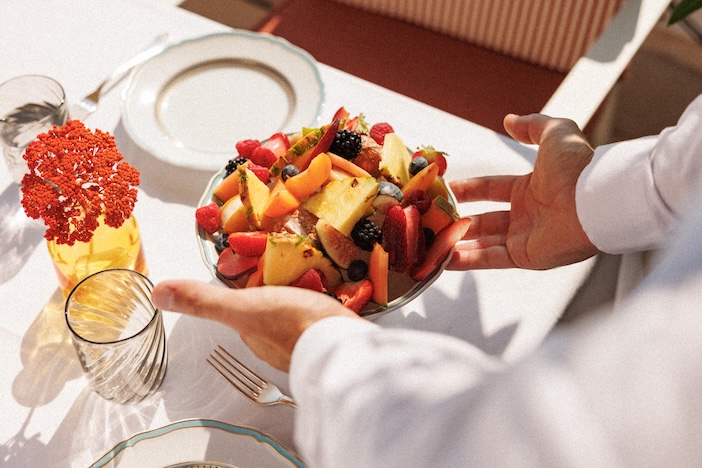
Dessert is another piece of Venetian sleight of hand. A chalice apparently filled with fruit conceals a fig containing fig sorbet and a walnut shell hiding walnut sorbet, accompanied by vanilla mille-feuille. The trompe-l’œil is entirely appropriate in a city which has been manipulating appearances with considerable success since the Renaissance.
Yet it is the people who make the most lasting impression. At dinner, a veteran waiter with a magnificent moustache conducts himself with such wholehearted enthusiasm that one hopes no consultant has been commissioned to moderate it. His personality seems to occupy almost as much space as the room’s splendid furnishings, and is every bit as welcome.
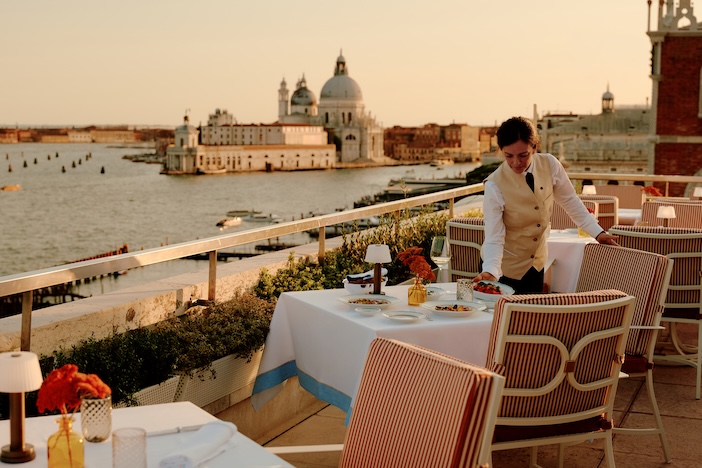
As the evening cools, blankets are produced for the terrace. Nobody attempts to explain the restaurant’s philosophy at exhausting length. The philosophy seems to be that people ought to eat well and enjoy themselves. Breakfast the following morning supplies further encouragement.
My cappuccino bears an intricate image of St Mark’s Basilica imprinted upon the foam, a miniature architectural achievement which seems almost too accomplished to disturb. A few tables away, a different veteran waiter, every bit as animated as his moustachioed colleague of the previous evening, asks an elderly guest to confirm his room number ‘for internal investigations’. The phrase, delivered with magnificent solemnity, is irresistible. What investigations? Has somebody misappropriated a breakfast pastry? Is the guest suspected of taking two cappuccinos? He offers no elaboration, and the elderly gentleman seems entirely untroubled.
It is precisely the sort of exchange which could never be invented by an international hospitality training department. Nor, one hopes, will such a department attempt to eliminate it.
For all its gilding, handsome fabrics, engineering and considerable investment, Danieli’s most distinctive asset remains its people. A glorious building provides the stage, though somebody must still know how to perform upon it.
Venetians have a saying: ‘Dai e dai la barca ariva ai pai’, roughly, keep rowing and eventually the boat reaches its mooring. After years of construction, substantial expenditure and the difficult business of reconciling old loyalties with new expectations, Danieli has covered considerable distance.
The transformation is unfinished, and the remaining bedrooms and facilities will eventually permit a fuller judgement. Nevertheless, the first impression is encouraging. Zandonella appears to understand that the business of running a grand hotel involves rather more than ensuring its chandeliers have been cleaned.
One can buy marble, commission magnificent flowers and instruct designers to conceal televisions behind increasingly elaborate arrangements of art. The ability to make guests feel genuinely welcome is harder to procure.
As for the waiter conducting his internal investigations, Four Seasons would be wise to leave him entirely alone.
Danieli, Venezia, A Four Seasons Hotel – Riva degli Schiavoni 4196, Castello, 30122 Venice. For more information, please visit www.fourseasons.com.