Trafalgar Square’s rotating art experiment welcomes its sixteenth commission this month, as Tschabalala Self’s technicolour “everywoman” takes over from Teresa Margolles. Rosalind Ormiston looks back at the plinth’s history — and ahead to a packed month of London sculpture…
Since 1999, when the English artist Mark Wallinger’s sculpture Ecce Homo — cast from a living body to depict a near-naked Christ with hands tied behind his back — was placed on the empty plinth in Trafalgar Square, London, sculptors have competed for the chance to temporarily take over this elevated, once-empty corner of the capital, each occupying it for around 24 months.
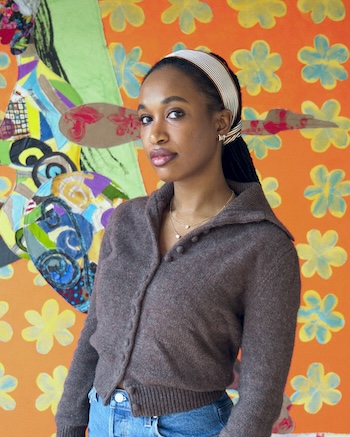
Tschabalala Self (photo by Christian DeFonte)
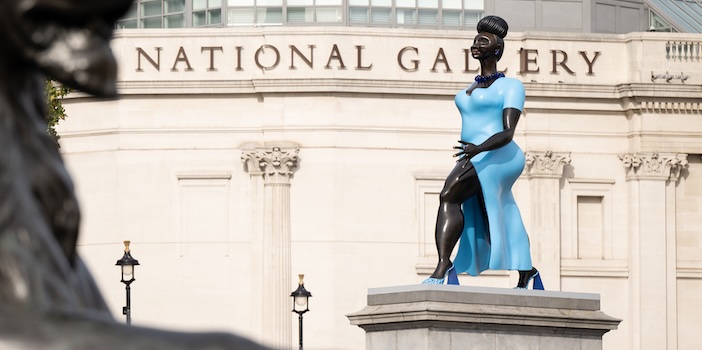
The ‘Fourth Plinth’ in the square’s north-west corner, now an international competition, unveils its sixteenth commission on 10th September 2026, after a funding-related gap of several years. This time it’s the turn of New York-based artist Tschabalala Self, whose larger-than-life sculpture Lady in Blue takes its name from the flowing blue dress and blue high-heeled shoes worn by its sculpted young woman.
Self sees her as a contemporary “everywoman” — dynamic, warm, and likely to bring a smile to the faces of many striding across the square. Lady in Blue replaces 2024’s oblong-shaped A Thousand Times in an Instant by Teresa Margolles, a work formed from plaster casts of the faces of 726 trans, non-binary and gender-nonconforming people.
The Fourth Plinth project was initiated in 1994 by Prue Leith, then chair of the Royal Society of Arts (RSA), who wanted to raise awareness of sculpture in public spaces after the plinth had stood unoccupied for around 150 years (the other three feature permanent nineteenth-century bronze statues of King George IV, Sir Henry Havelock, and Sir Charles James Napier, respectively). The RSA agreed that three contemporary sculptures would each stand independently on the plinth for around 18-24 months, beginning in 1999, with the public given a say in the selection.
Responsibility for choosing and installing further sculptures transferred to the Greater London Authority (GLA) and the Mayor of London’s cultural team between 1999 and 2003. Today, the choice rests with the Fourth Plinth Commissioning Group, through public consultation and a panel of artists, curators and journalists, with the Mayor of London making the final decision.
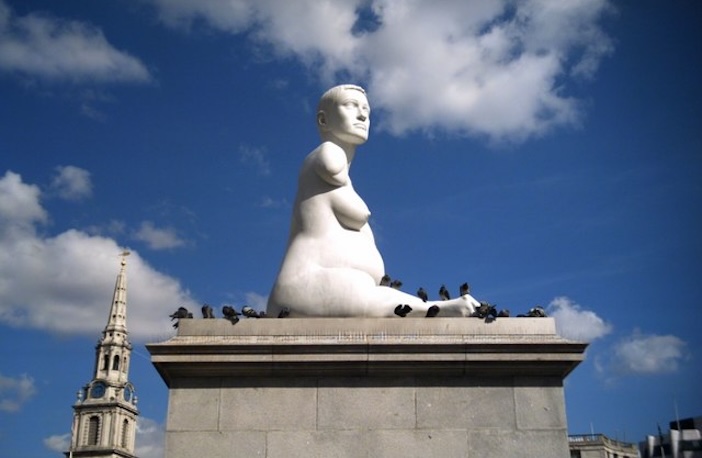
Alison Lapper, 2005, by Marc Quinn (Photo: Creative Commons)
There have been some fabulous sculptures commanding the plinth’s view of the square. Who can forget 2013’s bright blue cockerel, Hahn/Cock, by Katharina Fritsch? Or David Shrigley’s fist with its ten-metre-high thumb, Really Good, from 2016, and the skeletal Gift Horse by Hans Haacke before that? Marc Quinn’s 2005 3.6-metre sculpture of Alison Lapper, carved from 13 tonnes of Carrara marble — Michelangelo’s favoured stone — drew wide attention to disability and disabled rights; Lapper was born with phocomelia, without arms and with shortened legs.
Quinn’s work was arguably the moment the Fourth Plinth began to command serious public attention. Many commissions since have surprised the square’s audience, from Yinka Shonibare’s Nelson’s Ship in a Bottle in 2010 to Heather Phillipson’s THE END, with its giant dollop of whipped cream, cherry and drone on top. And now it’s Tschabalala Self’s turn, with Lady in Blue.
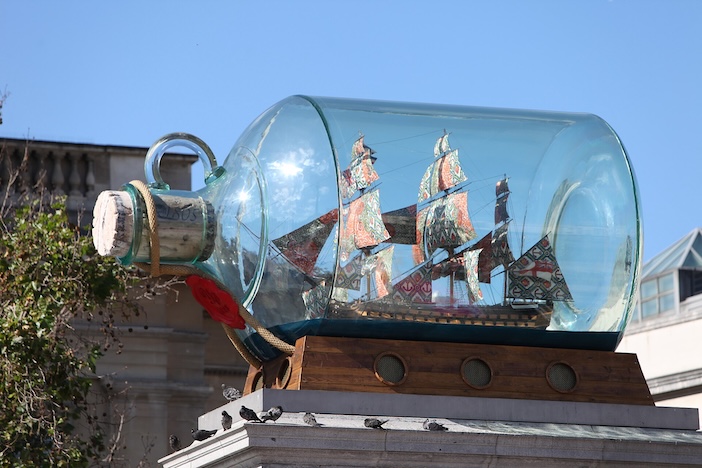
Nelson’s Ship in a Bottle (2010) by Yinka Shonibare, MBE (Photo: Creative Commons)
Running parallel to the Fourth Plinth launch is London Sculpture Week, from 19th-27th September, packed with public art exhibits. A Taste of Sculpture in the City combines visual art with food, offering dishes inspired by artists including Ai Weiwei, Julian Opie and Maya Rose Edwards, among others. In east London, ‘The Line’ is a public art trail of 24 installations connecting Queen Elizabeth Olympic Park and The O2 along waterways that follow the Greenwich meridian, with works by Antony Gormley, Eva Rothschild, Madge Gill, Carsten Höller and others. And East Bank has organised a walking tour following works commissioned for the London 2012 Olympic and Paralympic Games.
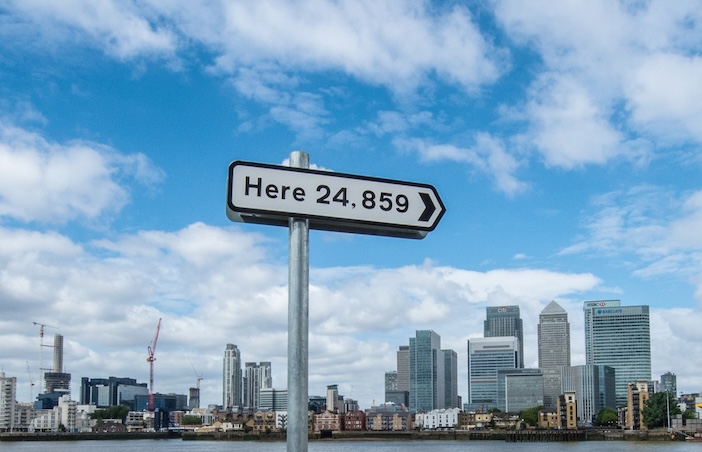
‘Here’ (2013) by Thomson And Craighead as featured in The Line (photo: Luis Veloso)
Then there’s Frieze Sculpture, running for longer, from 16th September to 1st November, a free exhibition of striking freestanding sculpture in Regent’s Park featuring international artists including Conrad Shawcross, Tarina Sethi, Angel Otero and Ivana Bašić. There’s a symposium too, on 25th September at the Warburg Institute, where speakers will discuss contemporary sculpture in “Reframing Monumentality.”
Between the Fourth Plinth’s newest arrival and the trail of exhibitions across the capital, there’s no shortage of sculpture this September — from major names to work by artists finding their audience.
For more information, including details of all free and ticketed events, visit the website.
Header image: Tschabalala Self’s ‘Lady in Blue’ on Trafalgar Square’s Fourth Plinth (PA Photo).