In the second part of her Chilean adventure, Estella Shardow fulfils a long-held wildlife wish: a day tracking the elusive pumas of Torres del Paine…
Never before have I been so pleased to see some animal poop. Standing on the sandy, sunlit shore of Lake Sarmiento in Chilean Patagonia, our guide Cristóbal Sánchez points to a couple of inch-long pellets, matted with fur and tiny bone fragments. “That tells us it came from a carnivore,” Cristóbal says, “and not our foxes, which like to eat a lot of berries. Then see how it tapers, and these scratch marks around it? Yes, we can be sure this came from a puma.” My husband George and I exchange excitable grins. This is the day’s first sign that we’re on the right track.
It all started with David Attenborough, as is so often the case with my travel plans. Back in 2022, Dynasties II followed a particularly queenly mountain puma, Rupestra, battling to keep her cubs safe from the harsh Andean winter and territorial rivals. Cat lady that I am, a trip to see these creatures in the wild was promptly added to my bucket-list. My honeymoon this year seemed like the perfect opportunity to finally realise the dream.
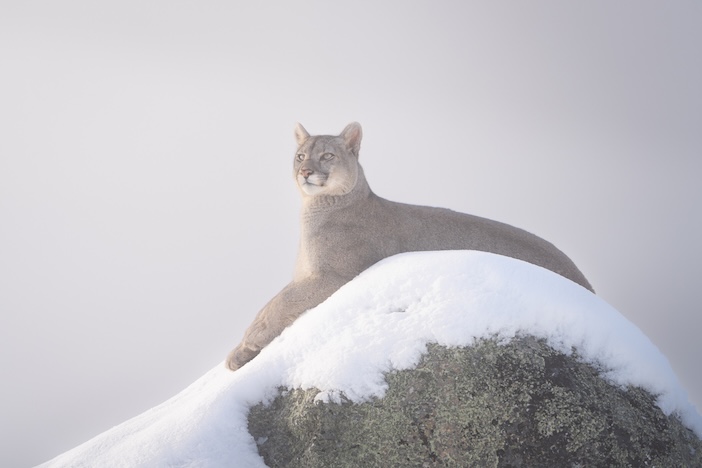
Photo: Cristina Asun
Mountain lion, cougar, panther, ghost cat – the Puma concolor has the greatest number of names of any animal, with 40 appellations in English alone. They’re also the planet’s most widespread wild cat species, roaming everywhere from Canadian Yukon to Chile’s most southern tip to Florida’s swamps. But the densest population is found in Chile’s Torres del Paine National Park and its neighbouring ranches, including Estancia Laguna Amarga. An estimated 20 individuals prowl this 7,000-hectare family-owned reserve – a former livestock ranch turned conservation and eco-tourism pioneer. This is where the BBC Wildlife crew came to film Dynasties II. There was surely no better place to embark on my puma quest.
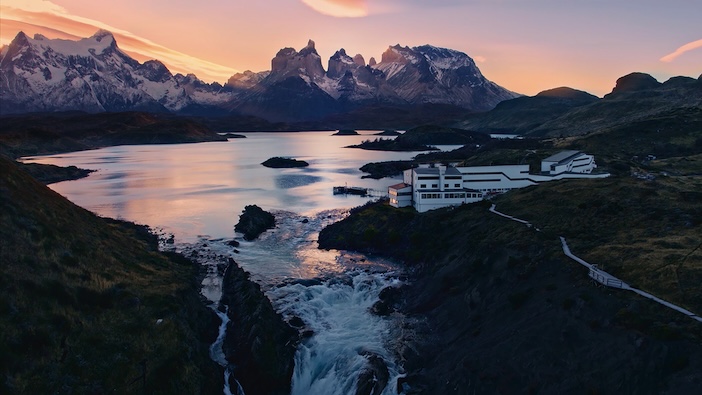
Every expedition needs a base camp and Explora Torres del Paine put us in the heart of the national park, only a 45-minute drive from the Estancia, with the immense granite folds of the Paine massif as a backdrop. Hugging the southern shore of Lake Pehoe, there’s something of the ocean liner about the hotel’s architecture, with its whitewashed cladding and strips of picture-windows wrapping around the building. Guests typically spend their days out on hikes, climbs and horse-rides accompanied by the lodge’s resident guides. Puma-tracking excursions, a niche yet growing activity, are outsourced to regional wildlife specialists Magellania.
Sunrise is slowly pouring honeyed light over the peaks as Cristóbal, one of the company’s most experienced naturalist guides, drives us along the twisting gravel road. Signs warning vehicles to ‘reduzca velocidad’ show the silhouettes not of cattle, deer or pedestrians but instead, promisingly, pumas. The native beech forest thins out, replaced by wiry, low-lying shrubs. Glacial valleys plateau into open plains. We’ve entered the Patagonian Steppe.
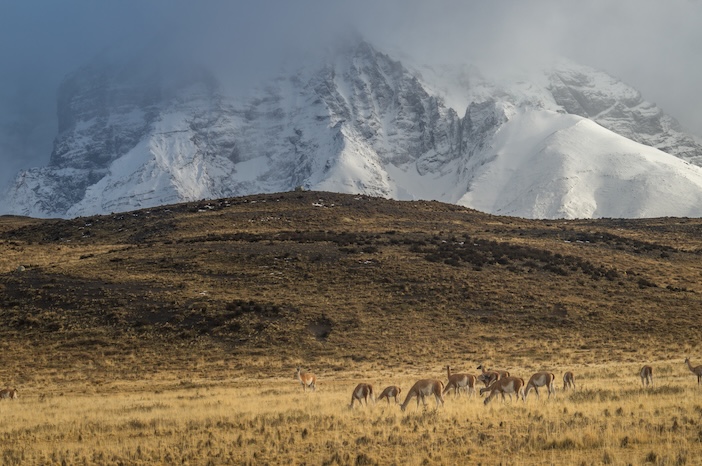
Within minutes, we’ve spotted a herd of guanacos – large, llama-like animals that happen to be the main food source for pumas, despite weighing twice as much as them. “Pumas are ambush hunters, expert hiders,” Cristóbal says, explaining that their fur, which ranges in colour from reddish brown to pale grey, camouflages well with the surrounding shrubs and rocks. “We’ll need to pay attention to the whole ecosystem – evaluating the direction of the wind, the terrain, the behaviour of other wildlife – for some clues. But let’s be honest, it’s about betting too. There are no guarantees. This is all part of the game of nature.”
At least we have some back up in today; the Estancia may appear devoid of other humans, Magellania’s founder Cristian is somewhere out there, guiding a small group of American photographers, while master tracker Roberto is scouring other sections. If any team member spots a puma, they’ll radio it in.
Cristóbal manoeuvres the 4×4 up a craggy outcrop to get a better vantage point. Within the Estancia, we’re allowed to explore off-road as well as to roam freely on foot, whereas within the National Park visitors must stick to designated trails. The three of us get to work scanning the terrain with binoculars and a thermoscope. Detecting a cat-shaped heat signature would of course be quick win, but more likely we’ll need to follow some of those subtler signs. A circling vulture is promising (“perhaps it can see a puma’s made a kill”), a guanaco staring fixedly or making its high-pitched “ne-ne-ne” alarm call even better. The herd we’re watching, Cristóbal concludes, is “just chilling”, though.
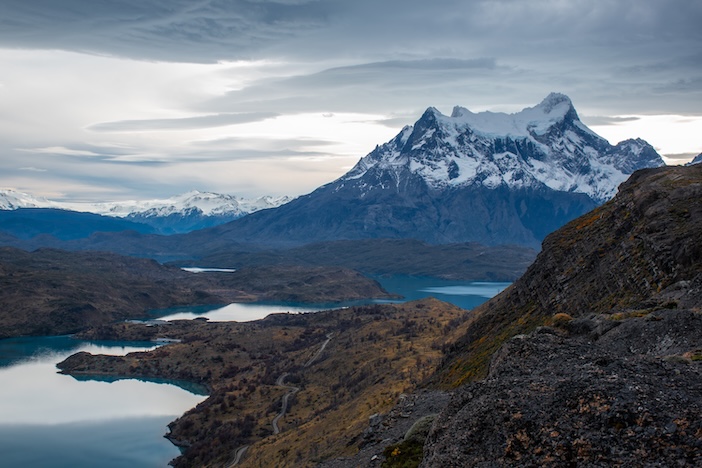
In this scrubby terrain, animal tracks are rarely preserved, unless the winter snows have arrived. Down on the lake’s black sand beach, however, we have a chance of catching such detail. Our focus narrows, taking in every shell and stray feather. First, we find the scat. Then, some faint but unmistakably feline, four-toed pawprints. Two sets of tracks running in parallel, in fact. Hang on, I remark, they’re both tiny – a similar size to my house cat’s. “That’s because they came from puma cubs,” Cristóbal grins. He tells us we must be on the trail of the Estancia’s latest mother, known as Escarcha (‘Frost’) for her silvery coat, and her three-month-old litter.
Photo: George Laing
My footsteps and pulse quicken as we follow the tracks along the beach, hopping over a series of white, reef-like rock formations. “We call these tromboloids,” Cristóbal says of the rough, calcium carbonate structures. “And they have a lot of little caves where pumas like to shelter.” Sure enough, the paw prints eventually disappear beneath a section of overhanging tromboloid. The only sound is the occasional crackle of the two-way radio. Holding my breath, I crouch down and peer into the hole. Nothing. The family must have moved on.
After pausing for a roadside picnic lunch, we hike through a hillside area densely covered in Mata Negra (Black Bush) and find some gristly remains of puma mealtimes in turn. A whole, hollowed out carcass stashed among the shrubs – returning to devour prey at a later date is apparently common behaviour of these predators. Dozens of bleached out guanaco bones. Everywhere there is evidence of puma activity, but the living breathing creature is proving elusive.
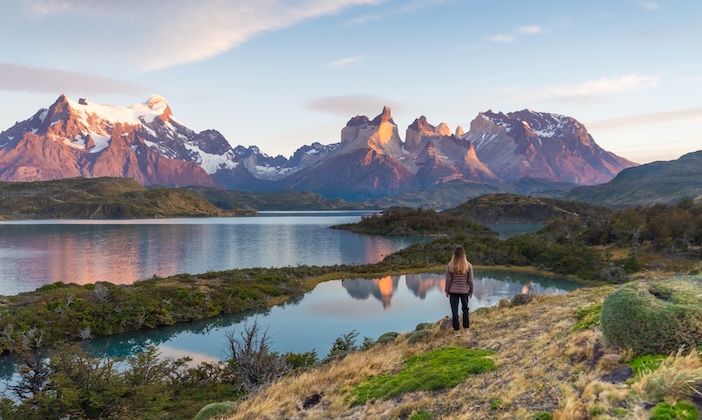
I start composing the article in my mind, striking a stoic, consolatory tone: we still had a great day, seeing a puma isn’t the be all and end all. And I mean it. The great amphitheatre of the steppe is a spectacle in itself, with the cathedral-like spires of Torres del Paine soaring beyond the rippling golden grassland and finding their doubles on the mirrored surfaces of glacial lakes, the dark berries clustering on thorny calafate bushes and a guanaco raising its head to check it is complete silence that surrounds us, not perhaps the crackle of tuft grass under a misplaced paw, and all of it in sharper focus since the knowledge of a naturalist guide has been poured into your ears.
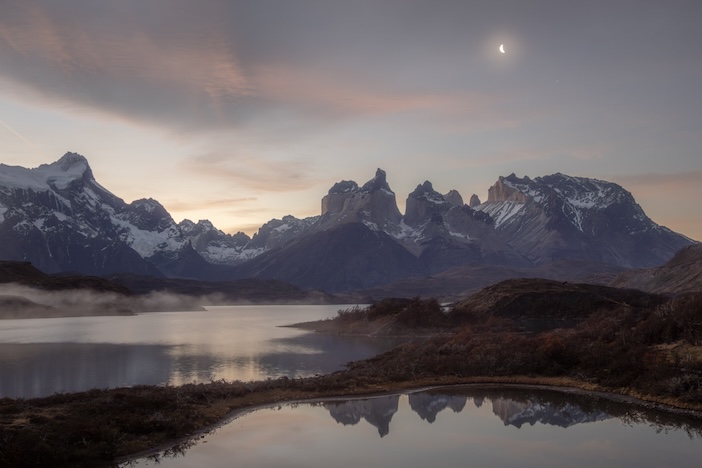
Photo: Geoge Laing
That said, the Patagonian spin on safari does call for a different mindset to its African forebears; the steppe doesn’t have the abundance of big game found in the Serengeti and its ilk, where if you fail to see a leopard, a few elephants or legions of wildebeest can compensate. As Cristóbal told me earlier: “Sometimes, our goal is not so much finding a puma as changing someone’s mind. Getting them to appreciate the smaller details, the silence and the space.”
Just as I’ve made my peace with this concept, the two-way radio in his hand sputters to life again – half static, half rapid Spanish. It’s the same tracker we’ve been in touch with all day, only his tone sounds different. More urgent. “Rio… rapido…” We’re already running back to the car as Cristóbal confirms Escarcha’s been spotted a few minutes’ drive away.
There are a dozen other people standing on the riverbank when we arrive – the Magellania guides and the Americans with their long lenses poised. I frantically scan the opposite bank with my binoculars as shutters click around me. Why can everyone else see them except me? A childish, self-pitying urge to burst into tears rises. But then Cristóbal is at my shoulder, speaking with the soothing, reassuring tone of a Chilean David Attenborough: “It’s okay, take your time. Let’s go step-by-step. Find the second bend in the river. Good. Now the fallen log. Follow that dark line of stones…”
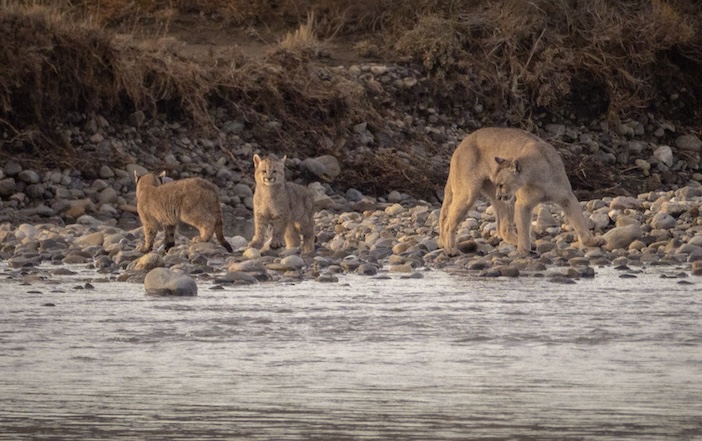
Photo: George Laing
Something between a gasp and a laugh catches in my throat. Six feet of pure silver and smoke materialise on the pebbled shore. There are kohl-rimmed eyes, a snow-white throat, the swish of a black-tipped tail. In a blur of mottled fur, one cub leaps onto its sibling and they tumble together in a play fight. Those scenes I’d watched on Dynasties have now sprung to life. That they’ve done so only after a long day deciphering pawprints, alarm calls and the contours of the landscape makes the reward all the richer.
Estella ventured to Chile with Explora, staying at the Torres del Paine lodge. For more information, including details of expeditions, please visit www.explora.com.