Rob Rees enjoys the complete Latvian city break. A four-hour sauna ritual, a UNESCO-listed Old Town with Michelin-starred ambition and one of Europe’s great Speedway GP races combine for a more novel weekend break…
I’ve been intrigued by the Baltics for over twenty years. Riga finally made it to the top of my city-break list. And boy, what a weekend. Take a UNESCO-listed Old Town, layer it with steely Latvian character and throw in one of the most atmospheric FIM Speedway Grand Prix weekends and you’ve got an unexpected sporting escape.
This year the number 825 is dotted throughout Riga, marking its foundation in 1201, when Bishop Albert of Bremen established the city on the Daugava. Riga became one of the Hanseatic League’s richest ports, its wealth surviving in Gothic churches, merchant houses and elegant squares. Unlike Prague, it doesn’t feel overwhelmed or touristically naff. It remains understated and lived-in.
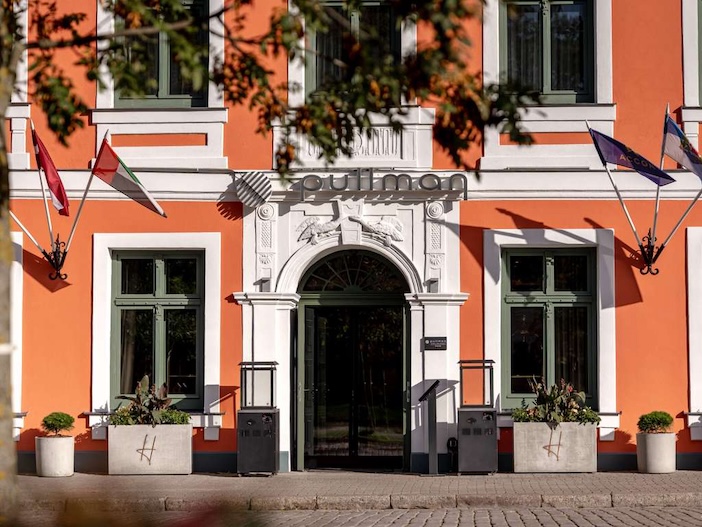
Our base is the Pullman Riga Old Town, a handsome 18th century building beside the old city walls and cobblestoned streets. Almost everything is walkable; only Biķernieki Speedway needs a Bolt taxi, the predominant mode of transport.
The centre is a mash-up: medieval Old Town (Vecrīga), Art Nouveau and grand boulevards. Start at Bastejkalns and Esplanade parks, then head for St Peter’s, Riga Cathedral and the swaggering House of the Blackheads. The Freedom Monument stands sentinel, while Alberta Street is Art Nouveau theatre at its most exuberant. The National Opera brings imperial grandeur, while the eccentric Armitstead statue nearby shows Riga’s British former mayor strolling with wife and dog.
That confidence reflects Latvia itself.
Wedged between Estonia and Lithuania, this nation of fewer than two million people spent centuries ruled by almost everybody except Latvians. German knights, Swedish kings, Russian Tsars, Nazis and the Soviet Union all left their mark before independence returned in 1991. Modern Latvia is young, but fiercely proud.
Nowhere tells that story more powerfully than the former KGB headquarters, the infamous Corner House. Our guided tour through its cells and interrogation rooms is deeply sobering. Suspected enemies of the Soviet state were brought here at night, interrogated and swallowed by a system in which guilt was often assumed rather than proved.
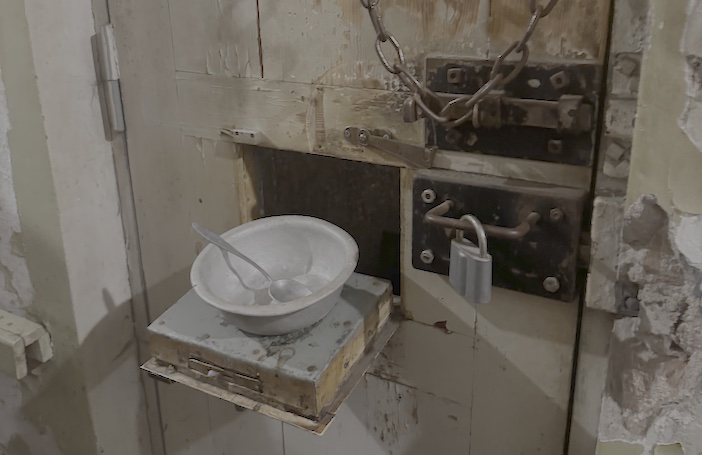
The cells remain, including the narrow walking pen where prisoners received just 20 minutes of daylight exercise a week. Bullet holes scar one room used solely for executions. The Latvian joke was that this was the country’s tallest building: from the top, you could see Siberia. 25 years in a gulag was what normally happened to most visitors.
Fortunately, Latvians are equally adept at celebrating life. Our first morning begins not with coffee but in the woods on Riga’s edge, where ‘pirts master’ Anna, salt scrubs and oak branches await.
I have done plenty of saunas. Finnish, Austrian, Turkish. But the Latvian ‘pirts’ is something else entirely. The ritual can last almost four hours. It is a choreographed sequence of heat, steam, herbs, cold water and rest, led by Anna – a ‘pirtnieks’ who is part therapist, part herbalist and keeper of an ancient rural Latvian tradition. Anna offers the only pirts within Riga city limits.
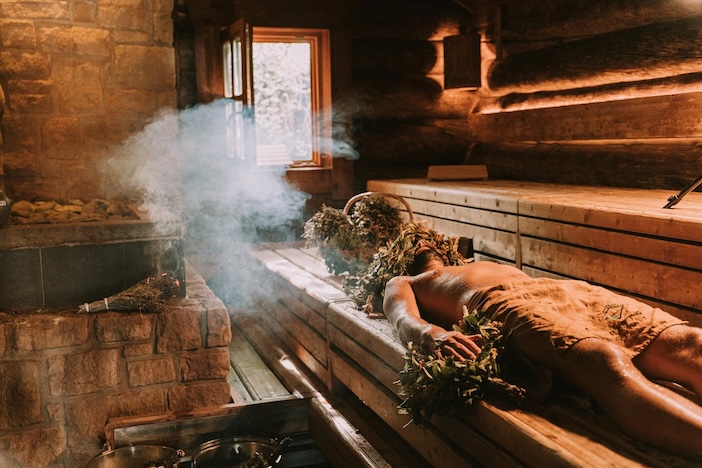
Photo courtesy pirtsspirit.com
For centuries, key moments in life unfolded in or around the pirts. Children were born there because it was considered the cleanest place on a farmstead. Newlyweds were blessed there before marriage. The dead were washed there before burial. It functioned as maternity ward, hospital, confessional and temple all at once. Even today, many Latvians describe stepping into a proper pirts as leaving the everyday world behind.
First comes preparation: a shot of wormwood tea, a traditional bitter digestive intended to wake the stomach and help stimulate the metabolism. I lie on yellow branches of goldenrod, reputed to increase your energy for life. Then comes the heat, not as an endurance test but as gradual surrender. Steam rises from hot stones and the room fills with woodland aromas: oak, birch and warm timber.
Then the salt scrub: not the polite exfoliation of a five-star spa, but Anna vigorously working your chosen salt mix into the skin. Choosing your combination of herbs and plants is all part of your individual ritual. And denotes where you are in your life and where you are heading. Anna is incredibly insightful at interpreting your choices.
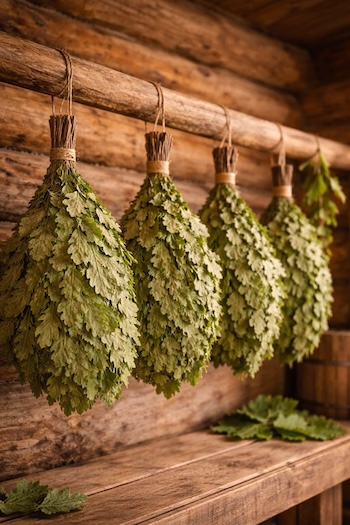 Then come the oak branches. We are tasked with turning them into a whisk ‘slotina’ by bunching and tying them together. Fresh bundles are soaked and heated before Anna begins the ‘pēršanās’. They are swept, fanned and pressed across the body, improving your circulation whilst releasing their oils and filling the sauna with the smell of a wet Latvian forest. Oak is masculine in essence, symbolising endurance, strength and protection in Baltic folklore.
At one point I am lying face down while oak whisks move across my back. Heat, pressure and the smell of leaves combine into something so physical that conversation seems unnecessary. I am fully present.
Then – cold. Or, as my fellow traveller Keith described it, water boarding! Buckets of freezing water poured over you before you stagger into the airy woodland garden. Anna tucks you under blankets and you lay there opened up, completely in your body and fully equilibrated.<
Pirts grounds you and helps empty the mind. You sweat, breathe, lie still, get scrubbed and beaten with leaves, wondering why Western wellness has spent a decade reinventing something Latvians have practised for generations.
You emerge lighter, calmer – and hungry.
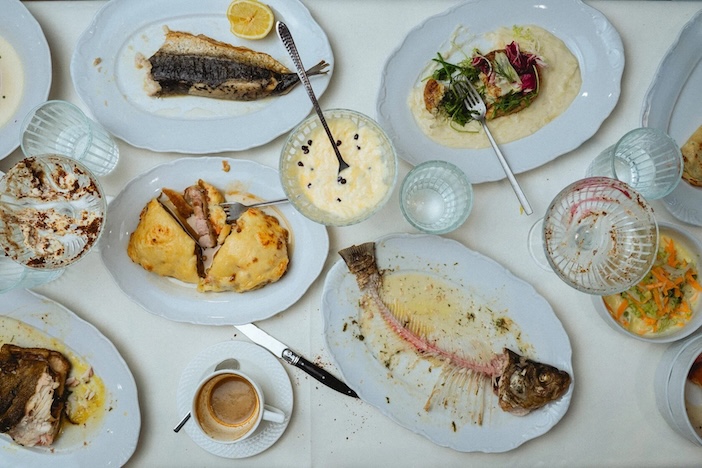
Lunch at MAMA Bistro reimagines childhood recipes with French bistro flair: vegetables, slow-cooked meats, perch, rye bread and seasonal produce. The country’s cuisine draws heavily from its forests, fields and coastline.
Then comes the reason everyone is here.
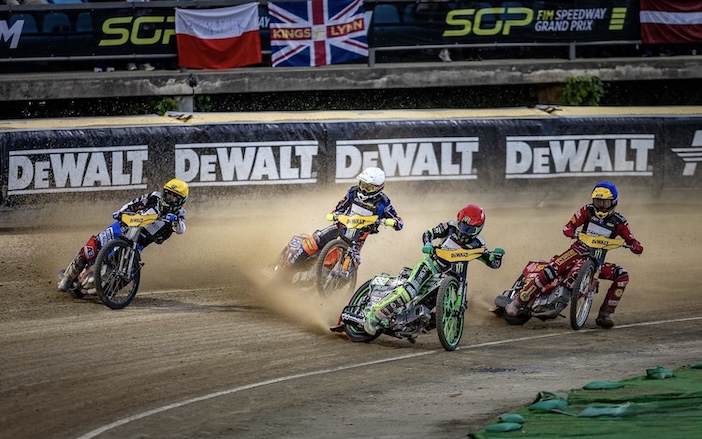
Biķernieki Speedway sits among towering pines on Riga’s eastern edge, the scent of warm forest giving way to methanol and two-stroke oil. It is one of the Grand Prix circuit’s most intimate venues. Forget sanitised arenas and sprawling corporate hospitality villages. This is speedway stripped back to its essentials.
Shale dust and exhaust smoke hang in the evening air. Floodlights catch brightly painted helmets. Four riders edge towards the tapes before launching 500cc machines into the first corner with extraordinary commitment and no brakes. Every race lasts barely a minute yet contains enough jeopardy and tactical intrigue to fill an evening.
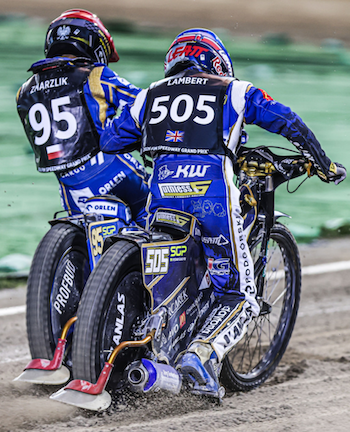 For Latvia, hopes rest on Andžejs Ļebedevs, the home-grown hero. His every overtake is greeted by a thunderous roar. Six-time world champion Bartosz Zmarzlik remains formidable, combining racecraft with an uncanny ability to find grip where others flounder. Australia’s Brady Kurtz is fearless around the outside, while brave Brit Robert Lambert has natural speed after his recent SGP win in Lodz.
These are the modern gladiators and Biķernieki becomes the global centre of speedway. Zmarzlik delivers. His victory is his third in four visits to Riga and his 31st Speedway GP win. You leave the woodlands as if you’ve been to a giant Latvian village fête involving some of the fastest motorcycles on earth.
The following morning, Riga changes pace again.
The Freedom Monument, unveiled in 1935, is topped by Freedom holding three stars for Vidzeme, Kurzeme and Latgale. After Soviet occupation, demolition was considered; instead, it survived. The Russians repositioned the propaganda with the three stars suddenly signifying Mother Russia protecting the 3 Baltic nations. In 1987, thousands gathered here to commemorate Soviet deportations — a crucial moment in the revival of Latvian independence.
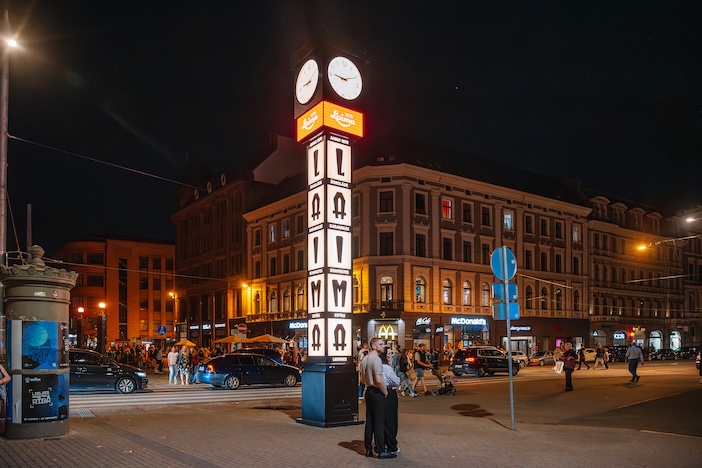
Nearby, the Laima Clock is smaller but woven into Riga’s social history. Installed in 1924 as a public timekeeper, it became a meeting point, particularly for young lovers. It remains Riga’s rendezvous.
We arrive at Riga Central Market, housed inside five enormous former Zeppelin hangars. If there is a better-value market in northern Europe, I’d like to find it. We duck into a kiosk for grey peas with bacon, smoked fish, rye bread, ham, pickled greens, sprats and cheese, washed down with cold Latvian cider. Simple, earthy and unpolished.
It’s also worth sampling the local Kvass – made from rye bread, water and sugar, it is naturally fermented and mildly alcoholic. And not unlike those Bass Shandies you sneaked onto the coach for the annual primary-school day trip.
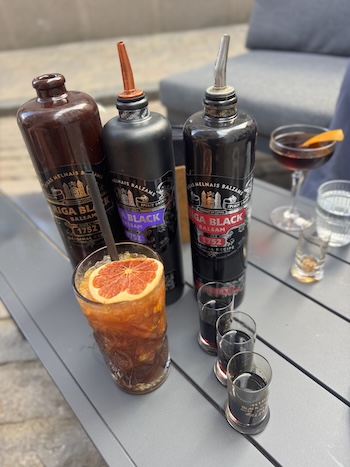 Pre-dinner we sit outside B Bārs overlooking Dome Square and I finally make peace with Riga Black Balsam. This dark, bittersweet herbal liqueur has divided opinion since the eighteenth century. Drunk neat, it tastes rough and medicinal; mixed into cocktails, its layers of herbs, berries and spice make more sense.
Made from 24 botanicals and 45% spirit, the secret recipe tastes of herbs, liquorice, pepper, citrus peel and caramel. Brilliant barman Sam leads a tasting; I admit to preferring his more refined Balsam Freshness cocktail: balsam, crushed grapefruit and tonic. The perfect preprandial.
At nearby 3 Chefs, hidden within Jacob’s Barracks beside the Swedish Gate, modern Latvian cooking keeps local ingredients centre stage. We eat saffron fish soup with pickled fennel and coriander, slow-cooked lamb and pink rump steak, followed by honey cake with whipped sour cream, beeswax ice cream and pollen sauce.
It is a fitting finale. Riga gives you architecture without crowds, food without performance, a sauna tradition that makes most hotel spas look feeble, and a visceral sporting weekend delivering noise, danger and atmosphere. Add Latvia’s history and the simple pleasure of eating, drinking and wandering easily through it, and the city feels richer than the conventional city break.
So come for the speedway, by all means. But stay long enough to take a pirts, eat grey peas with bacon, drink Black Balsam and explore the impressive Art Nouveau streets.
Riga isn’t trying to be the next Copenhagen or Berlin. Thank goodness. It has its own rhythm, humour and just enough edge to keep it truly interesting.
Air Baltic fly regularly from London Gatwick to Riga. It’s a 20min Bolt taxi to the Old Town. For more information about Latvia, and to start planning your trip, please visit www.latvia.travel. And more information about Riga can be found at www.liveriga.com and @rigastories.
For more information about Speedway, including details of the last race of the season on 28th September, please visit www.fimspeedway.com.