At 2,100 metres above Lech in Austria, Sarah Tucker finds art, weather and a little vanity conspire to shrink the inbox and enlarge the sky…
I went to Lech in search of mountains and found a mirror: less an encounter with nature than an intervention by my mother.
Lech lies in the Arlberg region of Vorarlberg in western Austria, just beyond the Tyrolean border. Above it, beside the Balmalp at approximately 2,100 metres, Snøhetta’s Mountain Mirror reflects the surrounding peaks back at themselves.
It is an audacious place for a looking glass. Mountains have never needed to check whether their ridge lines are flattering. Yet the installation works because it does not decorate the landscape; it changes the act of looking.
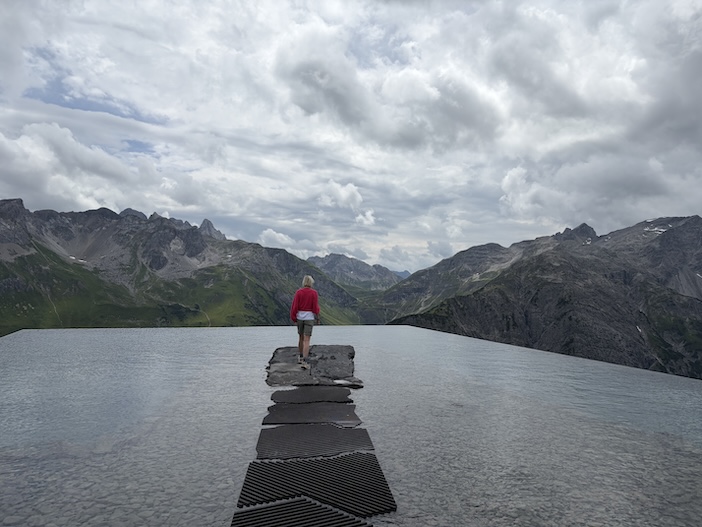
A dark reflecting pool shifts with wind, cloud and light. Stepping stones lead across the water, while larch seating invites visitors to pause. Inspired partly by Caspar David Friedrich’s Wanderer above the Sea of Fog (c.1818), the installation replaces the solitary Romantic figure with the modern traveller, who contemplates the sublime before checking whether the wind has done something regrettable to her hair.
The pool may be the world’s highest catwalk, although staging a show would require cable cars, mountain guides and a backstage team prepared to carry couture uphill. The Alps are magnificent but unsympathetic to stilettos.
Perspective has not always come so gently. Years ago, I had frozen at the top of an icy black run while my former husband insisted I follow him down. A ski guide asked the only useful question: ‘Do you want to ski this slope?’ When I said no, he accepted the answer.
The distinction between a poor companion and a good guide is partly perceptual. One imposes his view of courage; the other changes the frame so the person inside it can see her own position. The Mountain Mirror performs a related act. It leaves me to decide what to feel and where to stand. It returns the landscape with me included.
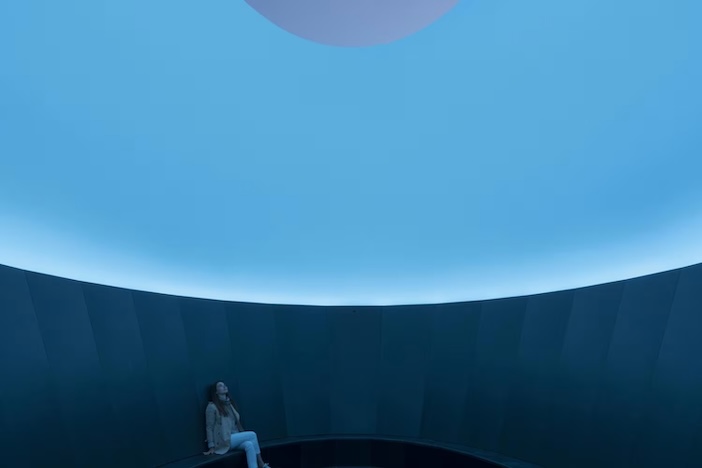
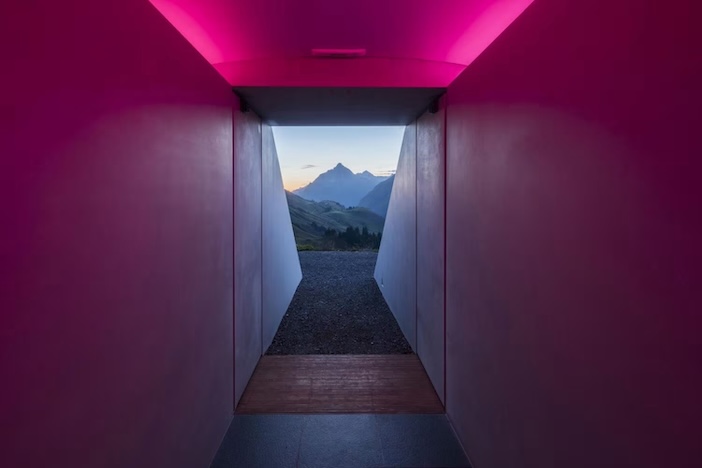
Skyspace interior (photo by Florian Holzherr)
Creative people are constantly advised to find space, which in London usually means moving a chair away from a radiator. Lech and Oberlech supply the real thing. The scale reduces an inbox to its correct moral significance, while the silence is not empty so much as unoccupied.
James Turrell’s Skyspace in Oberlech is the reverse of the mirror. Instead of multiplying the view, it removes almost everything except a framed section of sky. Turrell reworks perception without improving the sky, which has managed perfectly well without consultancy.
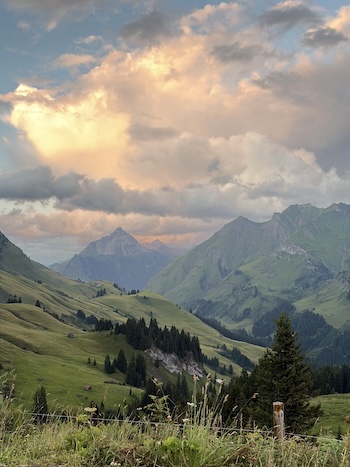 During my sunset visit, weather took over the installation. As I left, thunder rolled and lightning split the mountain. Light art became live theatre, with the sky producing its own unscheduled programme. Mountain weather can change at a whisper, and joy in the Alps includes the mild terror of being reminded that nature has not signed the visitor agreement.
Antony Gormley’s former Horizon Field took another approach. One hundred iron figures stood across the high Alps between 2010 and 2012, all at precisely the same altitude while the terrain rose and fell beneath them. Gormley distributed the body, Turrell isolates the sky and Snøhetta gives the landscape back to itself. None tries to outshout the mountain, which would be difficult and vulgar.
The same confidence appears inside the hotel Goldener Berg. Its exterior observes Lech’s strict architectural language; inside, owner Daniela Pfefferkorn places fuchsia beside pistachio and hangs work by local artists. In my room, a woman with pink hair and cow horns looked down from the wall. I felt represented, though not entirely explained.
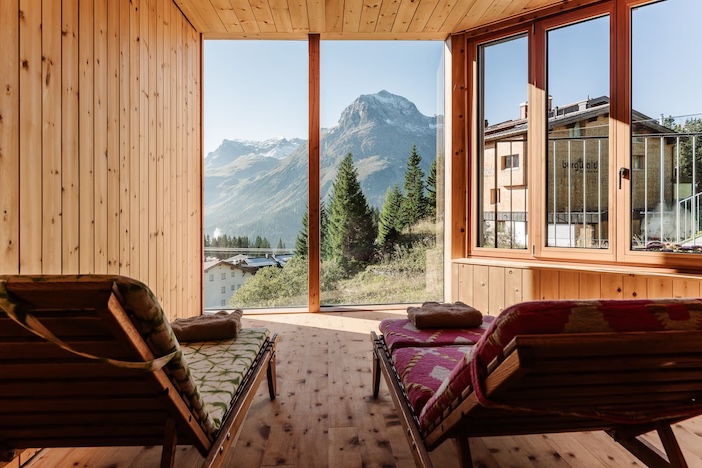
The hotel’s windows treat the view as an active collaborator. Each room catches a different angle of mountain, cloud and changing light. Creativity here is a series of devices for paying better attention, not a flourish laid over the Alps.
At curious, the village art space, the exhibition A Contemporary Alpine Summer gathers painting, photography, sculpture and design. Prices travel from the hundreds to the hundreds of thousands, allowing visitors to acquire either a small work or a lasting sense of financial inadequacy.
Robert Macfarlane’s Mountains of the Mind examines the imaginative power that draws people upwards. Nan Shepherd’s The Living Mountain makes a quieter proposition: a mountain is known by entering its weather, surfaces and moods, not merely by reaching its top. Thomas Mann’s The Magic Mountain uses altitude to suspend ordinary time and expose the minds of those within it.
Lech does something similar. It alters scale, then allows thought to move sideways.
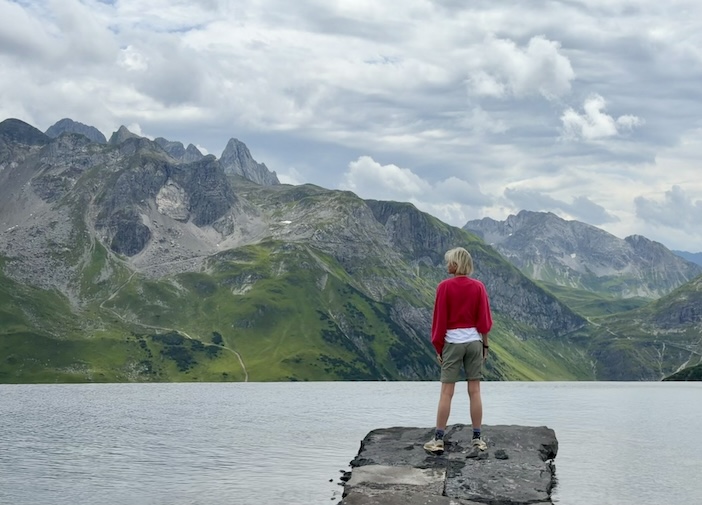
That may be why creative people need mountains. Not because altitude automatically produces wisdom: many foolish ideas have occurred above sea level. Mountains interrupt proportion. They make the deadline smaller, the sky larger and the self less certain of its central role.
The mirror catches cloud, face and occasional vanity; the Skyspace turns weather into performance; the hotel places serious art beside lived pleasure. There is delight in the refusal to explain everything.
Originality may not require another object, statement or strategy. Sometimes it begins by changing the frame and allowing what was already there to look back.
For more information about the Lech Mountain Mirror and Balmalp, please visit www.balmap.at. For more information about Lech Zürs, please visit the official tourism website at www.lechzuers.com. For more information about the Goldener Berg hotel, please visit www.goldenerberg.at.
Header image: Skyspace, photo by Florian Holzherr