Keira Knightley returns to the stage in ‘The Lives of Others’, but Allana Isaacs finds the real stars are the staging and Stephen Dillane’s captivating Stasi officer…
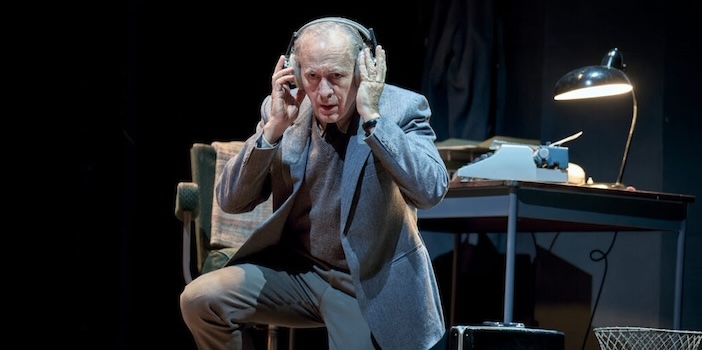
Robert Icke, known in recent years for his star-led adaptations of the classics, now turns his hand to a reimagining of Florian Henckel von Donnersmarck’s ‘The Lives of Others’, which takes up residency at the Adelphi Theatre. The iconic story is set in 1980s East Germany, a state under hyper-surveillance. At its peak, the Stasi had one officer for every 166 East German citizens; enough data to fill a staggering 48,000 filing cabinets. We follow officer Gerd Wiesler (Stephen Dillane), whose latest subjects, the writer Georg Dreyman (Luke Thompson) and his partner, the actress Christa-Maria Sieland (Keira Knightley), are deemed public enemies.
What follows is an exploration of the relationship between art and power, the oppression of artists’ free speech, the unpredictability of emotional connection and what it means to be human. I won’t delve too deep into the plot: if you know the film, you’re already aware of it, and if you don’t, a first viewing really deserves you going in on high alert, ready to observe. As Wiesler tells us as the play begins, ‘Keep your attention on what matters.’
While the performances are of course exemplary, the real standout of this play is the production itself. At just over two hours’ running time, without an interval, the environment is unsettling, oppressive, and at times incredibly uncomfortable. Whether it is down to cast members moving through the auditorium, the repeated use of the front-of-stage steps for entrances and exits, the intense darkness (my press night notes were largely illegible as a result), the large cast of supernumeraries who flood the stage and create a sense of claustrophobia, or the heightened sensory experience, all these elements in combination create a deeply affecting experience.
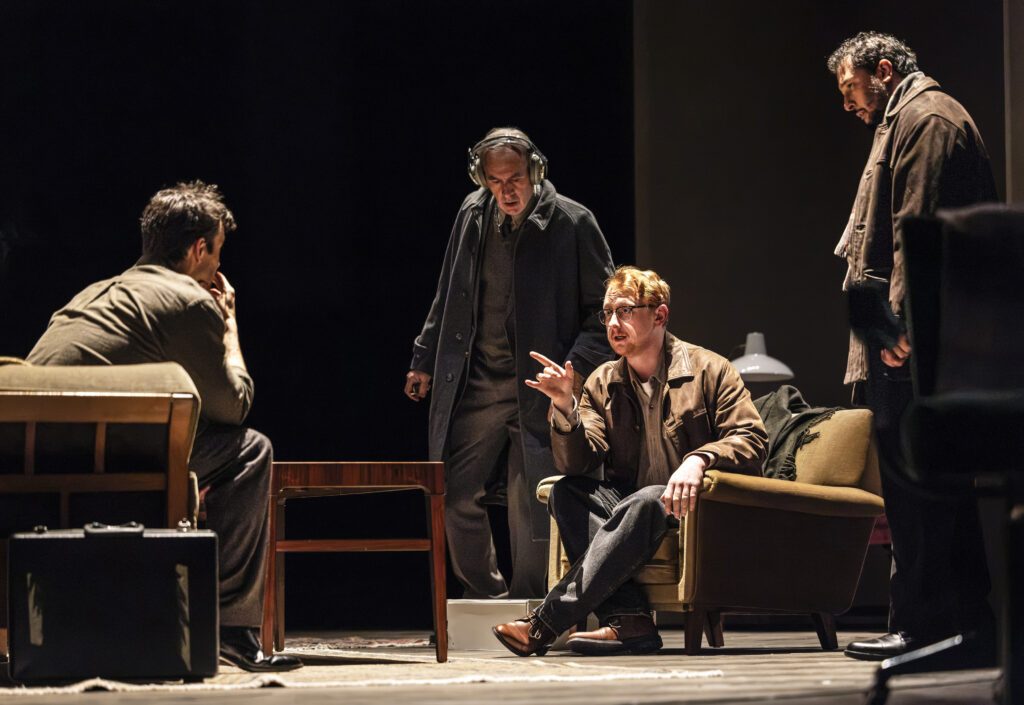
Hildegard Bechtler’s set design, centred on Dreyman’s home, is inspired: a two-room apartment on a revolve that interweaves the audience with the most private spaces of the characters’ homes and personal lives, with gauze-like walls obscuring and concealing certain actions, and serving to reveal others. In some dramatic set changes, stagehands are seen on stage as orchestrators of the action, further underpinning the uncomfortable reality that the characters’ lives are not their own. In one particularly affecting moment, the house splits in two to reveal the interrogation room – a literal splintering of home life by the state. The language throughout focuses on secrets, surprise, watching, spying and interrogation – the rhetoric of state surveillance seeping into everyday life, even when they are with friends.
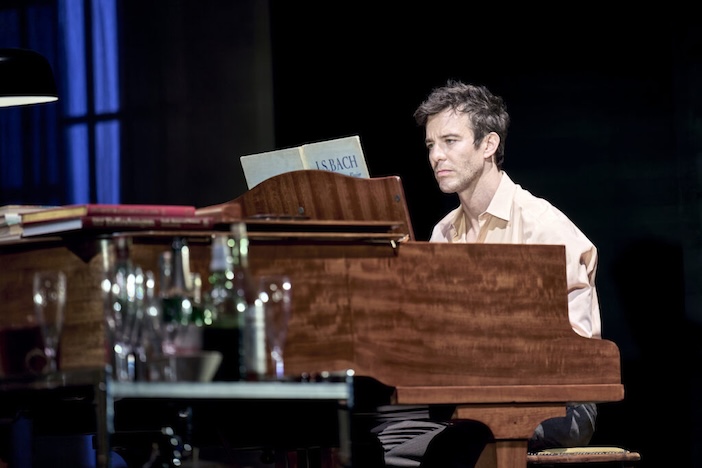
Lighting and sound design by Jon Clark and Giles Thomas respectively work in perfect sync, shifting focus between headphone-wearing Wiesler in his starkly lit, cold surveillance area and the main action of the story – the crackle of static, pauses in movement and muffled tones once the headphones are removed subtly add to the strength of the storytelling. Projection, video and cameras (designed by Tal Yarden) are used to brilliant effect to demonstrate the all-seeing nature of the Stasi. Finally, music is a key thread, whether Max Richter’s original music, classical elements of the original film score, Luke Thompson’s beautiful piano interludes or more contemporary tracks such as “Make Your Own Kind of Music”, heightening tension and creating moments of discomfort.
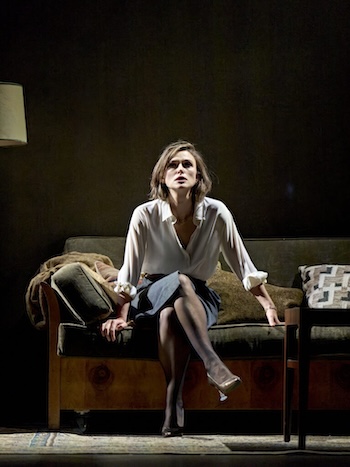 The draw of this adaptation will undoubtedly be Keira Knightley’s return to the stage after more than a decade, or the chance to see ‘Bridgerton’ star Luke Thompson in the flesh – and both shine in characters who are arguably thinly written. However, the standout among the cast is Stephen Dillane as Gerd Wiesler. For the trajectory of the piece to land as desired, he has to display the full range of human emotions: we must fear him in an interrogation room, be repulsed by his cold brutality, be warmed by his change in approach and ultimately empathise with his conflicted choices. His performance, which barely sees him leave the stage, is entirely captivating, beginning with cold apathy, separated from the action in his surveillance suite, and moving through the physical and mental choreography of his becoming entwined in it.
Throughout the production, we see real film footage of life under the Stasi regime, leading to the fall of the Berlin Wall in late 1989 and the eventual reunification of Germany. Interspersed with the action, it heightens the emotion even more. While for some this may seem disconnected from the story, for me it demonstrated that although what we are seeing isn’t based on real people, or an exact replication of a single true story, it is actually more troubling than that.
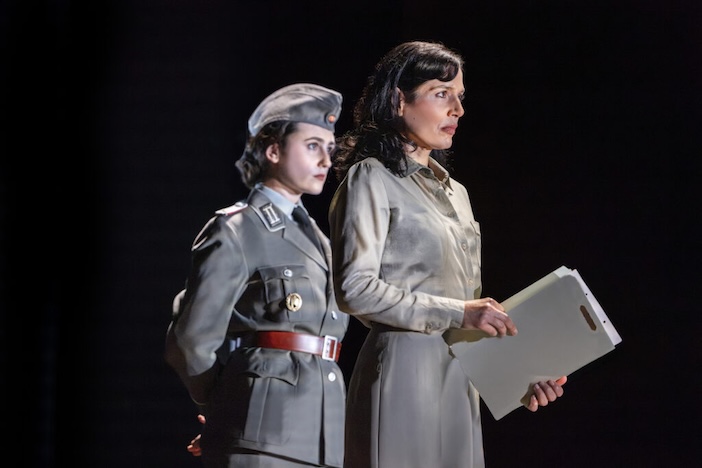
This story is the amalgamation and collation of thousands of notes, stories and anecdotes that seem unbelievable, and yet were commonplace for decades. The play is self-consciously metatheatrical throughout, which works well with the theme of voyeurism, and is exemplified by a line from one character, ‘People will watch the pretend people to help them make sense of the real ones’ – an apt distillation of the power of theatre and storytelling, and the need to unpick history (even if relatively recent) to learn for the future.
‘The Lives of Others’ runs at the Adelphi Theatre until 9th January 2027. For more information, and for tickets, please visit thelivesofothersplay.com.
Photos by Pamela Raith