From dazzling light festivals and riotous carnival traditions to lakeside saunas and fondue on a snow-capped summit, Karen Yates discovers that Lucerne in winter is a city of spectacle, story and soul…
I’m looking up at the elaborately decorated ceiling of the Baroque Jesuit Church in Lucerne, central Switzerland, watching brightly coloured dolphins, whales, tortoises and bears interspersed with celestial shapes and psychedelic patterns projected above me. They are moving in time to music specially composed to accompany the SOUL light show, one of three shows and 38 installations chosen from work by 200 artists to form the Lights of Lucerne Festival.
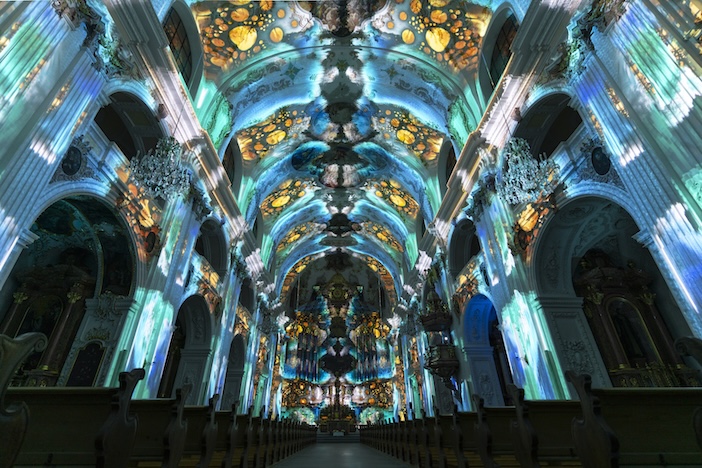
Lilu, as it is also known, started in 2019 as a way to bring light and cheer to cold, dark January evenings and attract visitors. Other favourite installations I see while walking around the Old Town include brilliant yellow giant sunflowers on neon green stems and a huge blue cylinder covered with luminous white fish, along with several light animations telling stories of the natural world and the city’s history.
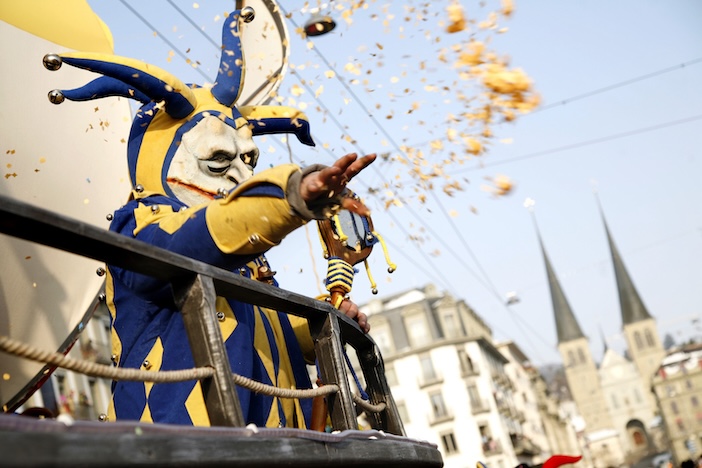
By February, the hotels are filled for Lucerne’s famous carnival, a full-on celebration that starts with a 5am explosion and continues with six days of rousing guggenmusik and parades intended to drive away the winter. There’s plenty to eat and drink and attendees wear costumes and huge grotesque masks, many of which are on display in shop windows and hanging outside buildings wherever I walk during my visit.
Along with the light installations dotted around this small, walkable city – Lucerne’s population, at around 82,000 is less than a fifth of Zurich’s – there’s plenty more to see and do. A good place to start is Château Gütsch, where Queen Victoria stayed for several weeks while mourning Prince Albert. After reaching the chateau, now a hotel and bar, by a steep funicular, I sit on a sofa at the far end of the American bar, order afternoon tea and take in the magnificent views over the picturesque city and lake towards the mountains opposite. Thoughts of clean, healthy air to aid Queen Victoria’s recovery and Gothic novels, Frankenstein in particular, fill my mind.
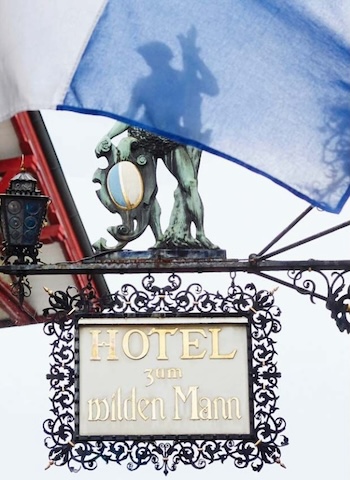 A great hotel choice is the characterful, 500-year-old Wilden Mann (wild man), a short walk from the main railway station via the Jesuit Church. The hotel was originally a bar and is now made up of seven interconnected buildings. There’s a surprise around every corner, be it carnival masks, a rocking horse or a carved angel hanging over the beds in some of the 48 individually decorated rooms.
The hotel’s cosy Burgerstube restaurant is a good spot for sampling Lucerne’s speciality chügelipastete, a domed puff pastry pie filled with sausage meat and cognac-marinated raisins, served with vegetables. The local Weingut Kastanienbaum pinot noir is a good match for this or the lighter fish dish I ordered. Another restaurant recommendation – a short walk away in the Old Town, on the banks of the Reuss – is Mill’Feuille, where the generously sized lasagne is made with pulled beef rather than mince and is complemented by the Malanser pinot noir.
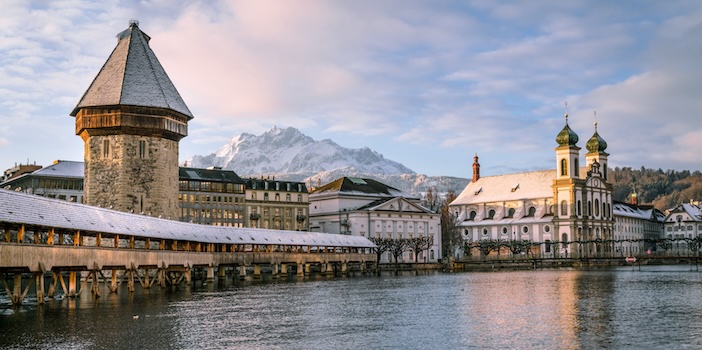
The aforementioned wild man figure originates in medieval European art and literature and can be seen dotted around Lucerne. There’s a painting of him in one of the triangular panels on Kapellbrücke, or Chapel Bridge, close to the hotel. This wooden bridge straddling the river Reuss was built around 1365, and some of the painted panels depicting the city’s history date back to the 17th century, although many were destroyed along with much of the bridge in a fire in 1993. In the centre of the bridge is the octagonal Wasserturm, the water tower, which over the years has been used as a prison and an interrogation and torture chamber. Apparently, it was possible to hear the screams – quite the deterrent I should imagine.
The Reuss feeds into Lake Lucerne, and what better way to explore this in midwinter than in a covered boat. At Pier 1 I board the one-hour-45-minute lunch cruise and choose from the many traditional Swiss dishes on the à la carte menu while enjoying the views as the boat sails quietly along.
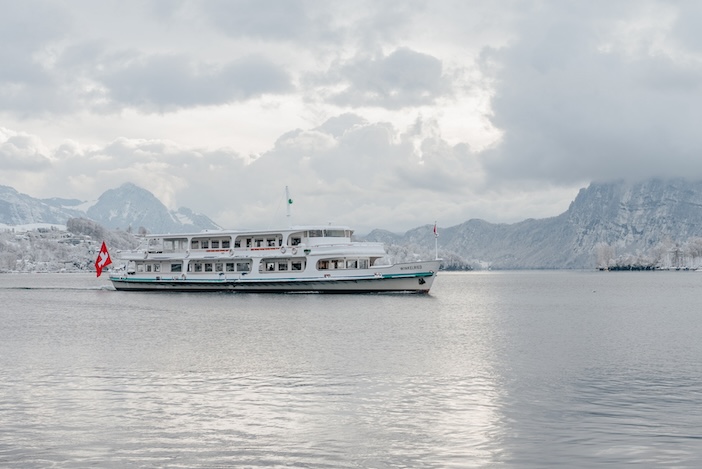
This being Switzerland, there are also sauna boats for up to six people, although four would be ideal. Guests can choose between the middle of the lake or a quiet bay, wait while the wood stove heats the sauna to 90C and if you want to move you steer the boat yourself. The boats are available for four or six hours and after relaxing in the sauna, you can lower yourself into the cold lake water for the most invigorating experience. It’s fair to say that all those who share my sauna boat are rosy cheeked and glowing afterwards.
Back on dry land, I visit Max Chocolatier, a beautiful design-led space where Hannah talks me through the process of making fine chocolate and explains that the company was named after Max, the son of owner Patrik König, who created it in 2009 because his son Max, who has Down Syndrome, loved Charlie and the Chocolate Factory so much he wanted Max to have his own.
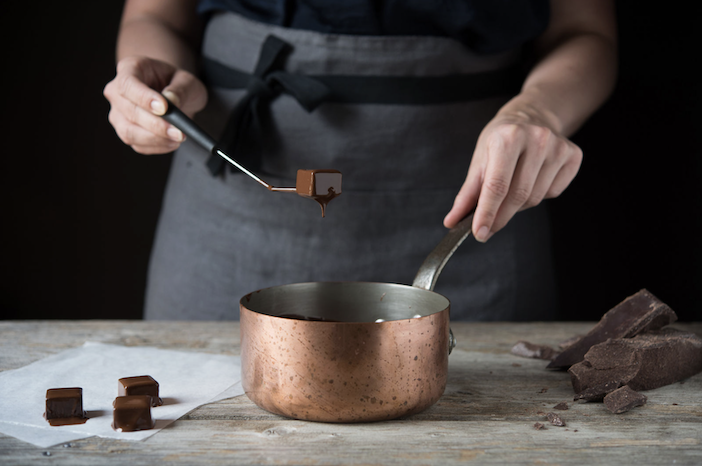
The handcrafted chocolates are as exquisite as you’d expect, and as I walk around Lucerne that evening I notice that one of the Lilu light installations is called Be the Max. First Max’s and then (if you like) your own smiling face is projected large on to the side of a building. It’s all about being present, enjoying the moment and having fun.
A not-to-be missed excursion is to the summit of Pilatus, also known as the dragon mountain. The number 1 bus takes you from Lucerne Station to Kriens, and from here it’s a short walk to the base, then about 30 minutes up in a panorama gondola and the ‘Dragon Ride’ aerial cableway – a basket packed with blankets and Laurent-Perrier Champagne or non-alcoholic sparkling Rimuss can be ordered in advance for an extra fee.
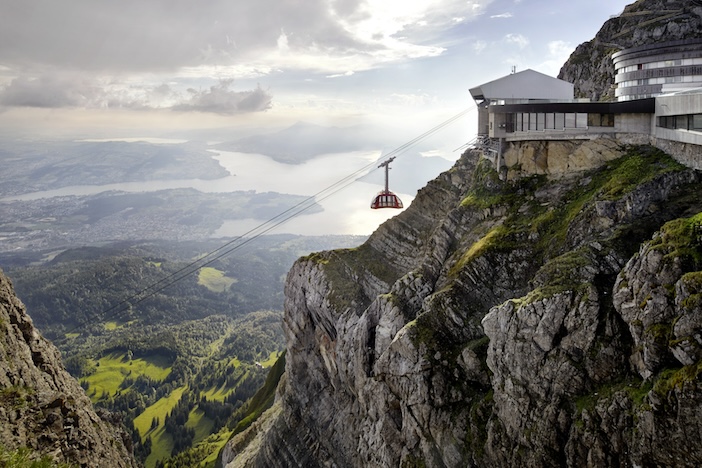
The views are magnificent as the cable car makes its way slowly upwards – and before I know it I’m surrounded by ice and snow, looking down first on treetops and flying birds, eventually on to other mountain tops and finally clouds. I get out at Fräkmuntegg to take in the spectacular view and go for a circular snowy walk through the trees before drinking hot chocolate in the café, then get back in the cable car for a final few minutes.
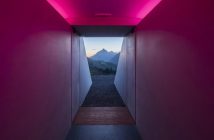
At the top, the view at Oberhaupt, at 2,128m, over the snow-capped Emmental Alps and Lake Lucerne, is sublime – it really does feel like being on top of the world. Surprisingly, there’s a small complex built in 1890 – also visited by Queen Victoria –with a hotel, an art installation and restaurants. I remove my walking boots to visit the multisensory Breathe with Pilatus installation by Annabelle Schneider (on until 26 April 2026), which involves lying in a white tent, imagining you’re inside a cloud, listening to a soundscape of birdsong and digital pulses, and focusing on your breath. It’s a moment of calm to complement the surroundings – I want to stay longer but lunch beckons.
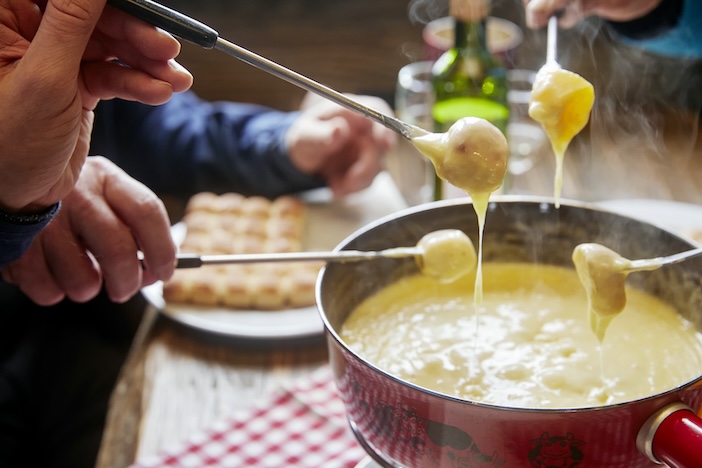
Restaurant Pilatus-Klum is a large and elegant dining space complete with an outside terrace for the summer months and views over the ice-capped alps. Choices include Luzerner weissweinsuppe, traditional white wine soup from Lucerne with whipped cream, grape and bread crumble, but it seems only right to order the classic cheese fondue made with local Schnider Giswil cheese and Yvorne Chant des Resses wine, served with bread and, on request, small potatoes. As I spear a spud and dip it into the delicious, warming pot I think how dining on a mountain top and sharing fondue is possibly as Swiss as it gets.
Karen flew to Zurich with SWISS, then caught a 30-minute train to Lucerne.
For more information about Lucerne, including details of Visitor Card Lucerne, and to start planning your trip, please visit www.luzern.com.
More information about Switzerland can be found at www.switzerland.com.