Rosalind Ormiston visits Zurbarán at the National Gallery: a near-fifty-painting retrospective that reveals the full range of a seventeenth-century Spanish master — from monumental crucifixions and martyred saints to a small, bound lamb that somehow stops you in your tracks…
It’s the sharp brilliance of the white loincloth draped in folds around the naked body of Christ in The Crucifixion that draws attention to the extraordinary skill of the Spanish Baroque painter Francisco de Zurbarán — his ability to paint Christ’s figure with such delicacy and realism.

‘The Crucifixion’, 1627, Francisco de Zurbarán (The Art Institute of Chicago, Robert A. Waller Memorial Fund)
The life-size painting opens the magnificent exhibition Zurbarán at the National Gallery, London, running until 23 August 2026. Zurbarán’s sculptural modelling of the human body, his intense naturalism and use of dramatic lighting were key components of his work — all three masteries present in The Crucifixion, which the artist “signed” on a piece of paper nailed to the base of the cross. This work is just one of nearly fifty exceptional paintings in a unique exhibition.
Francisco de Zurbarán, one of the greatest Spanish painters of the seventeenth century alongside his friend Diego Velázquez and the younger Bartolomé Esteban Murillo, was born in 1598 in Fuente de Cantos, near Badajoz, Extremadura, the sixth child in a prosperous textile merchant family. At fifteen, he moved seventy miles south to Seville to take an apprenticeship in art, sculpture and gilding. His professional career began in the mid-1620s, with the city council of Seville inviting him to settle permanently in 1629 — the same year he created the multi-figure history painting The Surrender of Seville. At the time, Seville was a wealthy city of 150,000 people and a pivotal location for transatlantic trade with the Americas, a connection Zurbarán exploited directly: between 1639 and 1645 he exported 120 of his own works for sale in Lima.

‘The Surrender of Seville’, 1629, Francisco de Zurbarán (Private Collection)
In Seville, patrons both public and private, secular and religious, kept him busy. The city’s wealth generated many new buildings, and art commissions for their interiors were plentiful — particularly from religious orders seeking devotional paintings to promote the Counter-Reformation. Zurbarán’s first independent commissions were for the Church of San Pablo in Seville in 1626, followed by religious works for the thirteenth-century Monastery of Nuestra Señora de la Merced. His superb portrait of The Venerable Míguel Gerónimo Carmelo (1628–30), receiving a vision of the Virgin Mary, and his portrayal of Saint Serapion (1628) — depicted as if asleep after the violence of his martyrdom, beaten, disembowelled and partially decapitated — both hung in the monastery’s mortuary chapel. They are reunited in the National Gallery show.
In 1634, Zurbarán was invited to the court of Philip IV in Madrid, possibly through the offices of his friend Velázquez. His commissions there included large-scale individual portrayals of the ten labours of Hercules for the Hall of Realms in Buen Retiro — a collaboration with Velázquez for the newly constructed royal palace. Two are in this exhibition: the spectacular Hercules and the Cretan Bull (1634) and Hercules and Cerberus (1634).

Zurbarán’s comprehensive knowledge of fabrics, gained through his father’s textile business, is evident in many works — among them an exquisite full-length St Casilda (1635) and St Catherine of Alexandria (1640), where the play of light on cloth makes it look almost touchable. So too does the wool fleece of the small lamb in Agnus Dei (1635–40): alive, lying on a stone slab, its legs bound with cord, its hooves projecting realistically beyond the edge of the stone. A halo hovers above the lamb’s head — a symbol of Christ.
Zurbarán’s diverse skills extended to still life, as in A Cup of Water and a Rose (c.1630). Also in the exhibition are three still-life works by his son Juan de Zurbarán (1620–1649), taught by his father and a leading still-life painter in Seville in his own right. His first known still life, Plate of Grapes (1639), painted when he was around nineteen, is here, alongside Still Life with Lemons in a Wicker Basket (1643–49) and the exquisite Flowers and Fruit in Bowl (1645) — works that reveal Juan’s considerable expertise in the genre. He died in the summer of 1649, possibly of the bubonic plague that ravaged Seville that year.

‘The Crucified Christ with a Painter’, circa 1650 (Museo Nacional del Prado, Madrid)
The works on show highlight Francisco de Zurbarán’s gift for varied approaches to the depiction of saints. One to seek out is the late work The Crucified Christ with a Painter (1650), in which a painter, standing in profile and holding his palette and brushes, gazes up reverently toward Christ — a private human interaction charged with empathy. Is the painter Zurbarán himself? We do not know. Worth noting, too, is that the four nails used to pierce Christ’s hands and feet represent a depiction of the Crucifixion unique to Seville. Another late work, The Holy Family (1659), highlights Zurbarán’s gift for portraying intimate moments in the tender grouping of Mary and Joseph with their infant child. His ability to convey immediacy — the sense of the spectator as present witness — is remarkable.
In his lifetime Zurbarán created around 250 signed works, with many more emanating from his Seville workshop. One that stands out — impossible to miss — is Colossal Head (c.1635), not signed but recently attributed to Zurbarán and first documented on the staircase of the Buen Retiro Palace in 1661. At 246 x 205 cm, the face dominates the gallery space. Why it was created is not known, but it is wondrous to behold, and one of the many reasons to visit this fabulous exhibition.
Zurbarán runs at the National Gallery until 23rd August, before transferring to the Musée du Louvre, Paris (7 October 2026–25 January 2027) and then to the Art Institute of Chicago (28 February–20 June 2027). An excellent 208-page catalogue, published by National Gallery Global/Yale University Press, accompanies the show. For more information about the National Gallery run, and for tickets, please visit www.nationalgallery.org.uk.
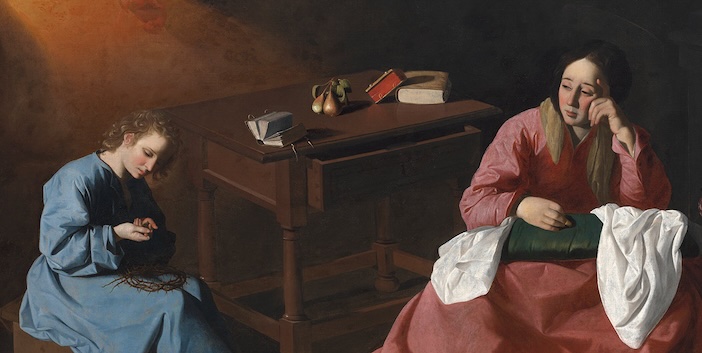
Header image: Detail from ‘Christ and the Virgin in the House at Nazareth’ circa 1640 (Cleveland Museum of Art)